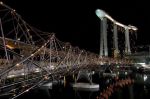
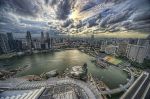
Gone are the days when only junk boats plied the waters of Singapore. Today Marina Bay boasts of a spectacular ship in the sky – a ship that Sands finds it hard to sail in the arid landscape of Les Vegas. SkyPark sits on top of the US$5.7 billion ($A6.8 billion) Marina Bay Sands Hotel & CasinoIntegrated Resort.
In Singapore, June 24, 2011 dawned the opening of a new wonder of the world. “Sky Park” Marina Bay Sands. It’s located on the 200-meter height on the three skyscrapers, as if on three pillars. Here is the most expensive & spectacular Integrated Resort in the world of casinos, bars, restaurants, the largest outdoor swimming pool, 150 meters long and even the Museum of Modern Art.
Stretching longer than the Eiffel tower laid down or four and a half A380 Jumbo Jets, with an impressive 12,400 square meters of space, the Sands SkyPark can host up to 3900 people. The gravity-defying cantilever is one of the largest of its kind in the world. From this privileged observation deck, hundreds of visitors at a time can feast their eyes on the unforgettable panorama view of Singapore.
The resort employs 10,000 people directly and generate up to £48m each year. Entrance to the casino alone is nearly £50 a day – but an average of 25,000 people have visited the casino daily since its initial phased opening two months ago.
Thomas Arasi, president and chief executive officer of the resort, said he expects to attract an astonishing 70,000 visitors a day once it is fully open. It was due to open in 2009, but was delayed thanks to labour and material shortages, and funding problems due to the global financial crisis.
Just take a look at these wonderful photographs of Singapore pride:
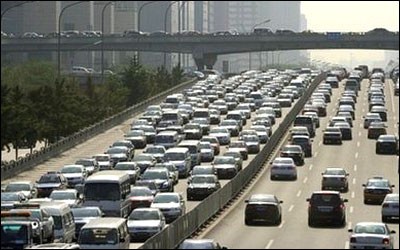
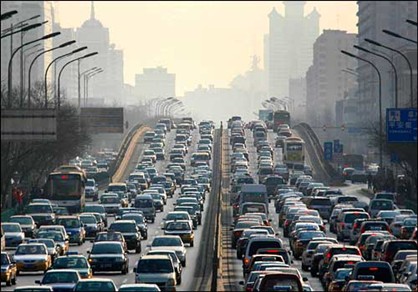
If you are one of those drivers confronted with road rage in traffic jams in Kuala Lumpur, Bangkok, or Jakarta, forget about driving in Beijing or be caught in one of their traffic jams . . . they could stretch for days on end.
How about this: ONE traffic jam snaking into Beijing is 100km long and expected to last for a month . . .
showing how China’s economic growth and booming car numbers are still outstripping the billions being spent on infrastructure.
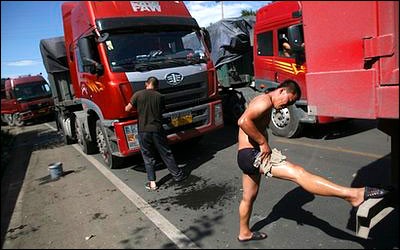
Baffled by the world’s longest traffic jam, the Chinese government has mobilised hundreds of policemen to clear the 100-km long stretch of the Beijing-Tibet highway, riddled with vehicles for 13 days, with the pile-up almost reaching the outskirts of the capital. Surprisingly, there have been no reports of road rage, and the main complaint has been about villagers on bicycles selling food and water at 10 times the normal price.
“Insufficient traffic capacity on National Expressway 110 caused by maintenance construction since August 19 is the major cause of the congestion,” a publicity officer with the Beijing Traffic Management Bureau told the Global Times this week.
The snarl up on the highway, on a section that links the capital to the Chinese region of Inner Mongolia was triggered by road construction and repair. While all sorts of vehicles appeared to have been caught up in the jam, it was mostly caused by lengthy coal carrying trucks, which brings fuel for the industries around the capital.
Traffic arrangements built up over generations in the U.S. are lacking in much of China, said Bob Honea, director of the University of Kansas Transportation Research Institute, who has visited China. “We’ll see this problem more and more often. It’s true of every developing country,” he said.
“Beijing’s already a big parking lot!” complained a taxi driver Gan during a traffic jam on the East Third Ring Road. “We’re making another Great Wall, it’s just that this one is made of cars,” he said.
In the worst-hit stretches of the road in northern China, drivers pass the time sitting in the shade of their immobilized trucks, playing cards, sleeping on the asphalt or bargaining with price-gouging food vendors. Many of the trucks that carry fruit and vegetables are unrefrigerated, and the cargoes are assumed to be rotting.
No portable toilets were set up along the highway, leaving only two apparent options — hike to a service area or into the fields. At several places, drivers, sick and tired of the snarl up, were bitter and angry as temperatures soared during the day and dipped in the nights. Many complained that local vendors were fleecing them for food and water, charging heavy rates, by selling water for 10 yuan as against 1 yuan.
The jam which some in Beijing say was not new in that particular section has also brought the spotlight back on China’s soaring auto sales. The congestion is set to peak in five years, when the total number of cars is expected to nearly double, the Beijing Transportation Research Centre said in its new report.
If people continue to purchase vehicles at the current rate of 1,900 new cars a day, the total will reach seven million in 2015 in Beijing alone, reducing average speeds in the city to below 15 km an hour, the report said.
By the end of 2009, Beijing had four million cars, a growth of 17 per cent over 2008. Experts say the urban layout forces people to buy cars and the city planning leaves people no choice but to travel.
In recent years, vehicle buying in the world’s most populous nation has gathered pace. China last year passed the US for the first time as the world’s biggest buyer of automobiles.
Car ownership is soaring fastest in China’s biggest and richest cities such as Beijing and Shanghai. About 650,000 new cars are estimated to be put on the road every year in the capital alone.
Road-Straddling Megabus 2011-08-03 (TED) One radical solution thown up this month is a road-straddling mega-bus so big that cars can drive under it. Proponents say this would eliminate the need to tunnel underground or build expensive bridges. The elevated buses straddle the road on rails and provide enough clearance for other vehicles on the road - apart from large trucks - to drive beneath. This strategy would allow the buses to travel faster than the other traffic without the need for dedicated lanes or structures.
And construction of 15km of rail track is planned for Beijing’s Mentougou district this year, with a further 170km if it is successful.
Source: CCTV, The Australian, Global Times, The Wall Street Journal
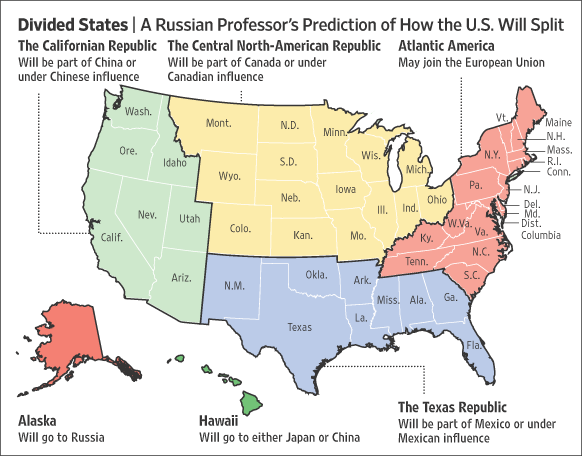
As though things weren’t bad enough for the Americans, Russian Prof. Igor Panarin, 50 years old, a former KGB analyst, Dean of the Russian Foreign Ministry‘s academy for future diplomats, invited to Kremlin receptions, lectures students, publishes books, and appears in the media as an expert on U.S.-Russia relations, predicted the breaking up of the United States of America in 2010.
Greed & cut-throat politics have left the United States in political stalemate.
Bankruptcy covers the US political landscape.
Source: RCG illustration/Paula C. Rondeau
Generally, all politicians initially start off with similar idealistic goals like peace, prosperity, health & success for everyone. The problem is not with the question of policy but implementation and polarisation results.
Democracy is “Demo Crazy” as demonstrated crazily all over the world.
With crippling unemployment, home foreclosures, years of overspending, and the makings of a second Great Depression, American citizens have called on politicians to do just one thing – unite & work together.
However, over the decades, political rift between left & right has grown from the size of a sidewalk crack to opposite ledges of the Grand Canyon – with miles of desolate, rocky terrain between the two . . . making it increasingly difficult to work in unity. Something has to give. Either the nation discovers the way to true unity, or it will disintegrate or dismantle itself from within.
It’s not a question of being “too big to fall or fail” but more so of being “falling harder.” The larger and more complex a system, the more likely it is to break down. A simple pendulum with few moving parts could last many more years.
America now has a population of some 300 million people, 50 states, and more federal, state and local agencies than anyone can possibly list. It is hard to govern such a large, complex and populous system when anything goes seriously wrong.
A lot is going wrong right now.
The U.S. military agrees that the chance of a break down in the system is real:
the use of American troops to quell civil unrest is likely if worsening economic crisis persists
warning that the U.S. military must prepare for a “violent, strategic dislocation inside the United States” that could be provoked by “unforeseen economic collapse” or “loss of functioning political and legal order.”
International Monetary Fund Managing Director Dominique Strauss-Kahn warned of riots and unrest in global markets if the ongoing financial crisis is not addressed and lower-income households are beset with credit constraints and rising unemployment, the Phoenix Business Journal reported.
The Defence Department has made plans to deploy 20,000 troops nationwide by 2011 to help state and local officials respond to emergencies.
In other words, the government is predicting that systems will break down.
Here’s an amazing outlook, hilarious too!
Gross Domestic Product (GDP) is a convenient way of measuring and comparing the size of national economies. Annual GDP represents the market value of all goods and services produced within a country in a year. Put differently:GDP = consumption + investment + government spending + (exports – imports)
Frank Jacobs loves maps, but finds most atlases too predictable. He collects and comments on all kinds of intriguing maps—real, fictional, and what-if ones—and has been writing the Strange Maps blog since 2006, first on WordPress and now for Big Think. His map “US States Renamed For Countries With Similar GDPs” has been viewed more than 587,000 times. An anthology of maps from this blog was published by Penguin in 2009 and can be purchased from Amazon and Barnes & Noble.
Not since 1917 has the United States of America been faced with the downgrading of its Credit Rating until this fateful Friday on 5 August 2011 from its AAA standing to AA+. Standard & Poor’s well justified its action evidently by US’ ceaseless mounting national debt & its inability to pay.
Europe and the US are both wrestling with the reverberations of the GFC as the various governments on either side of the Atlantic confront the reality that throughout 2008 and 2009 they were obliged to bail out the privately run financial miscreants with massive injections of taxpayer moneys, just to prevent a complete meltdown of the global financial system. It has been a close-run thing, and the latest aftershocks are an indicator that we have further to go. (National Times AU).
Setting aside all political rhetoric, just through simple common sense of the “Man in the Street” as against the “Men in Wall Street” – great financial wizards or more correctly manipulators & crooks, the game of living it up beyond the economic limit cannot go on & on. The world at large cannot be held at bondage to keep on supporting the glamour & luxuries that’s been put on show.
Robbing Peter to pay Paul
Cutting the cloth according to your fit
Simple economic rule of supply & demand
Over-subscription hits on pride & plight
are all familiar to the layman, but completely thrown out of the window by the game that politicians play!
Take a close look at the above map of “National Debt by Country”. The key to take note is the debt percentage to the GDP (Gross Domestic Product). With the exception of Russia, most of the great rich countries, show a dismal performance in this economic aspect.
They say that the “Gate of Hell” has three main entrances: anger, lust & greed. In this case, GREED is the biggest culprit. The Romans had their fall. Similarly, such fate awaits the mighty & tall. For far too long, US has been pulling the economic wool over the eyes of the world – its currency has no tangible value as backed by gold . . . only the world’s confidence support it as the reserve currency. It’s really “toilet” paper money which US Treasury resorts to printing in plentiful amount in short term measures for long term benefits.
I remember the days during the Japanese Occupation in Malaysia, my father was landed with bags & bags of Japanese notes that were worthless as toilet paper! These days in Zimbabwe, people are going around with bundles of paper money for just daily shopping needs. Want to own a Zimbabwe billion dollar note?
An attendant stands in the Presidential suite of Tianjin Aircraft Carrier Hotel in Tianjin on Aug. 8, 2011. The first aircraft carrier hotel in China, which lies in the Kiev aircraft carrier, the former Soviet Union’s flagship of the Pacific Fleet, has completed the interior decoration of two presidential suites. (Xinhua Photo). Below: Tianjin Aircraft Carrier Hotel.
China has built up a USD$3.2trillion foreign reserve, not through conquest or domination of other countries, but by providing goods and services. Indiscriminating or unlimited spending on “weapons of mass destruction” with the building & maintenance of global naval bases, could only lead to financial disasters and self-destruction in the end.
China owns just three ex-Russian aircraft carriers – the Kiev, the Minsk and the Vareyag. In the process, these carriers have accordingly been refitted for their peaceful humantarian use, research & training as opposed to the likes of others.
It is already a well known fact that the Varyag is now China’s “Shi Lang Aircraft Carrier”. Latest news is that the Kiev is now the “Tianjin Aircraft Carrier Hotel” based in Tianjin, China, one of its kind, uniquely refitted to be the world’s first Aircraft Carrier Hotel. See more of the following pictures:
The foregoing pictures show Tianjin beautiful interior layout. Two attendants clean the Presidential suite of Tianjin Aircraft Carrier Hotel in Tianjin on August 8, 2011. [Photo/Xinhua]
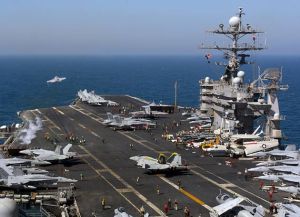
Glimpses of USS Midway aircraft carrier & Others –
All equipped for war!
Tianjin might play up to be a great competitor with the world’s best cruise ships. It can become a unique floating hotel with great destinations! Also in the offering will Aircraft Carrier Theme Parks!
It’s been a long time coming – the way that the American have been spending “as though there’s no tomorrow”. The writing has been on the wall but just being ignored. You don’t have to be an economist to understand simple mathematical equation of economic balance. Going on to the negative end for far too long will only lead to deep & deeper waters.
The “gloom & doom” has finally been announced by Standard & Poor’s when they downgraded US Credit Rating by one notch to AA+ on late Friday afternoon opf 5 August 2011. It’s not since 1917 that this has happened! But what will all this means to US economy, the impact & aftershocks on the global scale? There’s that warning of a one in three chances of further downgrading if US does not come up with a more permanent fix for its fiscal woe. It’s “largely because of the failure of bitterly divided US leaders to reach a consensus on containing the country’s spiralling debt “
Been having it too good?
Now the end is near & here!
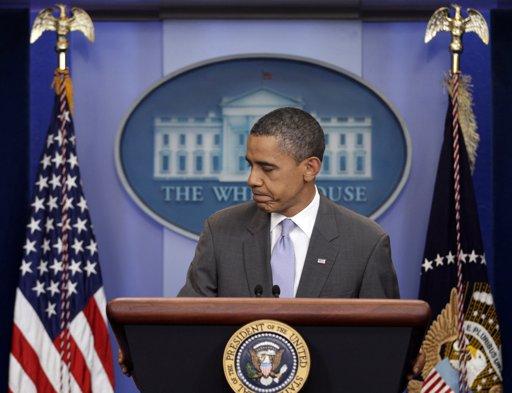
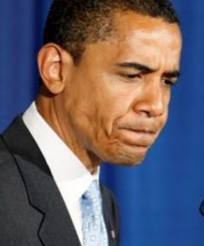
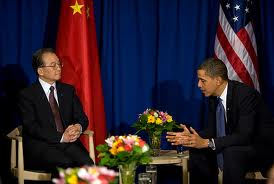
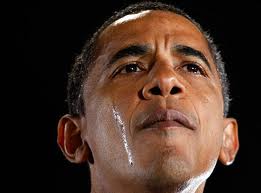
Let Obama‘s body language & gesture tell the story:
What happened to all his charisma? His dynamism & verbal eloquence?
Body language can often say much than spoken words.
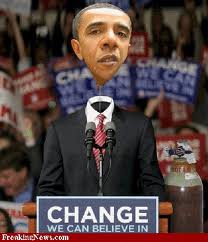
Whatever happened to the “CHANGE” We Can Believe In?
Now he’s leaning on to others!
Listening to others?
Still that arrogance with all the might & power?
Leaning on to China's Wen Jiabao
US maybe contemplating WW3 to resuscitate its economy
& to redeem its power before losing it all to China!
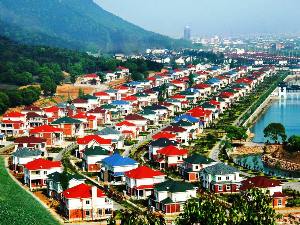
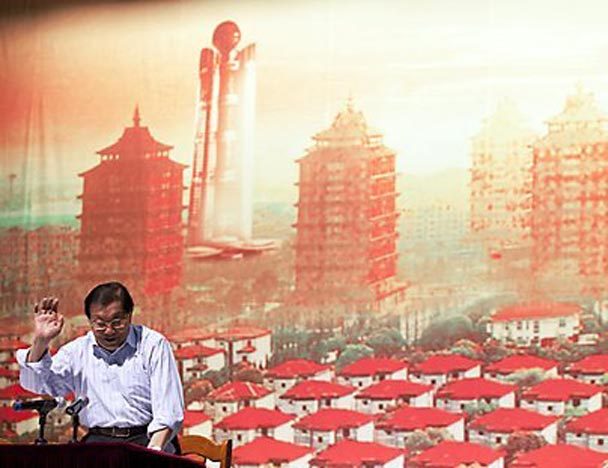
Westerners have always been seeking for Shangri-La, the utopian lifestyle. Search no more. There is in reality a place such as this in China. Talk no more of Hangzhou or Suzhou. It’s a miracle wonder of a place!
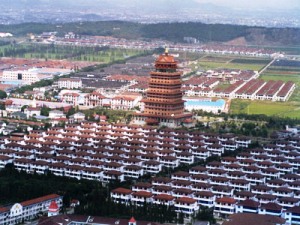
Huaxi Golden Pagoda
It’s called Huaxi, a booming market town of 36,000, first set up in 1961 in the affluent eastern province of Jiangsu. Everyone here has all the luxury that life can offer such as a huge house, a car (Benzs, BMW etc.), even free cooking oil, clothes, healthcare, education etc. Huaxi has fixed assets of 3 billion Yuan (US$362 million). All they have to do is work 7 days a week for the village industrial operations, milling steel or some such industry. Only one condition is that you can never leave. If you do, you lose everything. But just to make it easier to stay, the city has built replicas of the Eiffel Tour, the Sydney Opera House, and the Arc de Triumf to bring the world to its doorstep.
People are not leaving. In fact, it’s attracting lots of migrant workers who hope to be accepted for work permit & in time enjoy such privileges like the permanent residents of Huaxi where each household has been assigned a car & a single-family home of 400 square metres, earn around US$6,000 per head per year. Compared with migrant workers who toil for an average monthly wage of 500 yean (US$60), the prosperity enjoyed by Huaxi villagers is an undeniable miracle
Like the song Hotel California – “You can check out anytime you like but you can never leave”.
But why would you want to leave when you’re already living in the best place of the world, as one resident said. Leaving is not the option but “living it up” and seeking other higher aspirations is the objective.
And all this started with the dream, hope & aspiration of one man, Wu Renbao (now in his eighties) who combine market economy, socialism with Chinese characteristics.
Wu Renbao (SIM CHI YIN/NYT)
When Chinese Daily writer Raymond Zhou wrote of Wen Renbao’s retirement, the announcement created aftershocks in the country media similar to what Bill Gates’s retirement about speculation in the software industry. Now Huaxi is headed by Wu Xie’en his fourth son, as elected 100% by the community.
This amazing video will help clear your curiosity.
I am a sucker for a good story. You probably have heard of Max Lucado
or read some of his books. He has a knack for telling a simple story
making it sound so interesting & inspiring that you wouldn’t put the story down till you’re finished.
Here’s one case “In The Eye Of The Storm” he related the story of an old guy
named Ed weekly routinely making his way to the pier with his bucket of shrimp . . .
It happened every Friday evening, almost without fail, when the sun resembled a giant orange and was starting to dip into the blue ocean.
Old Ed came strolling along the beach to his favorite pier.. Clutched in his bony hand was a bucket of shrimp. Ed walks out to the end of the pier, where it seems he almost has the world to himself. The glow of the sun is a golden bronze now.
Everybody’s gone, except for a few joggers on the beach. Standing out on the end of the pier, Ed is alone with his thoughts…and his bucket of shrimp.
Before long, however, he is no longer alone. Up in the sky a thousand white dots come screeching and squawking, winging their way toward that lanky frame standing there on the end of the pier.
Before long, dozens of seagulls have enveloped him, their wings fluttering and flapping wildly. Ed stands there tossing shrimp to the hungry birds. As he does, if you listen closely, you can hear him say with a smile, ‘Thank you. Thank you.’
In a few short minutes the bucket is empty. But Ed doesn’t leave.
He stands there lost in thought, as though transported to another time and place.
When he finally turns around and begins to walk back toward the beach, a few of the birds hop along the pier with him until he gets to the stairs, and then they, too, fly away. And old Ed quietly makes his way down to the end of the beach and on home.
If you were sitting there on the pier with your fishing line in the water, Ed might seem like ‘a funny old duck,’ as my dad used to say. Or, ‘a guy who’s a sandwich shy of a picnic,’ as my kids might say. To onlookers, he’s just another old codger, lost in his own weird world, feeding the seagulls with a bucket full of shrimp.
To the onlooker, rituals can look either very strange or very empty. They can seem altogether unimportant . . . maybe even a lot of nonsense.
Old folks often do strange things, at least in the eyes of Boomers and Busters.
Most of them would probably write Old Ed off, down there in Florida . That’s too bad. They’d do well to know him better.
His full name: Eddie Rickenbacker. He was a famous hero back in World War II. On one of his flying missions across the Pacific, he and his seven-member crew went down. Miraculously, all of the men survived, crawled out of their plane, and climbed into a life raft.
Captain Rickenbacker and his crew floated for days on the rough waters of the Pacific. They fought the sun. They fought sharks. Most of all, they fought hunger. By the eighth day their rations ran out. No food. No water. They were hundreds of miles from land and no one knew where they were.
They needed a miracle. That afternoon they had a simple devotional service and prayed for a miracle. They tried to nap Eddie leaned back and pulled his military cap over his nose. Time dragged. All he could hear was the slap of the waves against the raft.
Suddenly, Eddie felt something land on the top of his cap. It was a seagull!
Old Ed would later describe how he sat perfectly still, planning his next move. With a flash of his hand and a squawk from the gull, he managed to grab it and wring its neck. He tore the feathers off, and he and his starving crew made a meal – a very slight meal for eight men – of it. Then they used the intestines for bait. With it, they caught fish, which gave them food and more bait . . . and the cycle continued. With that simple survival technique, they were able to endure the rigors of the sea until they were found and rescued (after 24 days at sea.
Eddie Rickenbacker lived many years beyond that ordeal, but he never forgot the sacrifice of that first lifesaving seagull. And he never stopped saying, ‘Thank you.’ That’s why almost every Friday night he would walk to the end of the pier with a bucket full of shrimp and a heart full of gratitude.
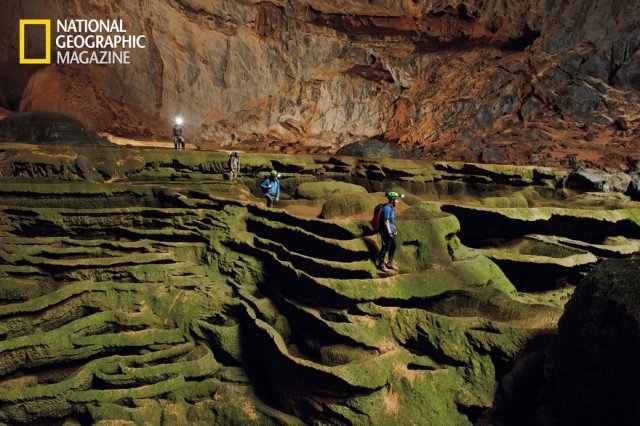
Hidden in the depths of the Vietnamese jungle lies The Hang Son Doong, part of a network of over 150 caves, the world’s biggest cave has been discovered by British cavers in 2009. The cave passage in Phong Nha-Ke Bang National Park, originally thought to be a modest 150 metres long and 200 feet high, is so large its end is yet to be found.
But these remarkable images – taken during two further expeditions of the caves – show the previously undiscovered depths of the magnificent cave passage, now the largest in the world.
At a mammoth 2.5 miles long, 330ft wide and almost 800ft high, Hang Son Doong also known as Mountain River Cave, is as high as 25 double decker buses.
And as shown in these amazing images taken by photographer Carsten Peter, there is even a jungle concealed deep inside the cave.
Carsten from Munich, Germany, took the images in 2010 when he joined British and German cavers during further expeditions of the site.
The purpose of the expedition was to make a complete exploration of Hang Son Doong and create a photographic record of the cave.
Cartsen, 52 said he spent up to two weeks at a time deep inside the caves, where he slept with just a sleeping bag and spent his time exploring and photographing the secret underground world.
He said: ‘We discovered new parts of the cave, it’s a huge area so to find them and access them is very difficult.
‘Photographing caves of this size is a challenge, it needs a lot of preparation.
‘But it’s a great feeling to photograph a newly discovered cave, for me I see the cave for the first time when I see the photographs.
‘I love to explore, I have been in some great caves in my lifetime and this is one of the most magnificent.
‘I’ve been a photographer and explorer for the last 35 years and I’ve visited so many caves, I’ve lost count.
‘But this is by far one of the most unique and unusual caves I have ever seen.
‘To see a cave so large it has a forest inside is superb – it was overwhelming.’
Before you begin to read this transcript, let me urge you to drop any pre-conceived ideas you may have about China. Have an open mind, otherwise it would be likened to dropping off a plane or cliff with a closed parachute – and it can be dangerous.
To quote the words of Martin Jacques in our preceding presentation of “Understanding the Rise of China” that:
“This is China, a civilization state rather than a nation state”
and
“China is not like the West, and it will not become like the West as its economy expands over the next decade.”
Here below, Robert Herbold presents a most enlightening concept on the differences that separate China from the United States and how the differences make them grow apart.
Bob Herbold, Former COO of Microsoft
(Robert Herbold, a retired chief operating officer of Microsoft Corporation, is the managing director of The Herbold Group, LLC and author of ‘What’s Holding You Back? Ten Bold Steps That Define Gutsy Leaders’ (Wiley/Jossey-Bass, 2011).
”Recently I flew from Los Angeles to China to attend a corporate board-of directors meeting in Shanghai, as well as customer and government visits there and in Beijing. After the trip was over, in thinking about the United States and China, it was not clear to me which is the developed, and which is the developing country.
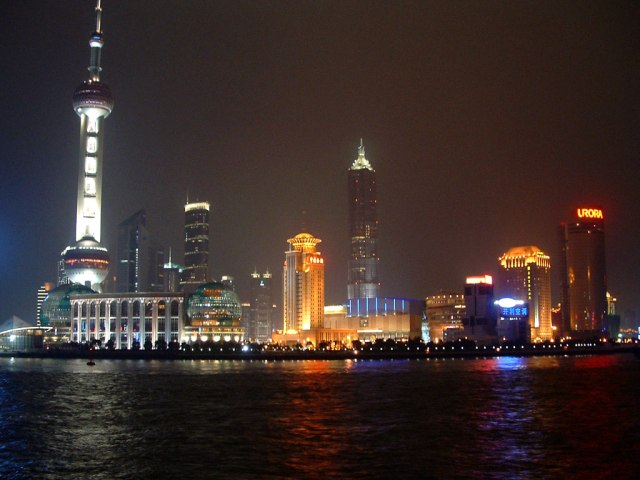
Infrastructure: Let’s face it, Los Angeles is decaying. Its airport is cramped and dirty, too small for the volume it tries to handle and in a state of disrepair. In contrast, the airports in Beijing and Shanghai are brand new, clean and incredibly spacious, with friendly, courteous staff galore. They are extremely well-designed to handle the large volume of air traffic needed to. In travelling the highways around Los Angeles to get to the airport, you are struck by the state of disrepair there, too. Of course, everyone knows California is bankrupt and that is probably the reason why. In contrast, the infrastructure in the major Chinese cities such as Shanghai and Beijing is absolute state-of-the-art and relatively new. The congestion in the two cities is similar. In China, consumers are buying 18 million cars per year compared to 11 million in the U.S. China is working hard building roads to keep up with the gigantic demand for the automobile. The just-completed Beijing to Shanghai high-speed rail link, which takes less than five hours for the 800-mile trip, is the crown jewel of China’s current 5,000 miles of rail, set to grow to 10,000 miles in 2020. Compare that to decaying Amtrak.
Shanghai-Pudong Skyline At Night
Government Leadership: Here the differences are staggering. In every meeting we attended, with four different customers of our company as well as representatives from four different arms of the Chinese government, our hosts began their presentation with a brief discussion of China’s new five-year-plan. This is the 12th five-year plan and it was announced in March 2011. Each of these groups reminded us that the new five-year plan is primarily focused on three things: 1) improving innovation in the country; 2) making significant improvements in the environmental footprint of China; and 3) continuing to create jobs to employ large numbers of people moving from rural to urban areas. Can you imagine the U.S. Congress and president emerging with a unified five-year plan that they actually achieve (like China typically does)? The specificity of China’s goals in each element of the five-year plan is impressive. For example, China plans to cut carbon emissions by 17% by 2016. In the same time frame, China’s high-tech industries are to grow to 15% of the economy from 3% today.
Government Finances: This topic is, frankly, embarrassing. China manages its economy with incredible care and is sitting on trillions of dollars of reserves. In contrast, the U.S. government has managed its financials very poorly over the years and is flirting with a Greece-like catastrophe.
Human Rights/Free Speech: In this area, our American view is that China has a ton of work to do. Their view is that we are nuts for not blocking pornography and antigovernment points-of-view from our youth and citizens.
Technology and Innovation: To give you a feel for China’s determination to become globally competitive in technology innovation, let me cite some statistics from two facilities we visited. Over the last 10 years, the Institute of Biophysics, an arm of the Chinese Academy of Science, has received very significant investment by the Chinese government. Today it consists of more than 3,000 talented scientists focused on doing world-class research in areas such as protein science, and brain and cognitive sciences. We also visited the new Shanghai Advanced Research Institute, another arm of the Chinese Academy of Science. This gigantic science and technology park is under construction and today consists of four buildings, but it will grow to over 60 buildings on a large piece of land equivalent to about a third of a square mile. It is being staffed by Ph.D.-caliber researchers. Their goal statement is fairly straightforward: ‘To be a pioneer in the development of new technologies relevant to business.’ All of the various institutes being run by the Chinese Academy of Science are going to be significantly increased in size, and staffing will be aided by a new recruiting program called ‘Ten Thousand Talents.’ This is an effort by the Chinese government to reach out to Chinese individuals who have been trained, and currently reside, outside China. They are focusing on those who are world-class in their technical abilities, primarily at the Ph.D. level, at work in various universities and science institutes abroad. In each year of this new five-year plan, the goal is to recruit 2,000 of these individuals to return to China.
Reasons and Cure: Given all of the above, I think you can see why I pose the fundamental question: Which is the developing country and which is the developed country? The next questions are: Why is this occurring and what should the U.S. do? Let’s face it, we are getting beaten because the U.S. government can’t seem to make big improvements. Issues quickly get polarized, and then further polarized by the media, which needs extreme viewpoints to draw attention and increase audience size. The autocratic Chinese leadership gets things done fast (currently the autocrats seem to be highly effective).
What is the cure? Washington politicians and American voters need to snap to and realize they are getting beaten and make big changes that put the U.S. back on track: Fix the budget and the burden of entitlements; implement an aggressive five-year debt-reduction plan, and start approving some winning plans. Wake up, America!”







































 Intrepid journey: A caver stands in front of a huge rock formation as the light shines beneath a skylight in Hang Son Doong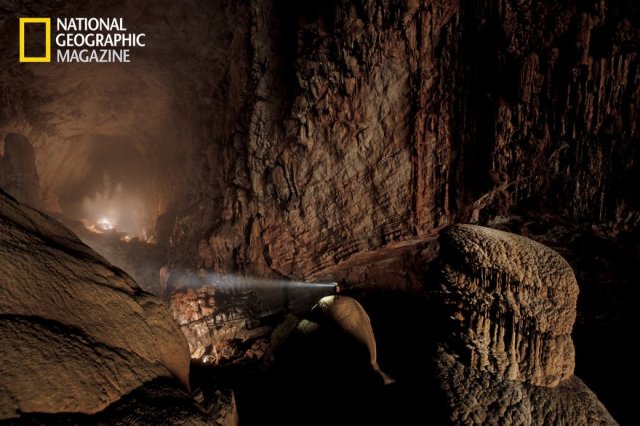
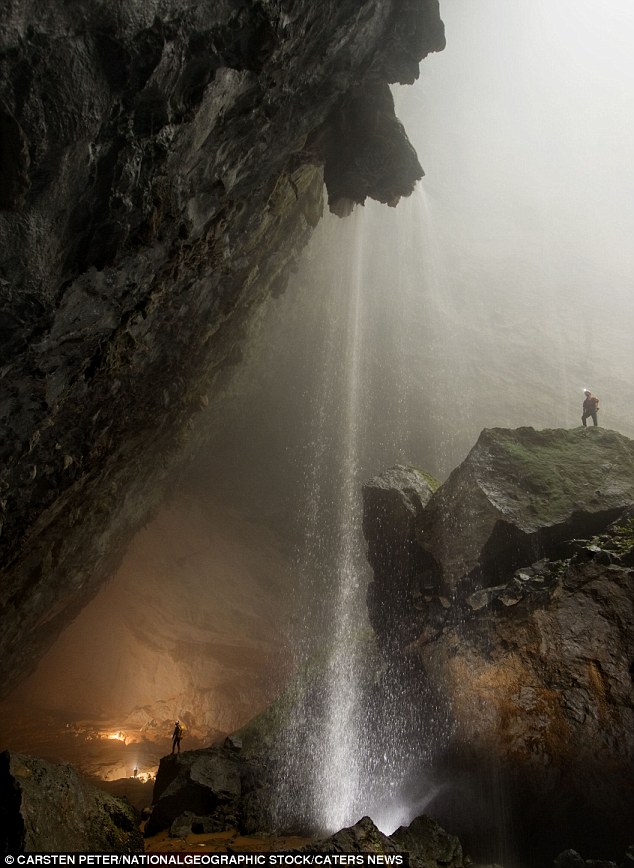 Wonderful waterfalls: A waterfall explodes into Hang Son Doong in the hidden depths of the Vietnamese jungle, which is part of a network of over 150 caves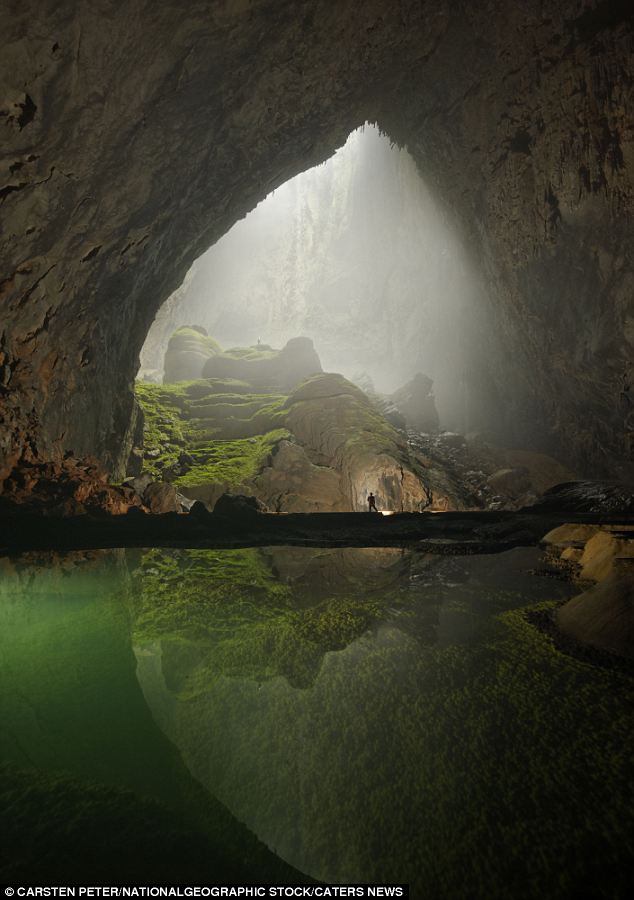



 Paul Chong's Blog