(Xuangongsi Hanging Temple literally means “Floating Temple”)
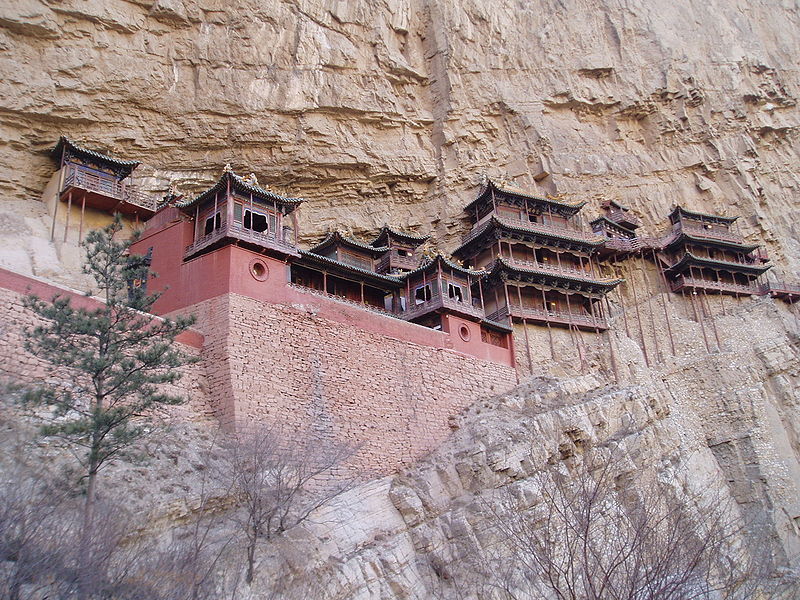
A distant view of the complex across the Golden Dragon River (Jinlong He).
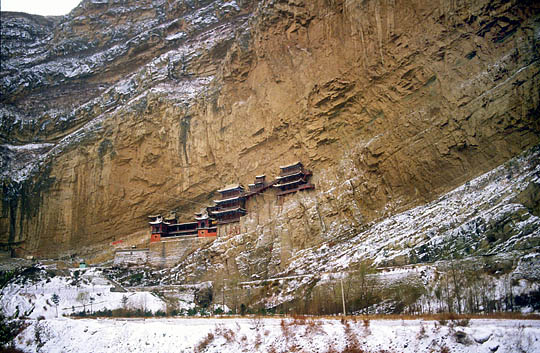
Built around 6th century, Xuangongsi of Hunyuan County, Shanxi Province is one of China’s unique and remarkable feats of architectural engineering. Sited about 50 mi (80 km) southeast of Datong, it is built about a third of the way up a vertical cliff in Jinlong Guan (Golden Dragon Gorge or Canyon), part of the long Hengshan (Heng Mountain), one of the four sacred Taoist mountains. The monastery was founded during the Northern Wei period (386-584) in the 6th century, although much was reconstructed from the Tang through the Qing eras, as well as in more recent times.
A More Distant View
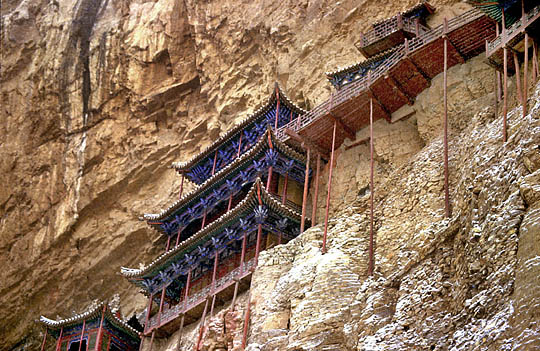
The underpinnings of the cliff buildings.
Little of the load is actually carried by the thin support pillars. Much of the cantilevering is supported by the weight of the buildings above it.
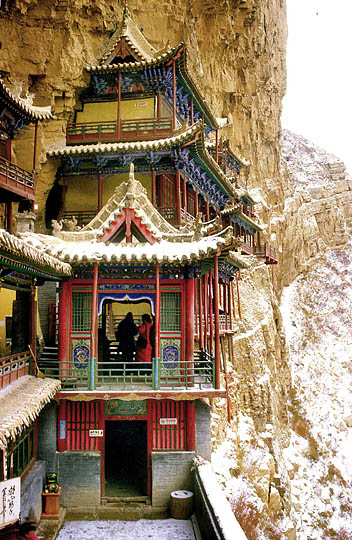
The complex consists of forty caves, or rooms, including six main halls, but its characteristic feature is the elaborate wooden façade of pavilions and walkways precariously resting on timbers jutting out horizontally and vertically from the cliff. There are colourful tiles on the roofs. Inside the caves are a number of Buddhist figures in bronze, stone, clay and iron. Although built on a sacred Daoist mountain, it has had many influences on it. The Three Religions Hall (San Jiao Dian) reflects the syncretic element of the Chinese religious and philosophical tradition. It contains the seated images representing the Buddha, Confucius and Laotzu, seemingly in perfect harmony with each other.
The Hanging Monastery is an architectural wonder to have withstood the stormy weather for this period of time. A unique mechanical theory was applied to building the framework. Crossbeams were half-inserted into the rock as the foundation, while the rock in back became its support. Seen from below, the Hanging Monastery appears to be a tumble-down castle in the air. Inside, it provides the same scene as other temples.
Pavilion
Construction experts from many countries including Britain, Germany, and Italy, have come to see the monastery. In their words, the Monastery, which mixes mechanics, aesthetics, and Buddhism, is rare. The monastery and everything it symbolises embodies a great cultural achievement of the Chinese people.
The second attraction of the Hanging Monastery is that it includes Buddhism, Taoism and Confucianism. Inside the Monastery, the sculptures of Sakyamuni, Confucius and Laotzu appear together, which is unusual. There are 40 halls and cabinets, which contain about 80 sculptures made of copper, iron, terracotta, and stone.
Why build a monastery like this? Location is the first reason – building a monastery on the cliff could shield it from floods. In addition, the mountain peak protects it from rain and snow; and the mountain around it also diminishes damage from long-time sunshine. The second reason is that the builders followed a principle in Taoism: peace & tranquility from all forms of human & natural pollution.
James Cameron‘s recent epic movie “Avatar” (Floating Mountains) no doubt helps to promote the spectacular wonders of the Chinese mountain scenic attractions.
All too well, people have long been familiar with the ancient mountains located around the vast Chinese landscape so mysteriously depicted in Chinese paintings.
The five famous mountains – Huangshan, Taishan, Huashan, Hengshan & Songshan are now facing competitions with newer discoveries such as Tianmen Shan or Tianmen Mountain.(Chinese Mandarin word“Shan” means “Mountain”).
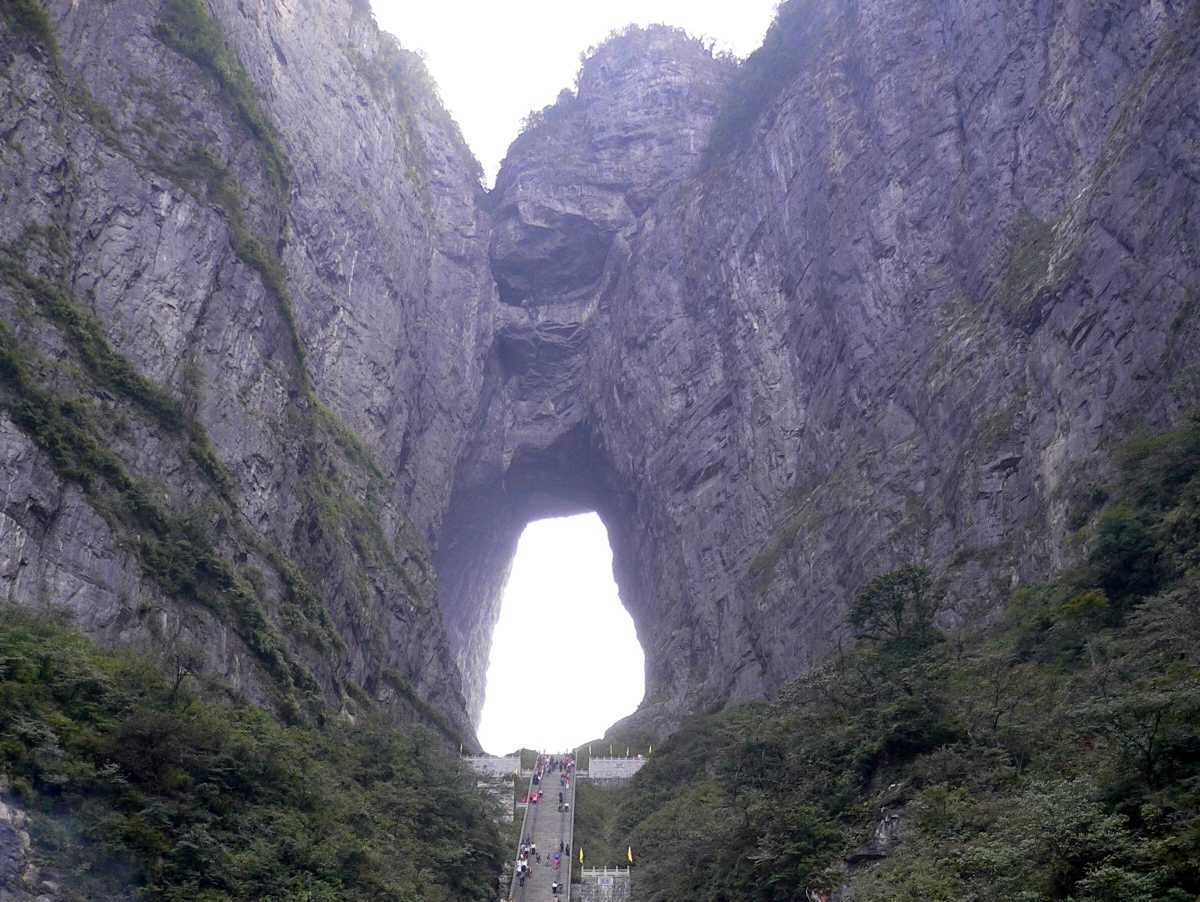
Tianmen Mountain in Hunan Province just south of Zhangjiajie City (previously known as Dayong City) is an absolutely ‘must see’ scenic area.
The main featured scenic spots are centralized in the north part of Zhangjiajie City – Wulingyuan Scenic Area which became China‘s first National Forest Park in 1983.
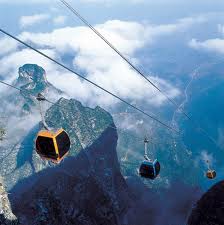
Cable Cars
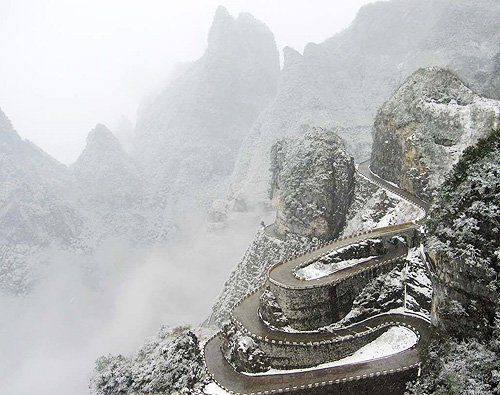
The best way to get to the top is by cable car. A one-way trip costs CNY48. The roads are scary with many twists & turns & certainly not for the faint-hearted.
Big Gate Road
If you have more time to stay in Zhangjiajie , there are lots of places you may want to visit . . . to fill your thrills & frills . . . too many to mention here because of time & space constraint.
A scenic spot you might enjoy is the Feng Huang Cheng (Phoenix Town) located some 210 kilometers (about 130 miles) west of Zhangjiajie Village. Here you can experience that Chinese minorities lead a life of primitive simplicity unaffected by the ways of modern development. This raises the question that in the failing realm of capitalism, shouldn’t economists consider the aspect of GDH instead of GDP – H as in HAPPINESS rather than P in PRODUCTIVITY. Could you be content & happy living just a basic lifestyle?
Finally, the newly opened Yangjiajie Scenic Area located in the northwest section of Wulingyuan is worth a visit.
Like they say “A picture is worth a thousand words”, you’ll be amazed by the slide show as presented by pps creator Dan Calistrat or view on YouTube the airflights through the Heaven’s Gate.
Flying Through Heaven’s Gate
UPDATE & LATEST NEWS
This is China’s newest tourist spot with a glass-bottomed walkway around the cliff face of the Tianmenshan – a feature similar to the Skyway of the Grand Canyon in US. However, this is of greater distance 200 ft long & stands at 4,700 ft. above sea-level.
To walk on it is to test your nerves, to see whether your heart can stand the dazzling height!
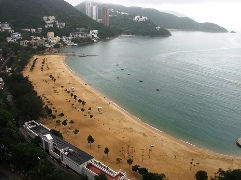
Repulse Bay, wide crescent-shaped beach, popular among locals and tourists alike, is one of the most beautiful beaches in Hong Kong.
Amidst the tranquility of The Repulse Bay, you are only 15 minutes from Hong Kong’s commercial hub, Central.
It is an artificial strip of sand on the south side of Hong Kong Island. Shark nets and floating platforms have been added as public safety for swimmers.
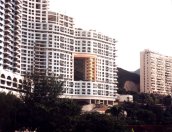
Visitors to the beach would notice the fascinating feature of a tall 37-story residential apartment block specially constructed with a square “hole” or empty space in the midst of it. This may seem to be such a waste of valuable residential space.
This is essential to the needs of a nearby legendary dragon. Legend has it that a dragon lives at the top of the mountain, and a “feng shui” master warned that the building would block the dragon’s access to the shore. Hence, a large hole was cut out of the tower’s centre to mollify the dragon and avoid a whole lot of bad luck.
Hongkees are great believers in “feng shui”. They would go to great length to accommodate the requirements of siting, orientation & the balance of the natural forces of “yin” and “yang” to secure the optimum fortune.
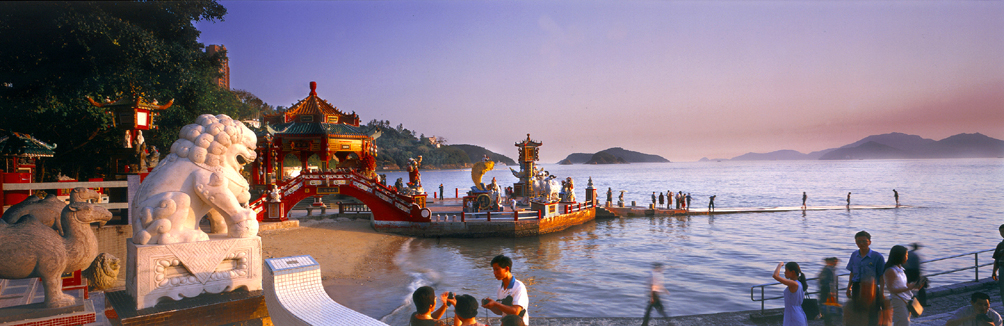
Repulse Bay Beach is also famous for the elaborate statues of Chinese sea goddesses at the Kwun Yam Shrine. Throw a coin into the mouth of the fish statue and receive good fortune; cross the gaudy Longevity Bridge and add three days to your life!
Source: HK Tourism Board: Kwun Yam Shrine
Such are the thrills & frills, apart from the sun, sea and sand . . . an ideal place for relaxation & sunbathing. It’s a delightful & popular place for the family outing though the name may sound “repulsive”. The name is derived from the past to remind the locals of the British army‘s victory over the haunting pirates in the old days.
Repulse Bay is quite a premium residential precinct among the top executives.
That you may never know & may never too be able to give. That’s what made us different & distinct from you. That which is good & most treasured is time-honoured, respected & revered right through the ages . . . since the dawn of the history of mankind. If you have not been around this long as a nation or race (if ever there was such an “adulterated”race historically), you’d never be able even to understand. Without understanding, you can never acquired the culture & become the benevolent & gracious person that is expected of you.
Small man settles for the crumbs
While great man freely extends his alms.
In the history of mankind, even the great Napoleon Bonaparte in all his conquering glory feared China, leaving it alone for fear of wakening the sleeping Dragon. History does not lie – all truth & falsehood are revealed therein. Try as you might tear off the “unwanted” pages & insert “invented” pages of your own, truth will prevail. You just cannot change past history. The crux is you may not have much of a history as a race!
You cannot grow strong by doing others wrong. You may think it’s so easy to intimidate & dominate others by your threats & wielding your “kris”. Their apparent fear exists only in your mind & imagination. There is such a thing as lowering one’s dignity by joining you in the throng of doing wrong. God forbids. (I have better avoid the use of the word “Allah”).
On the “Bumiputra” question, being “son of the soil”, the connotation is so baseless & laughable with the benefits of special privileges & rights. The international court of law will rule this out as invalid & all acquisitions through this privilege ruled as unlawful & illegitimate. The true “Bumiputra” in Malaysia are the aborigines or as we used to call them “Sakai”. The word “putra”, if I am not mistaken means “prince” and not “son”. By Malaysian law, all other races, though born & bred in Malaysia, are not deemed as “Bumiputra” except the Malays. They don’t even have to be born to be legitimate under the law – so long they profess the Muslim religion & are of Malay origin. Now, you’ll be the judge and jury. What’s your verdict?
How can you ever stand tall, strong & proud by throwing your illegitimate weight about? Deeds & thoughts of great men in the past always provide the guiding light for those blind of sight. You can learn a great deal from Abraham Lincoln, who was perhaps the greatest of the American Presidents. He said:
You cannot bring about prosperity by discouraging thrift.
You cannot strengthen the weak by weakening the strong.
You cannot help the wage earner by pulling down the wage payer.
You cannot further the brotherhood of man by encouraging class hatred.
You cannot help the poor by destroying the rich.
You cannot keep out of trouble by spending more than you earn.
You cannot build character & courage by taking away man’s initiative & independence.
You cannot help men permanently by doing for them what they could & should do for themselves.
Lincoln had that special ability of “painting with words” with the things he said, and he said it all in pure simple words – nothing bombastic about them.
A good many lessons can be learnt & drawn from the above wisdom for Malaysia. The principles should be advocated & applied to right the wrong, if the young nation hope to have any standing at all in the world stage.
What do the Chinese want? It’s all inherently stated by this brief & concise piece of my writing. Fairness & justice must be seen to be in practice for all Malaysians.
Take heed & implement righteousness with all speed
Squabble not & avoid planting hatred seed
Stand tall & erect as a man
Be fair & just to all in the land!
The writer is “A Chinese by Descent . . . An Australian by Consent”
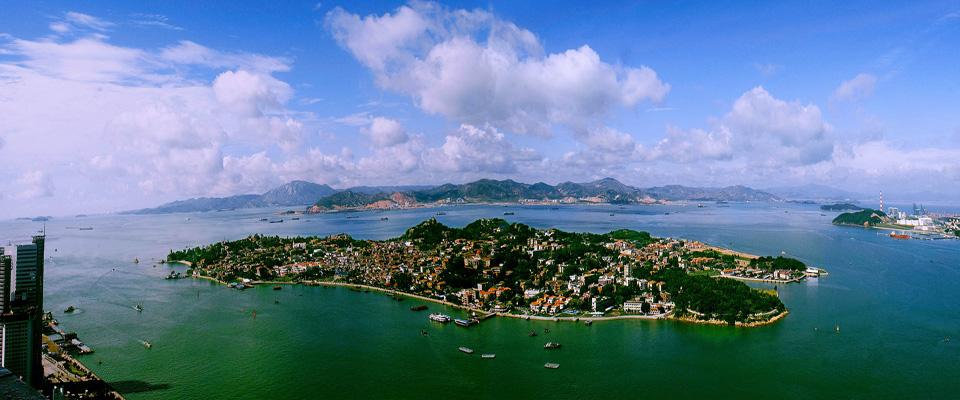
Gulangyu Island – 5-Minute Ferry Ride from Xiamen. Only 1 sq.km in area.
Europeans have their Mediterranean resorts and Americans have Florida to flee to in the depths of winter, Chinese have Gulangyu. This is where sun, sea & serenity prevail.
With no cars or bicycles, a stroll among Gulangyu’s winding streets can be a truly tranquil experience
As a place of residence for Westerners during Xiamen’s colonial past, Gulangyu is famous for its architecture and for hosting China‘s only piano museum . . . giving it the nickname of “Piano Island” or “The Town of Pianos” or “The Island of Music”. There are over 200 pianos on this island.
This fascinating island became a foreign enclave following the Treaty of Nanking in 1842, hence the predominantly Victorian-era style architecture throughout the island, of which many were offices and residences of Consulate-Generals, as well as that of the past thriving expatriate business community.
Car-Free Streets & Colonial Residences
Gulangyu Island is renowned for its delicate natural beauty, ancient relics & varied architectures. It is on China’s (Fujian Province) list of National Scenic Spots. It’s also well-known for its beaches & winding lanes. It’s the sort of place to relax & escape from the hustle & bustle of hectic city life of Xiamen by taking the 5-minute ferry across the river.
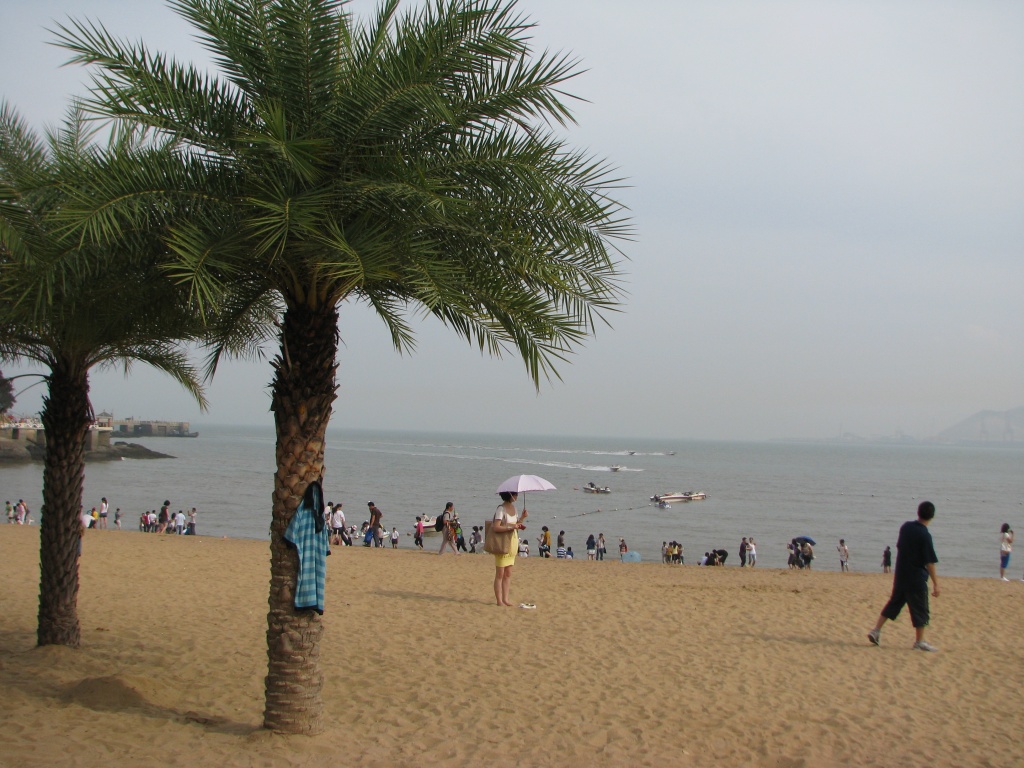
Gulangyu Beach
Gulangyu is a car-free island off the coast of Xiamen, Fujian Province in southern China. It’s small & only about 1km2 in area. It is home to about 16,000 people and is a very popular tourist destination. The community’s only means of transport is by foot, and the peaceful island provides an alternative to the hectic life in Xiamen city across the river, although the recent introduction of electric tourist buggies is damaging the island’s charm.
Xiamen Hotel
Freight is pulled on wheeled buggies up the often steep lanes by teams of strong men, much like what they do in Huangshan, the Yellow Mountain, except that the freight there is carried on the shoulder.All powered vehicles are banned, including bicycles. As mentioned, the only powered transport are the electric tourist buggies, which barge around the island damaging the otherwise tranquil and safe streets. Ironically, as is often the case, tourists are damaging the very thing they come to see & enjoy.
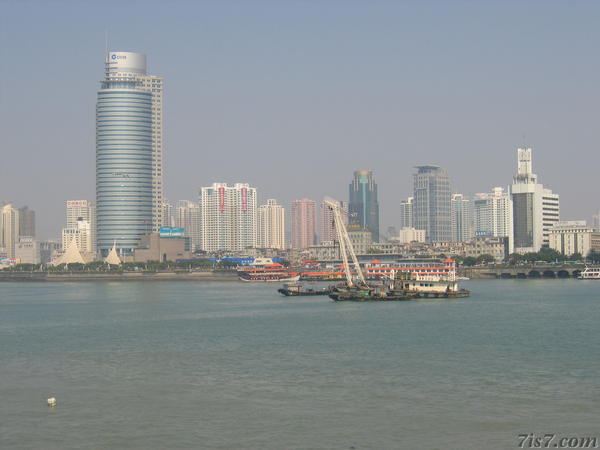
Xiamen from Gulangyu
Xiamen is like any Western city, bustling & teeming with activities, high rise buildings, traffic, din & noise. Anyone who’s been there & not visited Gulangyu would have missed something so precious & memorably so different not found elsewhere in China.
A great place to visit . . . where serenity prevails with sun & sea
It will long be remembered even when others fade from your memory.
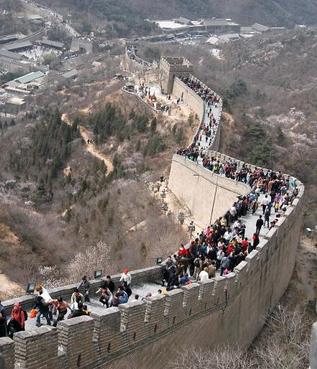
“Wan Li Chang Cheng” – literally means “Ten Thousand Miles Wall.” It’s not one great wall but a monumental series of wall that constitute The Great Wall of China. They were erected over the centuries to thwart & deter the barbaric invaders from encroaching upon the Middle Kingdom. The Wall twists through Chinese dynastic history. Today the nation welcomes visitors near & far together with their wallets. What the visitors, more than a million a year, really see is the impressive gleaming stretch of wall at Juyongguan near Beijing. Such commercialisation is marring an archaeological treasure as claimed by preservationists.
Teaming crowd of visitors
It’s been more than a fifth of a century since I first stepped & climbed The Great Wall of China. To tell you the truth, the feeling & excitement were simply beyond me! I had led a party of ten to China, all of them virgins in this world of ancient civilisation. Coincidentally, May/June 1989, saw the Tiananmen political debacle undertaken by the students.
In all the years since the landing on the moon, Western writers declared, with absolutely no evidence that the Great Wall could be seen from there. But what Deng Xiaoping, the small & yet most dynamic of a man, proclaimed “Let us love our China, let us restore our Great Wall” has become a well-known slogan.
In the passage of time, I have seen great growth, progress & changes:
From Friendship Stores to Departmental Stores
From virtually no phone to modern convenient cell phones
From million bicycles to million vehicles.
This is truly representative of a complete transformation & material revolution unseen & unheard of in the history of mankind! All within one lifetime, one generation!!
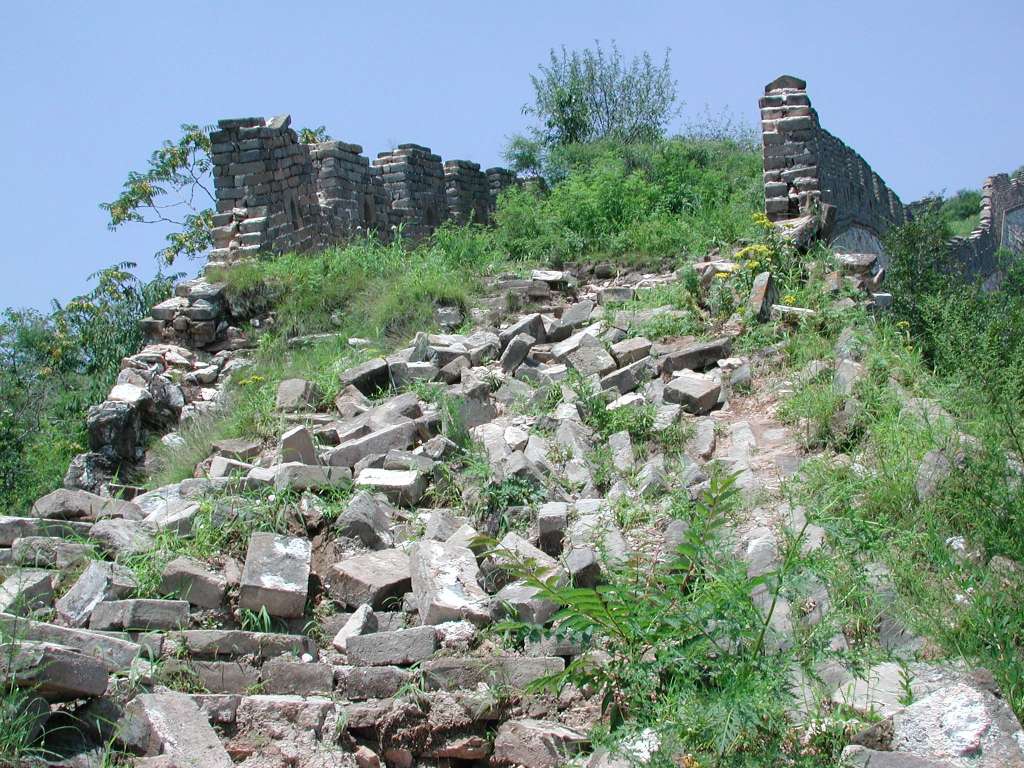
However, there are walls which tourists seldom get to see or visit in the outer reaches where there are crumbling sections of the Wall awaiting attention & preservation.The crumbling walls were never far away, a companion piece to the halfway stage of China’s rush to progress.
Visibly, there are signal towers & walls that stretched out for miles in ruins & villages entirely contained by high-walled forts for security purposes in the ancient days. Some homes carved out from the Walls have 20-foot-thick walls – “Very warm in the winter, cool in the summer”.
"With courtesy of Richard Chiang who purchased it from the Wushipu Oil Painting Village of Xiamen in May 2008.”
This slideshow requires JavaScript.
It is truly amazing! Now that the smoke signals are replaced by cell phones, what is there in store for the ruined parts of the Wall where even certain sections have disappeared. Will modernity bury archaeology? Will a history of more than 2,000 years be lost in a time vault or capsule?
By Paul Chong Sunday, 29 November 2009 A Chinese By Descent, An Australian By Consent
President Hu Expounds China’s Views On Development
China can boast of its silk and tea culture long before any other country in the world. Even the technological plough was first discovered in China. By and large, all discoveries were directed towards peaceful use and the enrichment of life and culture, as with the gun powder. Now the world is witnessing an unprecedented quantum growth in China – all within one generation!
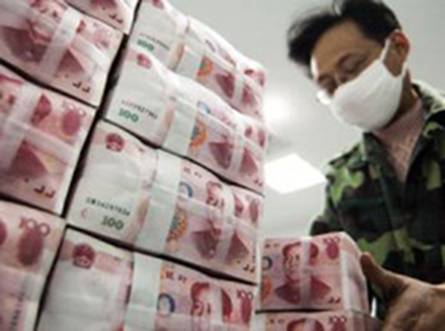
China Foreign Reserve World No. 1
China Oil Consumption World No. 2
China Trade Value World No. 3
China Economic Output World No. 4
Latest: China is the richest nation in the world.
‘Xiang Qian Zou’ – The Road To Riches
The Road To Riches – A Nation of Bicycles To Motor Vehicles
Of the nations in the world today, China stands out progressively tall and strong. It is as though a sleeping dragon is finally awakened. This appears to be the fear of the West. Though an economically strong China is good commercially for all the trading nations in the West, politically China poses a great threat. It is feared that “once China stands up, it won’t topple or be toppled.” That was why precisely Napoleon in his wisdom decided to let China be and not to rouse her.
In retrospect, China is undoubtedly the world’s greatest civilised nation over a continuous period of thousands of years – a civilisation undiminished and unbroken, unlike past civilisations like Egypt, Greece, or the Romans. By any reckoning, China should have by now be far more superior than the rest of the world. Why not?
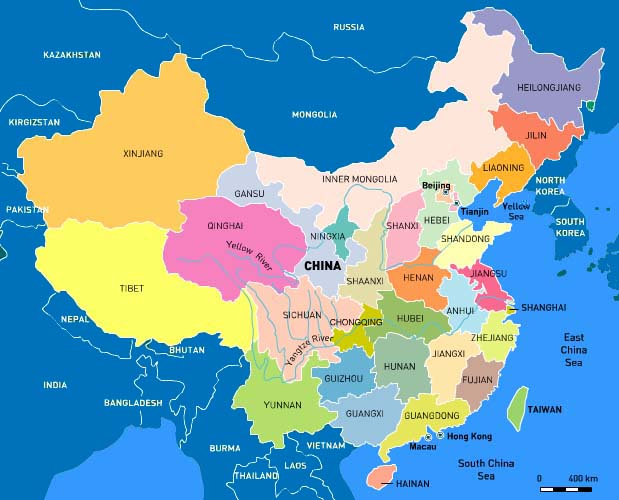
Map of the “Middle Kingdom”
Of the many reasons why China did not progress beyond its initial lead in technology and discovery, the main cause of which can largely be attributed to its inward looking policy . . . viewing all territories outside the Great Wall of China and its boundaries as barbaric in nature. This nationalistic pride and closed door policy led to its seclusion, totally depriving itself from the inter-change of ideas and exposure to new scientific developments and industrial growth. While China lavished in its culture, philosophy and essentially non-materialistic form of development, it began to lag behind the West in terms of economic industrial growth. In preserving its civilisation from being tainted by corruption, disruption and deterioration, it never knew new growth, development and discoveries elsewhere in the whole wide world. The “Middle Kingdom” realised too late the encroachment of other nations upon its shores and territories. Countries like Britain, Portugal, Japan were making inroads into China through modern superior arms of war instead of its age-old “kung-fu”.
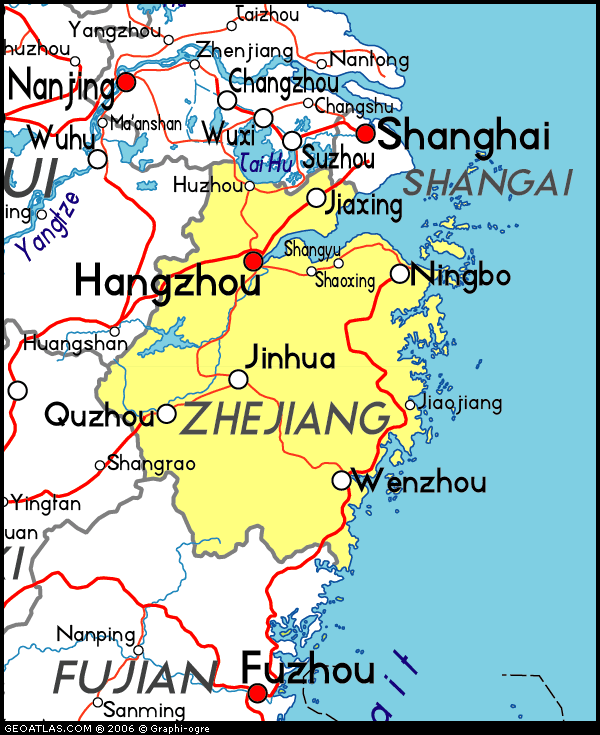
Zhejiang – Economic Zone
To grow, to progress is to change. Sentiment must give way to progress. There is no room for inhibition to changes. Change needs to take place before growth and progress can be attained. It’s attitude more than aptitude that scales the altitude. Mr. Lee Kuan Yew, the great former prime minister of Singapore, is credited for the great strides achieved by the City State. His visionary ideas have no room for inhibition or sentiment to change or any hindrance.
Now, what a change has come about as a result of Deng Xiao Ping’s visionary concept of “Xiang Qian Zou”. In Mandarin, it means “Forward Move”, but by replacing the middle word with the similar pronunciation, it becomes “Moving Forward With Money”. This started a great frenzy for the Chinese striving for monetary progress in all spheres of work and life. China has made a quantum leap – a country virtually with no phone to the modern technology of mobile phones! But capitalistic way of life does have its price. A single generation can witness the most remarkable change & progress. Transformation just sweeps aside all inhibition, resistance and sentiment.
Greed always breed a profound loss of goodness in mankind. Simple honesty, truth, kindness and compassion are lost in the process. The dollar sign is etched prominently on the foreheads of goal-getters. It is evident to an outside observer that the whole civilisation is transformed overnight. China, in its forward economic stride, has done away with its traditional large families, and its door is wide open to the corrupt western way of life. There is a price to be paid, for consequential results cannot be avoided.
Like most economies in the world, the road to riches often affect those who are involved, largely the urban folks, leaving behind a vast majority of the rural peasants. Even then great disparity may result among the urbanites. Encouraged by the concept of “Xiang Qian Zou” and ‘you’ve got to be in it to benefit it’, waves and tides of migrating movement are emptying the youth from the rural and pastoral areas. China is vast country where hundreds of millions of the peasant still labour and toil and are poor by comparison with the urban rich. No doubt, this is creating a set of social chaos unknown before.
Hong Kong, for instance, is a magnetic attraction for mainland Chinese. Tens of thousands cross the border which still has the immigration formality with number restrictions. In 2002 this number has been lifted and the hours of opening has even extended to 12 mid-night. This is largely due to the fact that the constant stream of exchange of people movement just keep on going growing bigger and bigger. The benefits work both ways. The affluent mainland Chinese pour money into Hong Kong, and the Hongkees likewise do the same in respect of investing in cheaper and more attractive housing in Mainland China.
On the more positive & human well being aspects, China has done itself proud by alleviating poverty for the great mass of the population. Consider this report by World Bank: “China has maintained a high growth rate for more than 30 years since the beginning of economic reform in 1978 and this growth has generated a huge increase in average living standards.
China’s sustained growth fueled historically unprecedented poverty reduction. Based on household surveys by the World Bank, the poverty rate in China in 1981 was 63% of the population. This rate declined to 10% in 2004, indicating that about 500 million people have climbed out of poverty during this period.’
Update & in a lighter vein:
China, now second largest economy in the world, has 19% of the world’s population, but consumes
. . . 53% of the world’s cement
. . . 48% of the world’s iron ore
. . . 47% of the world’s coal
. . . and the majority of just about every major commodity.
In 2010, China produced 11 times more steel than the United States.
New World Record: China made and sold 18 million vehicles in 2010.
China currently has the world’s fastest train and the world’s largest high-speed rail network.
China is currently the number one producer in the world of wind and solar power.
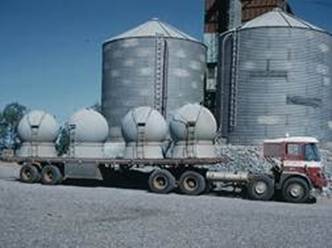
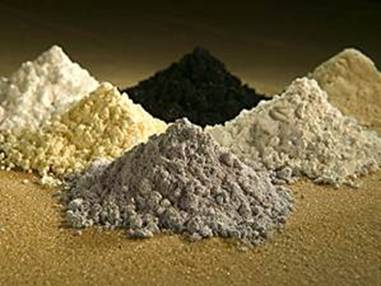
China currently controls more than 90% of the total global supply of rare earth elements.
In the past 15 years, China has moved from 14th place to 2nd place in the world in published scientific research articles.
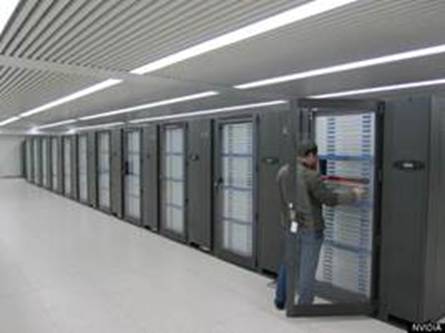
China now possesses the fastest supercomputer on the entire globe.
As at the end of March 2011, China has accumulated US$3.04 trillion in foreign currency reserves- the largest stockpile on the entire globe.
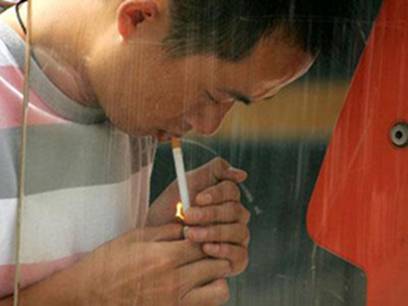
Chinese consume 50,000 cigarettes every second …Not an enviable record though …
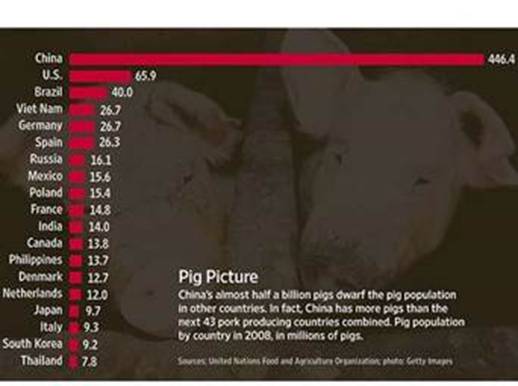
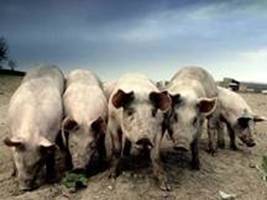
And here is the secret to the Chinese miracle: There are more pigs in China than in the next 43 pork producing nations combined.
So it is PORK that is driving China !! ENJOY YOUR PORK !
Now . . . you know why we eat “bak kut the” to be one in spirit with our China cousins.
Comments
Your comments are invited.
What problems do you envisage for China in this economic crisis?
How would the rest of the world, particularly US, react or act towards China?
What role do you think that China is likely to play on the world stage?
Do you think that China would follow the path of US & change its basic peaceful co-existence policy?
Søren Aabye Kierkegaard (b. 1813, d. 1855), philosopher, theologian & psychologist, was a profound and prolific writer in the Danish “golden age” of intellectual and artistic activity. He said: “Life can only be understood backwards; but it must be lived forwards.” Thus, if not for any other reasons, this fact alone is sufficient for us to dwell on history in order to understand the present & serves as a guide towards the future.
Until about 400 years ago, Western Europe was largely a feudal society – one that valued service & chivalry. The turning point in history arrived with the discovery of a new hierarchy of values. Feudalism was then replaced by capitalism – an economic system in which the means of production and distribution are privately or corporately owned and development is proportionate to the accumulation and reinvestment of profits gained in a free market. Wealth became the measure of success, and everyone was set in a frenzy for cash. The cult of money replaced all other values, including religious.
Capitalism turned the western world topsy-turvy. Making money was the be all and end all of objectives. This system turned out to be extremely efficient in terms of production of goods, services, and comfort. America benefited from the system the most, and decided that the rest of the world has to adopt it as well. Underdeveloped countries, if unable to appreciate the benefits of capitalism, would even be forced to do so.
However, after all the glories & excesses of high living, America is now facing the collapse of the illusion – the illusion of power & might, of conquest & dominance, of grandeur & sheer luxuries. In a word the collapse of capitalism.
We are either fortunate or unfortunate to be living in an era witnessing the unfolding of the old & the making of new history. We are on the threshold in time to see an unprecedented event that will transform the global geopolitical landscape.
This transformation will be in transition – slowly, steadily & most certainly. Philosophers & economic analysts maintain that capitalism is driven mainly by the striving for hard cold cash & the consumption of these goods. It’s this obsession that breeds greed, avarice & the inherent covetous nature of man that is the root of all the present day problems.
There is a lack of spirit in the power mind of the capitalist. There is no soul. A society that was built on the premise of “In God We Trust” is now doing away with God, throwing Him out of the schools, institutions & public places – forbidding the preaching & practice of anything religious.
With moral degradation setting in, a near collapse & breakdown in its economy, an unemployment of the highest in excess of 10%, a dollar currency that’s steadily losing its value & hallmark, America is now further faced with the dilemma of the emerging power in the East.
American’s values are exhibiting flaws, and the appeal to adopt them would be madness considering that the system is in crisis. Pragmatic Americans will soon realise they are no longer “boss” of the world to continue to impose its will upon billions of other nationalities, where traditional values & spirit are held in high esteem.
Globally, people are amazed by the economic miracles & achievements of China. Nations are flocking to learn of its wonders & adopting its system of development.
Signs are everywhere that Obama & his administration is shifting in the US policies bringing about changes that are possibly hard to believe:
From confrontation to negotiation & mitigation in its approaches to Iran & North Korea
Obama’s decision not to build the Missile Defence System in Poland & the Czech republic
Obama’s acceptance of his controversial Nobel Prize Peace Award as a “call to action”
Obama’s bowing gesture to the Saudi King & Emperor Akihito of Japan.
Has America, the bulwark of capitalism, grown tired of imposing its rules on others? Is America feeling the importance of friendship with other nations – rich or poor? Does it need to dominate to subjugate? Perhaps, as evidenced by the above actions, America is finally convinced that there are more to pursue than just power & money. If this be the case, we will soon be witnessing another turning point in world history with US embracing more elements of socialism.
“Capitalism creates a rational frame of mind which, having destroyed the moral authority of so many other institutions, in the end turns against its own.” – Joseph A. Schumpeter
The lip-synced girl, Lin Miaoke, who sang in the Beijing Olympic Opening Ceremony now has every potential in $$$ making; few movie directors in Hollywood hunting her out. The actual singer Yang Peiyi is virtually in the back stage.
The whole nation sings
The Minorities
with
The Majority
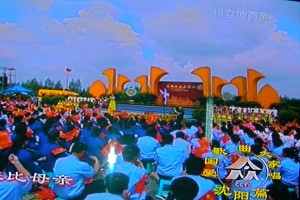
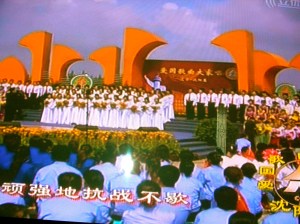
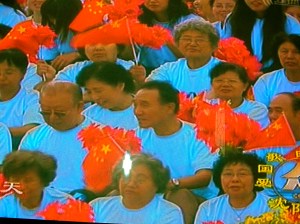
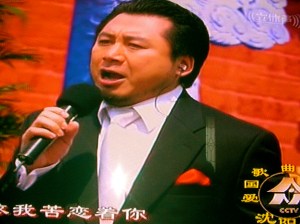
The illustrative display of the photos taken directly off the satellite TV with my little digital camera shows & verifies the truth that China is a great singing nation. On the stage comes a galaxy of singing stars, both male & female, known by the thousands & millions throughout China, though maybe little heard of in the western world. In all their brilliance & golden voices, they thrill & enthral the teeming audience in the thousands & millions. With shouts, cheers & tears they raise their hands & flags of all colours flying high. Truly a colourful event to celebrate the 60th. Anniversary of the founding of this new great ancient nation. This is a nation where everybody sings – young or old, rich or poor, male or female, indoor or outdoor, professional or amateur, from native folk songs, pop or rock to the very high class of opera – Chinese or Western. Singing could be backed up by a full orchestra or just simple musical instruments.
In terms of sheer numerical numbers, no other nations in the world can compare!
There is no shortage of talents with a pool of 1.3 billion population neither is there any lack of singing contests, festivals or celebrations to put the whole nation to songs! Often the audience would sing along as with the more popular tunes.
On an amateurish basis, some may even be professional, Karaoke is very popular in China. Karaoke provides an excellent avenue for social life at home, bars or karaoke houses known as “KTVs”, & for business entertainment between suppliers & customers. Good deals are often sealed & there’s no shortage of attractive hostesses helping out in the entertainment. For the uninitiated this could be a daunting experience.
Audience of young girls singing in unison with the star performer on stage.
More matured audience with red flags in hand
Pictures Below:
A male singer rendering a popular number.
A female performer
October 1 2009 is the 60th anniversary of the founding of the People?? Republic of China (PRC) and Beijing will host a grand celebration.
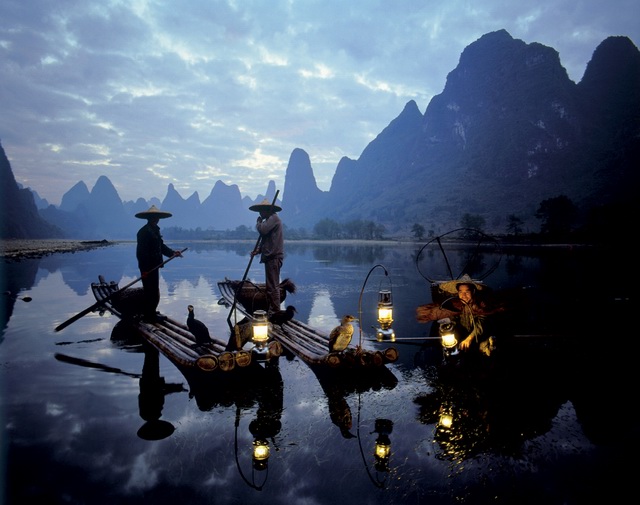
A cruise down the Li River to Yangshuo is one of the highlights of a holiday in Guilin, China.Among the Chinese, the saying, “Guilin has the most beautiful scenery in China, and Yangshuo is the most beautiful part of Guilin.”
The riverside karst hilly landscape, reminiscences of those limestone hills of Ipoh, Malaysia, & calm pristine waters with fishermen at work all fill an air with awe & refreshing wonder.

 A distant view of the complex across the Golden Dragon River (Jinlong He).
 A More Distant View
 The underpinnings of the cliff buildings.
 Little of the load is actually carried by the thin support pillars. Much of the cantilevering is supported by the weight of the buildings above it.
 Pavilion





















 On an amateurish basis, some may even be professional, Karaoke is very popular in China. Karaoke provides an excellent avenue for social life at home, bars or karaoke houses known as “KTVs”, & for business entertainment between suppliers & customers. Good deals are often sealed & there’s no shortage of attractive hostesses helping out in the entertainment. For the uninitiated this could be a daunting experience.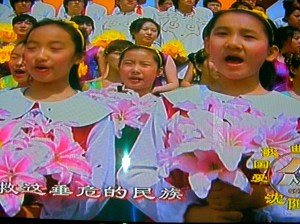





 Paul Chong's Blog