The Jumbo Kingdom was established in October 1976 by Dr. Stanley Ho. It took four years and over HK$30 million to design and build it. It was originally decorated in the style of an ancient Chinese imperial palace.
Free motor launch transport
The Jumbo Kingdom recently underwent a major multi-million dollar renovation, which transformed it into “a theme park on the sea” including dining, shopping, sightseeing and cultural attractions.
Jumbo Entrance
A Chinese culinary school taught by the chefs
of Jumbo Kingdom has been established.
Visitors can experience the nostalgic Hong Kong dining experience from a bygone era, the Typhoon Shelter seafood meal on a sampan.
The Chinese Tea Garden, Pier Plaza & Bronzew are Exhibition are additional attractions.
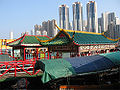
Since its opening in 1976 as the Jumbo Floating Restaurant, it has excelled in the preparation of seafood for discerning diners. Designed like a classic Chinese palace, it can accommodate up to 2,300 people. Situated in Aberdeen Harbour, the Jumbo is one of the world’s largest floating restaurants and an iconic tourist landmark of Hong Kong.
Image via Wikipedia - Interior
The combination of good food & place makes eating all the more pleasurable!
Colours & lights at night add on to the romantic delight!
HK Sunset Cruise By Chinese Junk
A romantic & worthwhile proposition is a Sunset Cruise plus dinner at the Jumbo Floating Restaurant!
Hong Kong offers a variety of cuisine from street stalls to imperial courts. Good food galore, for the Cantonese are undoubtedly the best cooks in the world. However, but it’s knowing where & what to eat, as like the locals, that will make the difference to your wallet & palate.
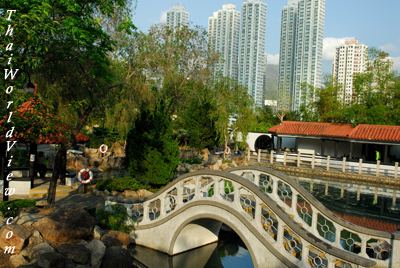
Beautiful Surrounding - Shatin Park
As a regular visitor to Hong Kong, I have come to be familiar with the Cantonese folks in their fondness of eating out. There is no shortage of choice restaurants.
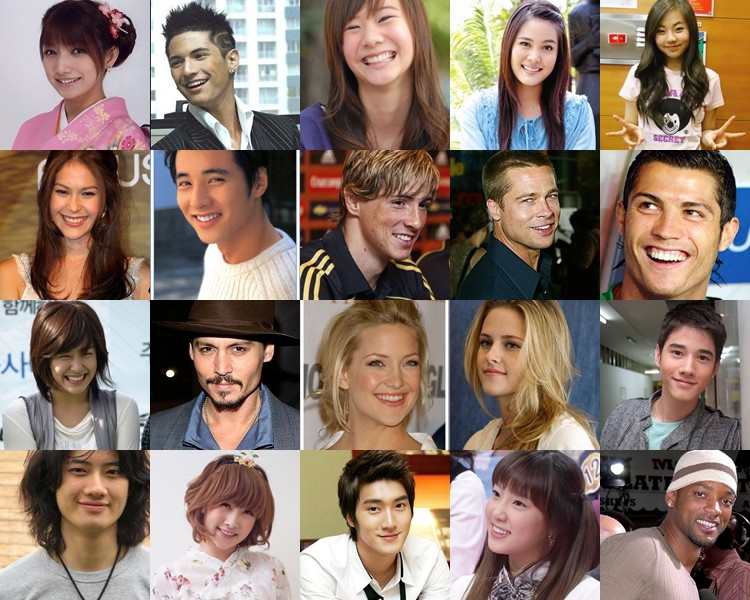
“Frown and you frown alone, but smile and the whole world smiles with you.”
You can smile with the parting of your lips & showing the whiteness of your teeth or a glint in the eyes.
You look beautiful when you smile . . . your heart gets a lift, your emotion glows, your blues get swept aside
and people will find you such a delight.
It seems that nothing is more powerful to elevate a mood than the impact of a genuine smile. The benefits are mutual. Yes, the old quotation may be true. “A smile is a little curve that sets a lot of things straight.” Here are some of the many benefits of a smile:
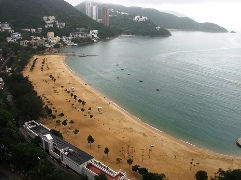
Repulse Bay, wide crescent-shaped beach, popular among locals and tourists alike, is one of the most beautiful beaches in Hong Kong.
Amidst the tranquility of The Repulse Bay, you are only 15 minutes from Hong Kong’s commercial hub, Central.
It is an artificial strip of sand on the south side of Hong Kong Island. Shark nets and floating platforms have been added as public safety for swimmers.
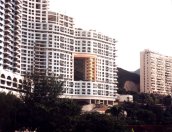
Visitors to the beach would notice the fascinating feature of a tall 37-story residential apartment block specially constructed with a square “hole” or empty space in the midst of it. This may seem to be such a waste of valuable residential space.
This is essential to the needs of a nearby legendary dragon. Legend has it that a dragon lives at the top of the mountain, and a “feng shui” master warned that the building would block the dragon’s access to the shore. Hence, a large hole was cut out of the tower’s centre to mollify the dragon and avoid a whole lot of bad luck.
Hongkees are great believers in “feng shui”. They would go to great length to accommodate the requirements of siting, orientation & the balance of the natural forces of “yin” and “yang” to secure the optimum fortune.
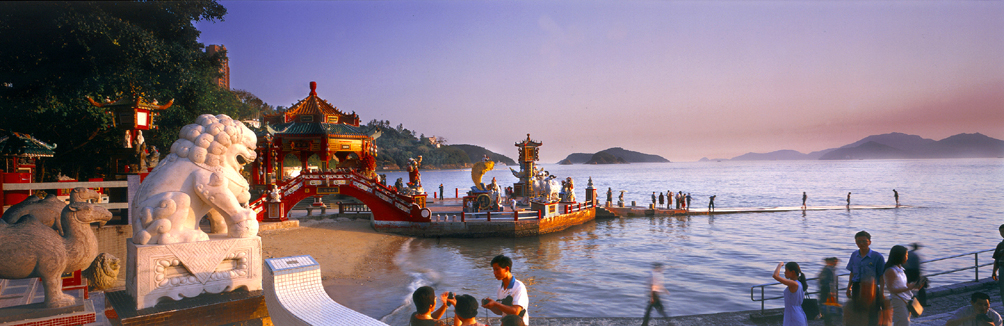
Repulse Bay Beach is also famous for the elaborate statues of Chinese sea goddesses at the Kwun Yam Shrine. Throw a coin into the mouth of the fish statue and receive good fortune; cross the gaudy Longevity Bridge and add three days to your life!
Source: HK Tourism Board: Kwun Yam Shrine
Such are the thrills & frills, apart from the sun, sea and sand . . . an ideal place for relaxation & sunbathing. It’s a delightful & popular place for the family outing though the name may sound “repulsive”. The name is derived from the past to remind the locals of the British army‘s victory over the haunting pirates in the old days.
Repulse Bay is quite a premium residential precinct among the top executives.
Earl Nightingale, once renowned as the Dean of Motivation, referred “attitude” as the “The Strangest Secret”. It’s a secret that spells magic because that one simple word can transform your life.
Before him, Frederick Langbridge (1849-1923), English poet & religious writer, famously expressed it well when he wrote, “Two men look out the same prison bars; one sees mud and the other stars.”
It is our disposition, perspective, viewpoint, or outlook. It is how we view the world. Our life is a reflection of our attitude. Here’s a little story for illustration:
One day, a rich family left on a trip to the country. The father’s sole firm purpose was to show his son how poor people can be. They spent a day & a night in the farm of a very poor family.
When they got back from their trip the father asked his son, “How was the trip?”
“Very good Dad!”
“And what did you learn?”
The son answered, “We have one dog at home. I saw they have four. We have a pool that reaches to the middle of the garden, they have a creek that has no end. We have imported lamps in the garden, they have the stars. Our patio reaches to the front yard, they have a whole horizon.”
When the little boy was finishing, his father was speechless. His son added, “Thanks Dad for showing me how poor we are!”
Now, isn’t it true that it all depends on the way you look at things? If you have love, friends, family, health, good humour and a positive attitude towards life – you’ve got everything!
You can’t buy any of these things, that’s why we say that the best things in life are free. With the right attitude, you can have all the material possessions you can imagine, fulfilling your hope, dreams & aspiration. But if you are poor in spirit, you have nothing!
Chinese are known for their culinary skills, and the dominant presence of Chinese restaurants in foreign lands reflects that. It is generally acceptable that Chinese food is tasty and most palatable. In Perth, for example, on a per capita basis there are more Chinese restaurants than anywhere else I know. Eating out in a Chinese restaurant on a Friday evening is a norm among the Aussies.
Perhaps, when you look at the life style in Hong Kong, where living space is a premium, and where people generally work right round the clock, then you begin to understand why Hongkies choose to eat out. The roaring trade of the restaurants here does not in any way indicate that the economy is down. People are still entertaining out or eating out with their families. Most families generally don’t have the luxury of proper dining room or kitchen facility adequately made for entertainment. Seldom you get an invitation from your Hong Kong friends to dine at their homes. Most meeting and entertainment whether social or otherwise are done outside the home.
Shopping in Ikea the other day provided an interesting experience, particularly in the café section. We were utterly surprised to see a great number of students doing their schoolwork there. Considering that the place, public though it is, probably provide a more conducive environment than the home for their studies. The management gladly permit them to linger on. Rightly and profitably too this crowd does form a sizeable clientele. Another venue popular with students is the many outlets of McDonalds and KFC. The availability of community libraries may be a solution for the students.
People are naturally gregarious and habitually gather together or congregate at “mahjong” tables or in the morning favour Dim Sim Houses for “Yum Cha”. Having lived for some twenty-six years in Perth where “Yum Cha” has taken on even with the Aussies, the atmosphere of such Dim Sim places is utterly different. Forget about the limit of noise pollution. In there all rules are broken. Don’t be annoyed that you can’t even hear your own self. Back in 1972 on our first visit to Hong Kong, we noticed that people literally had to queue by your table, waiting to pounce upon your vacating it. Today this may not be so, but people still queue outside with allotted numbers.
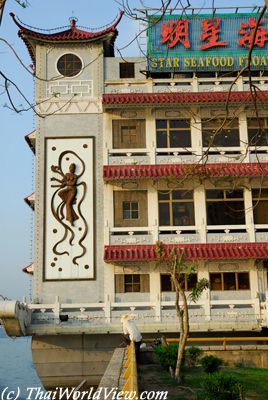
Seafood Restaurant Serving Fresh Seafood
Our son and daughter-in-law took us to a rooftop restaurant in City One, Shatin, where full-suit attired male waiters serve on their diners. We had expected a quieter atmosphere, but not so even with all its grandeur. I guess Hongkies are generally loud people. Hong Kong must be the noisiest city in the world. Perhaps, if the floor is carpeted and the walls soundproof . . . but then the authenticity will be altered. All would seem so alien. The busy pressure of serving, the noise generated by the diners, and the impatient diners all contribute towards the “fun and joy” of dining out in Hong Kong. I guess this is one experience quite unlike anywhere in the world. But generally the food is good and the price . . . well, it depends where you dine or what you compare with.
For all its shortfalls, Hong Kong cooks are about the best there is in all China and possibly in the world. Whatever the outcome, people will continue to eat out! I guess this is one of the simple pleasures in life. With the famed roast goose and such seafood paradise as Lei Yue Mun and Sok Kwu Wan, sometimes I wonder whether we eat to live or live to eat!
My article was initially written in 2001. This little island paradise
has one aspect of tourists’ delight that foreign visitors to Hong Kong know
little about – sort of a well kept secret.
Hometown Boy - Chow Yun-Fatt & Granitz
Being of Chinese descent, and though an Australian citizen by consent or choice, you can’t help feeling proud that for the first time among the glitter of stars at the Hollywood Academy Award 2001 ceremony were Chow Yun-fatt, Michelle Yeoh Choo Keng, Zhang Zi Yi and of course director Ang Lee of the famed “Crouching Tiger & Hidden Dragon”. It looks like China is finally awakening and ready to pounce on the world scene with its staging of the 2008 Olympics in Beijing and its recent entry into World Trade Organization after long and tedious negotiations.
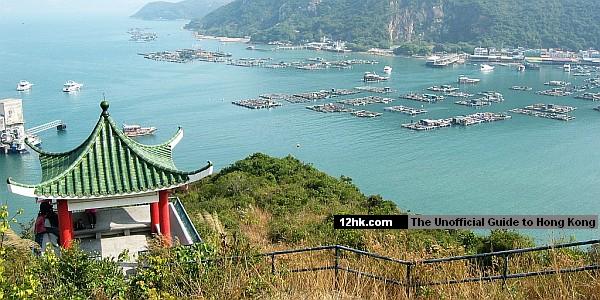
A pavilion on Lamma Island – hikers’ resting place & look-out point
Chow Yun-fatt, in the footsteps of Jacky Chan, is also the star of “Anna & The King ” and who would have thought that he was born in a humble and tranquil place like Lamma Island, a half-hour boat ride from the bustling metropolitan Hong Kong. Through the assistance of a young lady by the name of Claudia whom I met at the North Lamma Island Library we located the house which Chow Yun-fatt stays each time he returns from Hollywood. Accordingly, he is most friendly with a ready smile for everyone, ever ready to oblige with his autographs. The true human nature of a person is never ever to forget his roots.
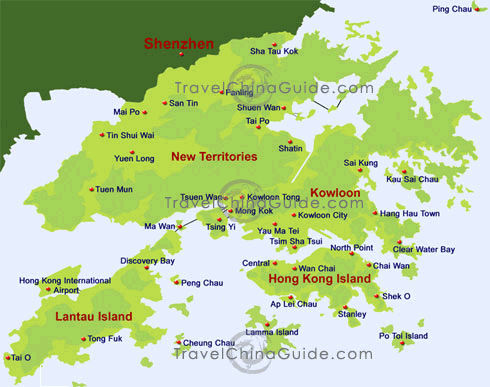
With the interest of the knowledge of the famous Chinese star’s association with Lamma Island, I spent a week exploring this place not too far from the maddening crowd of Hong Kong. Lamma Island is the second largest of Hong Kong’s 232 islands. It is an island with a conglomeration of villages. The one that Yun-fatt calls home is Wang Long Village. The house is newly built, three storeys tall, and I was told two floors are rented to some Japanese working at the Lamma Island Power Station. Most of the villages, like Tai Yuen Village, Sha Po New Village and Wang Long Village sort of merge into one another, mainly three-storied, sitting on the valleys and rising from the slopes of surrounding hills. Yung She Wan is the main town centre with a galore of shops, many of them opening well past eleven at night. Other villages, nearly 20 of them, such as Tai Ping Village, Yung Shue Long New/Old Village, Po Wah Yuen, Pak Kok, Tai Wan To Village, Sok Kwu Wan and others are all linked by cemented Family Trials. The houses all present an air of affluence. There is no motor traffic on the island except the small tractor-type of vehicle, similar to those I found in China, used for multi-purposes like land ploughing, load and people transportation in the rural areas. In China where bicycle is fast fading from the streets, especially in Beijing, mountain bikes here provide a useful means of individual transportation and rambling up and down the hilly scenery.. It’s a walking paradise under the canopy of trees and greenery. For the more ambitious hikers, there are many more unpaved and challenging trials.
Ferry Jetty - Bicycles Galore (Park & Ride)
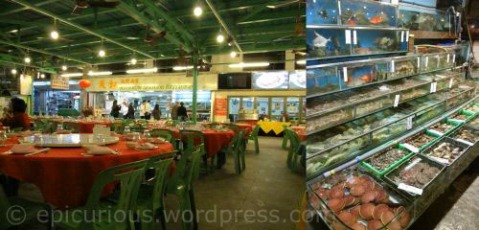
Lamma Island is far from being rural. It’s well built-up and everywhere you turned there are people around. Ever so frequently teams of holidaymakers stream onto the jetty, making their way to such picnic spots like Hung Shing Yeh Beach with its barbeque facilities, shark safety net on the fringe of the bay, and lifeguards on two watchtowers. Some come just to sample its famous seafood restaurants, lining the Yung Shue Wan Main Street with their display of live-seafood of a good variety of fish, crabs, prawns, shrimps, scallops, oysters and other shell varieties. The best seafood restaurants are found in Sok Kwu Wan, particularly Rainbow Seafood Restaurant and Winstar Seafood Restaurant which offer free ferry services to and from Queen’s Pier and Sok Kwu wan or between Repulse bay and Sok Kwu Wan. Like Lei Yue Mun, the seafood speciality place in Hong Kong, this is the seafood paradise on the Island.
Seafood Restaurant
The roads made largely for human traffic and small vehicles are cement paved with the narrower ones known as Family Trials. A network of such trials with proper signage covers virtually every part of the island. It’s a pity that the Islands District Office has not established the many lookout points in Northern Lamma for visitors to enjoy breath-taking views. Perhaps following the norm of international signage, brown signs could be displayed pointing to spots of tourists’ interest. On the trial to Sok Kwu Wan, which leisurely takes about one and a half hours, there are pavilions for resting and serve as points for lookout.
Un-spoilt Beach
The streets are clean and rubbish bins are well positioned and provided. There is a post office, banking facility (HSBC), hotel (Man Lai Wah Hotel), police station and several police report centres, fire station which also houses an ambulance vehicle and primary school. Generally, Chinese are most assiduous in their economic pursuit. Everybody is busy and doing something. Empty lands are covered with vegetable gardening. There is a sizeable portion of European population living on the Island and who made the crowd that frequent the bars at night. Lamma Island can boast of having clean public toilets. Martin Yan, internationally well-known chef, chose Lamma Island as the backdrop of his culinary program.
It may be of interest to folks with rural experience to live in a place like Lamma Island. For the city folks, they might need getting used to be wakened by nature’s alarm clock – the not so familiar cockcrow. Cocks turn on their early musical repertoire as early as 4 am and unceasingly follow it through till the break of dawn. To me this is pleasant compared to the noise pollution of Hong Kong, not just in the streets, the ever-crowded shopping centres or eating in the restaurants. Hong Kong people are so loud! I find the lifts being the only places where people are quiet – not a word is exchanged. Exchanging greeting in the streets is a rare phenomenon. Don’t expect it to be reciprocated! Friendliness is so vital, and the display of hospitality will go a long way to establishing a place like Lamma Island as a top tourist spot. . . . a retreat from the hustle and bustle of hectic living in Hong Kong . . . or just a quiet place to visit and enjoy.
Talking of Chow Yun-fatt having his annual retreat in Lamma Island, what of Michelle Yeoh’s. I well remember her as a young girl living adjacent to Ipoh Swimming Club, Malaysia, playing squash with a group of us. She first came into public eyes as a teenage Queen in our Ipoh Lions Club Motor Show in the 1970s. Hailed as a former Miss Malaysia, she has made it in the glitter world of the big screen. I wonder if she still retains that sweet and friendly nature of her young days. People do change due to circumstances and success and stardom may mean non-association with the past.
Stature Square in Central is an ideal rendezvous for Filipino maids on Sundays when they have their day off.
Filipino Maids at HSBC
On any typical Sunday in Hong Kong, don’t expect to get a seat at the popular McDonald’s in Pacific Place. The whole place is swarmed with Filipino maids, just like they congregate in Central, also at the waterfront in Tsim Sha Tsui, Wan Chai area and most of the popular public places. Whenever you go to Hong Kong, try to visit Statue Square . . . it also serves as a place where hundreds of Filipino maids flock there to meet, to chat or to sing. They are everywhere. Never has such gathering been more evident elsewhere in Malaysia, Singapore or Taiwan – that’s because in Hong Kong, the maids work busily through the week and Sunday is their day of rest. On such a day, they go to church, socialize with their friends, lunch and dine out, do their personal shopping and attending to personal affairs, and then gathering together in groups chatting, singing or simply lazing around. Some of the large churches are largely frequented by them.
In Hong Kong, more than any other cities in Asia, this social phenomenon is to be seen to believe. These Filipino maids are a great export from developing Philippines. Their monetary remittances are much needed at home where unemployment or poverty necessitates the separation or sacrifice of the maids from their loved ones. In Hong Kong, they earn a good salary which contributes towards a better life at home. Most Filipino maids flock to Hong Kong because of the comparatively high pay and working condition.
Be not surprised that many a Filipino maid is college or university educated. Elsie (not real name) for instance is a qualified nurse with four college years of training and has been away from her family for 6 years now. Even as a nurse she won’t earn as much in the Philippines as working as a domestic help in Hong Kong. It pays for her to be away from her house husband and three children. She speaks and writes good English. In Hong Kong where Cantonese is the dominant dialect, she gets sparsely by with few essential words when doing her day’s shopping. With the family she works for, her English is an asset.
She would be the first to rouse preparing breakfast, getting ready the kid(s) for kindergarten or school to be followed by her daily routine of general housekeeping, shopping for the day’s meals and preparing them. A typical family she works for would be a young couple, both professionals, whose day begins at about 7.30 am and ends at about 8.00 pm or even later by the time they get home. She is virtually in charge of the household in the absence of her employers with multiple duties and responsibilities – a cook, babysitter, and general household chores.
Her life is not entirely just that. Every now and again, particularly whenever her employers are off work or on holidays, she gets to be part of the family’s activities. She does benefit from the family’s outings to restaurants for “dim sum” or lunch/dinner and even on trips to Macau and other places of interest. For instance, Elsie is looking forth to going into China again with the family during the coming Christmas break. The pay is good and the variety of activities do compensate for her absence away from home. It was her birthday a few days before Christmas. Dinner with the family was followed by the cake at home with photo shots and video clips which she could forward and maintain contact with her own family.
With the growing affluence of the Asian families and where the extended family assistance is no longer available, such domestic service would be irreplaceable. Through a recruiting agency Elsie like other Filipino maids found her employers. Each contract is for a two-year basis. The initial first contact she would benefit for a two-year work permit and subsequently, she would need to leave Hong Kong after one year to get re-entry immigration extension of the other year.
In Hong Kong where space is a luxury and certainly pricy, she is fortunate, as some do, to have privacy in a room of her own with adequate storage facility and a small attached toilet. In some families, two maids are employed instead of one, each with specific duties. There’s a couple I know with three maids, but they have five children and are both business professionals. They have one maid just to drive the kids to school and back. One to cook and the third for general cleaning all three floors of their condominium apartment – combined, designed and refurbished into one luxurious apartment. They have even an additional driver specially for the gynaecologist husband. Once a year the maids’ highlight is getting the privilege to accompany the family on their overseas holidays and cruises. The affluence of the Hongkees does stretch on a great economic scale of needs. One would be a largely absentee employer because of her constant travel or another would be a single mother.
From time to time, we do hear of horror stories reported in the media relating to these maids of fighting, stabbing their employers and even murder. One particular horror story that I know was of a young and pretty maid infecting two equally young masters of the house with HIV through illicit sex. These stories however are far and few in between their tremendously needed household performance. Oftentimes, I notice there’s a clear good relationship between the maids and their employers .Extension of contract is often the norm with the same employer.
At the end of the day, all that is said and done, we each find the niche in the society we live in according to our skills and standings. If you like crowd and the hustle and bustle of life, Hong Kong has plenty of. On ordinary days, the shopping streets like Nathan Road or Mongkok area see crowd of people edging their way around. On Sundays Filipino maids have their preferred locations of congregation. If you’re getting home late by buses or MTR, be prepared to be hemmed in with them. Tagalog sounds pretty musical and clear above the drowning Cantonese dialect for once. Their day’s R & R being over, the crowd gradually all disperse like homing pigeons only to rise again happily for that busy day & week ahead.
Dentists Galore . . . Services Deplore (By Paul Chong)
Kalamunda is a delightful place up in Perth Hills reflecting its glorious days when it used to be a weekend retreat for folks down in the City. Needless to say, you’ll find a greater number of retirees living up here with every conceivable human conveniences. There are banks, shops, shopping centres, post office, restaurants, bar lounges, lawyers, doctors & of course dentists – all in close proximity & within walking distances.
Dentists are found in every nook & corner whether it’s in Kalamunda, Lesmurdie or Gooseberry Hills. Like the medical doctors, they’re expected to perform a worthwhile dental service in true professionalism. With their numerical spread, one would expect the convenience & choice of excellent dental service.
To begin with, we as patients are much to be blamed when it comes to dental care. Though an essential part of health, we invariably neglect this area of care, especially when it means visiting a dentist. The very thought of the dentist’s drill sends chill down my spine. For that alone, we tend to postpone our dental appointment and seldom maintain our regular visits (at least speaking for myself).
As though it’s not painful enough, more pain is being extracted out of our pockets & wallets. This is because dental service is unregulated and charges & costs can hit the roof without any control. Unlike consulting your personal physician, you can be sure you’ll never be ripped off. But with the dentist, it’s said they make more money than the medical doctors!
The shocking thing is that in Kalamunda Shire where I have chosen to live for the last twenty odd years, dentists galore . . . but service deplore! Our Government has a scheme in place called EPC (Enhanced Patient Care) for diabetic patients, where dental charges are reimbursed by Medicare. The nursing sister at Stirk Medical Group told me that she wrote to all the dentists seeking their services under the scheme without getting as much as an acknowledgment. But why would they want to come under the scheme with restrictive charges? I have personally sought out some of them myself but to no avail with the exception of one pretty dentist, whose gentle hands & soothing voice release your tightening grip on the dentist’s chair.
Are dentists trained just to make money? With due respect & without prejudice, lots of the dentists are brilliant & bright, but I guess their lights shine along more on the financial path than on the path of care & service to the community at large. Diabetic patients requiring dental care are ever increasing but will be facing increasing deplorable dental service. Really a pathetic state of affair.
There is however one dental practice in Kalamunda, Jan Yeo Dental Surgery, that deserves every praise for the services rendered. Staffed by two very proficient dentists I(both ladies), it’s also staffed by a well qualified dental therapist (complete with a Bachelor of Oral Health), whose gentlest of hands render you a scaling & cleaning service virtually free from pain or uneasiness.
Dental care begins with oral health and here you have it at no. 1 Kalamunda Road, Kalamunda.





 HK Sunset Cruise By Chinese Junk
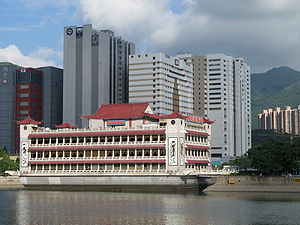
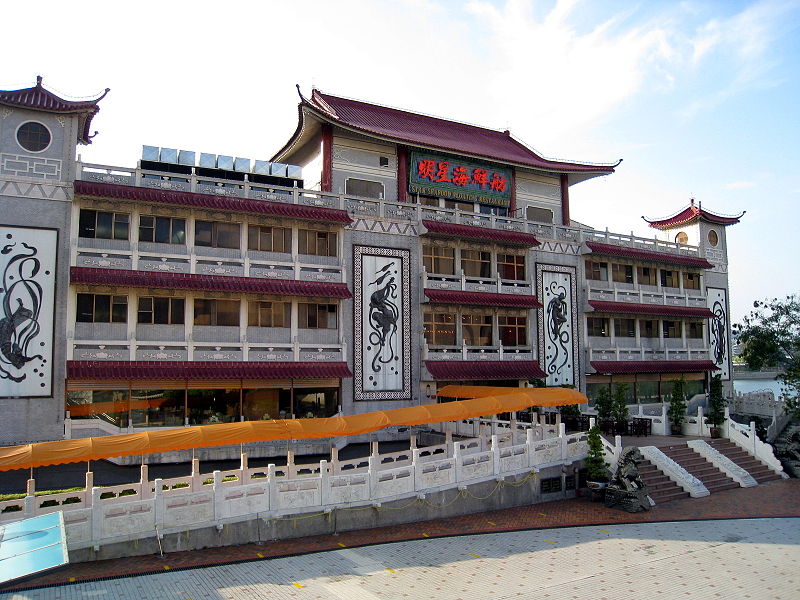














 Jumbo – Famous Floating Seafood Restaurant
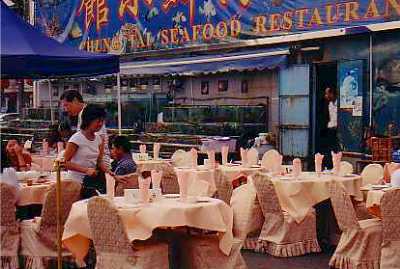 Seafood Restaurant Serving Fresh Seafood

 A pavilion on




 Paul Chong's Blog