A workplace generally for some can be a pressure house & in another extreme you’ll find employees relaxing by drinking coffee or having unnecessary breaks.
To find a work environment that is stimulating, creative,innovative, fun & conducive that will ensure & encourage maximum productive work
from the employees will be hard to come by . . . but NOT with Google Headquarters!
A workplace that is “feng sui” fabulous . . . a high tech company that is virtually a desired home or city . . .
Ever think sometimes you work in the wrong place???!!!
Knowledge is limiting but creativeness & imagination are unlimited.
Moving around: A slide allows quick access from different floors …
There are also poles available … they are similar to the ones used in fire stations.
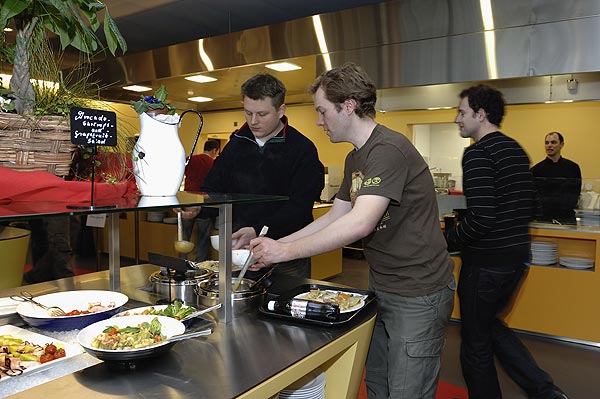
Food. Employees can eat all they want from a vast choice of food and drink.
Work Station: Each employee has at least two large screens. There are 4-6 ‘Zooglers’ per office.
INNOVATION: Large boards are available just about everywhere because ‘ideas don’t always come when seated in the office’ says one of Googles managers.
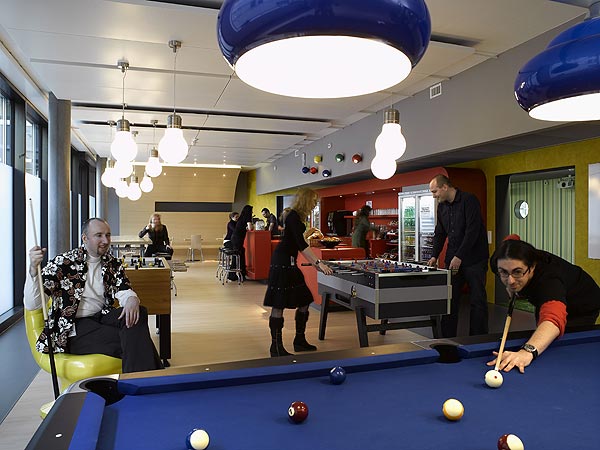
LEISURE. Pool tables, video games etc. are available in many areas.
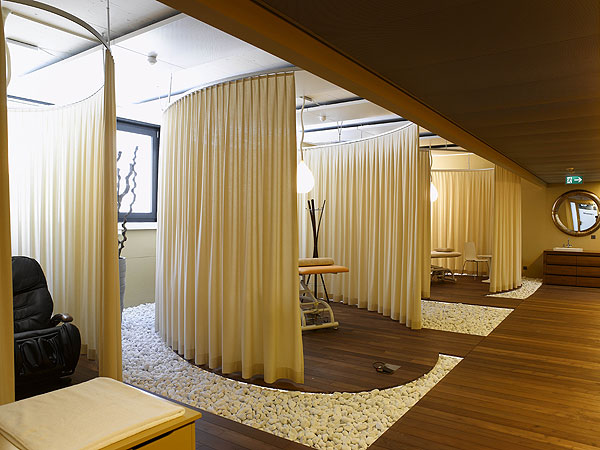
Communication… On each floor, there are private cabin areas where employees can attend to personal affairs.
Technical Support: Problem with your computer ? No problem …Bring it to this area where drinks are available while it is being fixed …
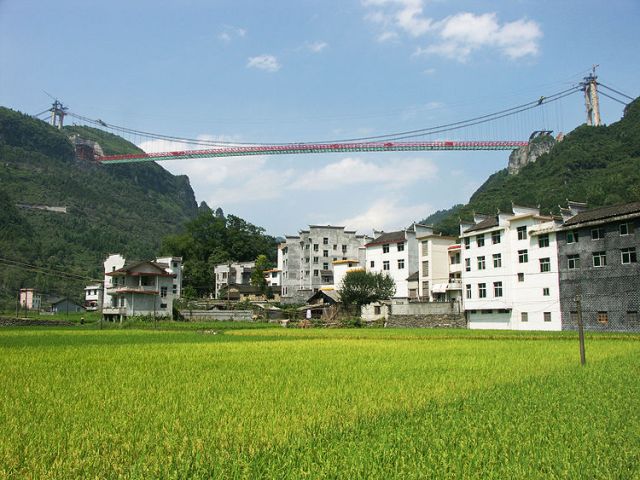
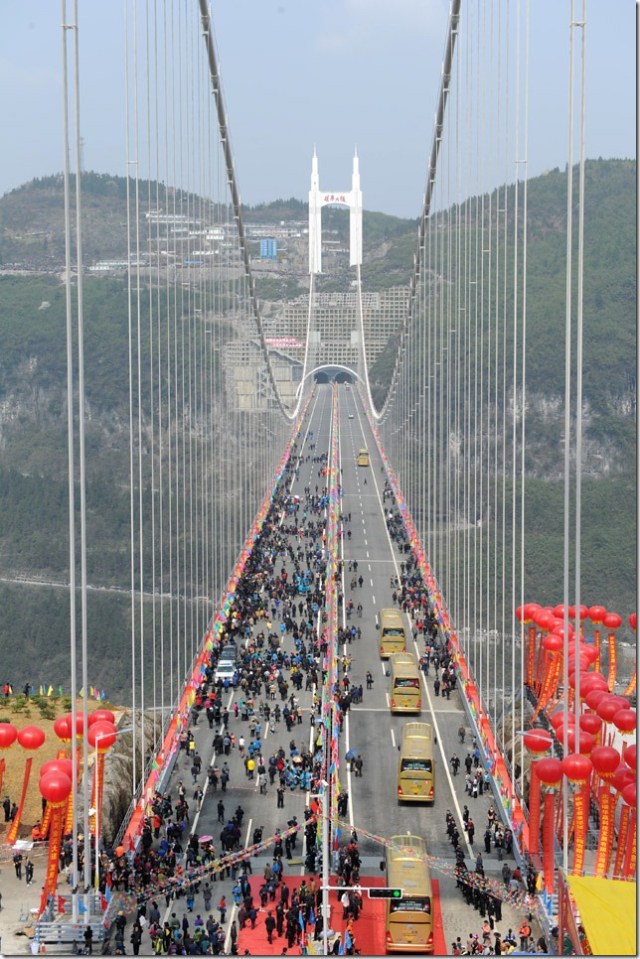
With a main span of 1,146 metres (3,760 ft) and a deck height of 350 metres (1,150 ft), it is the sixth-highest bridge in the world and the world’s twelfth-longest suspension bridge. Of the world’s 400 or so highest bridges, none has a main span as long as Aizhai. It is also the world’s highest and longest tunnel-to-tunnel bridge. The bridge contains 1888 lights to increase visibility at night. (Wikipedia)
Construction took five years. Work finished at the end of last year, making it among the world’s longest and highest suspension bridge, carrying traffic 355 metres above the foot of Dehang Canyon. Construction of the bridge started in October 2007 and its main sections were completed at the end of last year. It is designed to help ease traffic in the mountainous region, where queues are common due to the narrow, steep and winding roads.
A brave worker put the final touches on the Anzhaite Bridge.
The bridge, which connects to two tunnels, was built to ease traffic. Drivers can take in the views of the Dehang Canyon People and traffic during the opening ceremony.
Vehicles motor along a two-way, four-lane motorway. Pedestrians walk along it on a special walkway under the road.
Aizhai is the fourth suspension bridge in China to cross a valley so wide that it seems to be connecting two mountain ranges. The first three were the Siduhe, Balinghe and Beipanjiang 2009 bridges. Located deep in the heart of China’s Hunan Province near the city of Jishou, the suspension bridge is the largest structure on the Jishou to Chadong expressway with a deck 1,102 feet (336 mtrs) above the DeHang Canyon.
The two tunnels on either side of the Aizhai Bridge allowed the engineers to use the mountain top for the location of one of the towers, reducing its height to just 165 feet (50 m) – unusually short for a bridge with a span nearly as long as the Golden Gate bridge at 3,858 feet (1176 m). In addition to cost savings, the stubby support also allows the bridge to blend more naturally into its surroundings. The taller bridge tower is no less unique with side span cables that soar down the backside of a mountain, making first time visitors quizzical as to what exactly lies ahead.
With most of the structure hidden from view, the bridge will come as a jaw-dropping surprise whether you enter the canyon from either tunnel. Due to a gap of approximately 328 feet (100 m) between the last truss suspenders and the tops of the bridge towers, the engineers added some additional ground anchored suspenders to stabilize the two massive suspension cables and reduce any oscillations that could damage other components of the bridge. An overlook and visitors center will offer additional views of the broad valley.
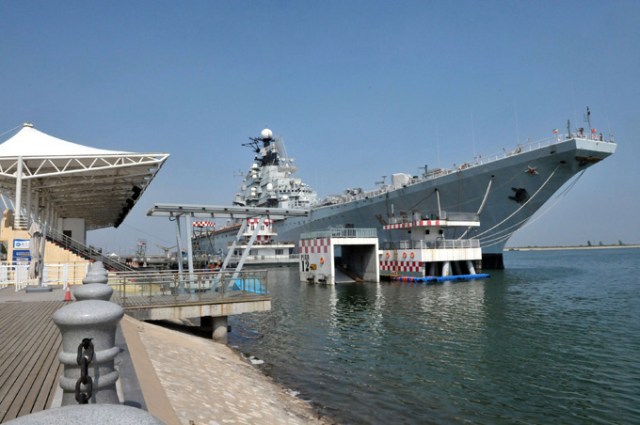
The Kiev, a 1,000 foot vessel, once the pride of the flagship of the mighty Soviet navy’s Pacific fleet (first began December 1972), serving them well for almost twenty years, as well as being able to hold more than a thousand crewmen, she could be loaded with dozens of missiles – some nuclear-tipped.
But now the Kiev is leading a much more sedate & humble life . . . available for business retreats, intimate getaways or simple relaxation (without actually getting away). That’s because the Chinese have bought the aircraft carrier and transformed her into a floating luxury hotel, the world’s first luxury aircraft carrier hotel, costing $15 Million.
It’s strange to think that a ship that was once a weapon of war is now a place of relaxation and fine dining.
The Kiev will stay permanently docked at theTianjin Binhai Aircraft Carrier Theme Park. Much as a Soviet-era sailor might resent the indignity, Kiev won’t go back out to sea. She’ll entertain guests and clients at anchor, a bizarre museum to a different country’s naval power. Guests will relax with Western-style cuisinein ornate luxury suites, dreaming of Chinese seapower.
Sold to Tianjin International Recreation Port in 2000, the Kiev has been refitted, furbished & transformed into a world-class floating hotel with 148 room – including two presidential suites, three VIP guest rooms and 137 standard rooms. Since it was purchased over a decade ago, the Kiev has also been upgraded with a luxury restaurant – something the original crew would have no doubt killed for.
Long after Shanghai’s 2010 World Expo has gone, the China Pavilion still stands magnificently. This striking immense red structure is the first building you’ll see upon entering the Expo Park & the last one upon leaving.
It’s certainly reflecting the theme: Better City, Better Life.
Timelapse and video shot on Canon 7d and GoPro Hero HD for SeeChina.org.cn and Danwei.tv by Janek Zdarski
“The main structure of the China Pavilion, “The Crown of the East,” has a distinctive roof, made of traditional dougong or brackets, which date back more than 2,000 years. The dougong style features wooden brackets fixed layer upon layer between the top of a column and a crossbeam. This unique structural component of interlocking wooden brackets is one of the most important elements in traditional Chinese architecture. Dougong was widely used in the Spring and Autumn Period (770 BC-467 BC).”
The contour design of the pavilion is based on the concept of “Oriental Crown, Splendid China, Ample Barn, and Rich People,” to express the spirit and disposition of Chinese culture. The pavilion has a core exhibition area on the top floor, an experience area on the second and a functional area on the first. China’s achievements in urban development from ancient to modern times are shown as the core theme of the pavilion.
The China Pavilion sits right next to the Expo Boulevard and the Sun Valleys, which act as the center of the Expo. (Slideshow Below)
This slideshow requires JavaScript.
Painted the same red as the Forbidden City, the China Pavilion consists of four pillars with 6 floors expanding out and up. The 30 meter high roof is constructed from 56 wooden brackets (dougong), which represent the 56 minority ethnic groups of China. Additionally, nine folded scripts engraved on the surface of the building list the short names of China’s provinces.
Designed by He Jingtang, the director of the Architectural Academy of the South China University of Technology, “the Pavilion includes many energy saving technologies. The exterior of the structure offers a temperature buffer zone and natural ventilation for the interior, and the inverted shape of the pavilion acts as shading for entire building as well as the courtyard below. The roof of the structure includes eco-friendly landscaping and harvests rainwater.”
The China Pavilion, also known as the Oriental Crown, represents the spirit of the people of China and is one of the 5 permanent green buildings on the Expo Park converted into a national history museum.
Video hosted by Nancy Merrill below showing the background to its construction:
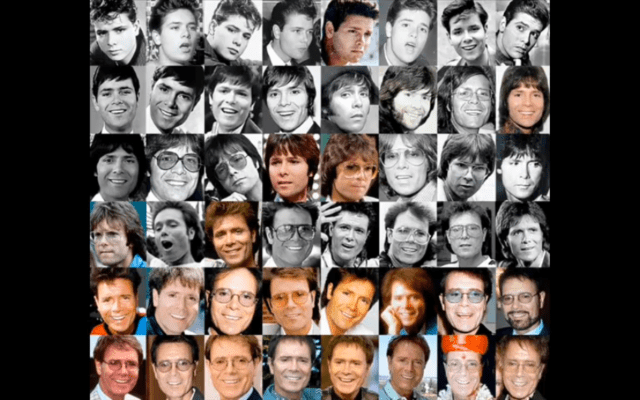
Cliff Richard was knighted on 25 October 1995, the first rock star to be so honoured.
My wife Lilian even today still remembers Cliff Richard as a 16year-old lad hitting the lamplights with such hits as Living Doll, Travelling Light, Summer Holiday, Starry Eyes & others. We were then in college in England. We enjoyed his singing then as we still enjoy his evergreen songs.
This slideshow requires JavaScript.
Watch Slideshow
Sir Cliff Richard, OBE (born Harry Rodger Webb; 14 October 1940) is a British pop singer, musician, performer, actor, and philanthropist. John Lennon once claimed that “before Cliff and the Shadows, there had been nothing worth listening to in British music.” A conversion to Christianity and subsequent softening of his music later led to a more middle of the road pop image, sometimes venturing into gospel music, as opposed to his early days (pre-Beatles period) as a rebel rock and roll singer.
For over 50 years, Richard has dominated the British entertainment world, amassing many gold and platinum discs and awards, including three Brit awards and two Ivor Novello awards. Richard is the biggest selling singles artist of all time in the UK, with total sales of over 21million and has reportedly sold an estimated 250 million records worldwide.
Richard has never achieved the same impact in the United States nor Canada despite his immense popularity. He had been in the top 40 in the 1950s, 1960s, and 1970s.
He has remained a popular music, film, and television personality in Australia, New Zealand, South Africa, Northern Europe and Asia, and retains a following in other countries. (Wikipedia)
Sir Cliff, a poster boy for the Christian faith, defends his decision to remain a “Bachelor Boy.” In his book, titled ‘My Life, My Way’, he writes:”People often make the mistake of thinking that only marriage equals happiness.” He denies he is gay.
He had a close relationship with Sue Barker in 1982 and was even rumoured to be romantically linked with Olivia Newton John, with whom he sang many a duet. According to a reliable source, for the first time recently he talks about his close relationship with a former Roman Catholic priest, and calls on the Church of England to approve same-sex marriages. He and Fr McElynn now live together.
On this question of his personal life, which is rampantly asked in the British media, Steve Turner, who wrote a biography of Sir Cliff in 1993, said: “Of all the people I’ve interviewed, from David Bowie to the Beatles, he’s the one most people ask me about. With Cliff, there’s always that element of uncertainty and puzzlement, because there’s something unresolved about his image.”
When I was young I was greatly influenced by such singers as Pat Boone, Elvis Presley, Cliff Richard, Perry Como, Dean Martin & some others including operatic tenors like Enrico Caruso, Beniamino Gigli & Mario Lanza. To some extent, my enthusiasm must have rubbed onto my youngest brother Mike.
He shares much the same taste in music & songs as I & even exhibits talents in piano & guitar playing, something which I never seem to acquire.
I used to collect stacks of LP records of Pat Boone including those smaller ones of 45 rpm. Except for the latter, which seem to disappear into thin air (for none of my siblings has any knowledge of them), Mike has inherited most of my old Pat Boone LPs. They do sound rather scratchy when played on the traditional gramophone player.
Fortunately, thanks to YouTube, it’s possible to hear them all again in all their magnificence! Herein below is a top sound track of Pat Boone:
Play Video – A Series of Pat Boone’s Top Sound Track
Born Charles Eugene Boone (June 1, 1934) in Jacksonville, Florida, Boone was reared primarily in Nashville, Tennessee, a place he still visits. “Pat” is an American singer, actor and writer. He was a successful pop singer in the United States during the 1950s and early 1960s. He sold over 45 million albums, had 38 Top 40 hits and appeared in more than 12 Hollywood movies. Boone’s talent as a singer and actor, combined with his old-fashioned values, contributed to his popularity in the early rock and roll era.
According to Billboard, Boone was the second biggest charting artist of the late 1950s, behind only Elvis Presley but ahead of Ricky Nelson and The Platters, and was ranked at No. 9—behind The Rolling Stones and Paul McCartney but ahead of artists such as Aretha Franklin and The Beach Boys—in its listing of the Top 100 Top 40 Artists 1955–1995. Boone still holds the Billboard record for spending 220 consecutive weeks on the charts with one or more songs each week.
At the age of twenty-three, he began hosting a half-hour ABCvariety television series, The Pat Boone Chevy Showroom, which aired for 115 episodes (1957–1960). Many musical performers, including Edie Adams, Andy Williams, Pearl Bailey and Johnny Mathis made appearances on the show. His cover versions of rhythm and blues hits had a noticeable effect on the development of the broad popularity of rock and roll. During his tours in the 1950s, Elvis Presley was one of his opening acts.
As a prolific author, Boone had a No. 1 bestseller in the 1950s (Twixt Twelve and Twenty, Prentice-Hall). In the 1960s, he focused on gospel music and is a member of the Gospel Music Hall of Fame. He continues to perform, and speak as a motivational speaker, a television personality, and a conservative political commentator. (Wikipedia)
Pat Boone’s Pictures Through The Years: (Slide Show)
As opposed to all Western negative reports, Chinese women are changing China and the world.
From the social-economic front to the war front, we find women in China playing a significant role.
Confucian patriarchal hierarchy has been an impediment to women’s leadership in China, but not since Mao Zedong said that ”Women hold up half the sky”. . . a view of women as a resource that ought to be deployed outside the home – fueled the rise of many women in professional fields,” said A Report on Women’s Leadership in Asia, entitled “Rising to the Top?”
As a result, Chinese women, who make up 49 percent of the population and 46 percent of the labor force, have achieved a higher proportion in the top layers of management than women in many Western countries, said the report which mostly analyzed data on gender equality and women’s leadership in the region. ”In China, gender equality embedded in communist ideology has mitigated the impact of Confucian patriarchy,” it said.
The findings of the report may be summed up:
In East Asia, “China leads in terms of women in senior management.”
Some 29 million, a quarter of the national total of China’s entrepreneurs, are female.
The highest percentages of women employed in Asia are also in China.
Half of the 14 billionaires on Forbes magazine’s 2011 list of the world’s richest self-made women are from mainland China. Many of them are property magnates; the others focus on retail and consumer goods.
“The pathway for female entrepreneurs tends to lead from excellent universities to high posts at large, state-owned enterprises, allowing women to build up business acumen, managerial skills, and networks that later enable them to raise capital for their new enterprises.”
Women in Asia are closing the gap with males in health, education, and employment, but are severely under-represented at top leadership levels, paid less than men, and disadvantaged by cultural and social norms.
Since 1949 China has promised women’s equality. “Women hold up half the sky,” Mao said. His revolution turned society and family upside down: It abolished family property, and replaced family-jobs patronage with a state bureaucracy. Mao put a final, nationwide end to the centuries-old practice of “foot binding.” For a time, communism was a girl’s best friend.
China’s 1950 marriage laws, for example, made men and women, at least theoretically, equal. They banned bride sales and concubines, and legalized divorce. For centuries men were allowed three or four wives, and women had no rights. It was a feudal world with brutally stark winners and losers. The film “Raise the Red Lantern,” with its bitter, subtle infighting among concubines vying for the attentions of a patriarch, captures something of those family dynamics.
According to Martin Whyte of Harvard University, “Changes in the Chinese family were imposed quickly and radically, In most societies these changes would take generations. In Mao’s China they were compressed into a time frame, really, of two or three years. Changes [involving women] are probably more important than the Great Leap Forward or the Cultural Revolution. By 1960, China had a ‘modern society’ in cities.”
Ironically, China is a developed country inside a developing country. Progress for women is found in cosmopolitan centers where law and culture are emphasized. Shanghai has always been a mecca for females. The mid-20th-century novels of Eileen Chang set in Shanghai that illustrate an independent voice for women are now extremely popular among college students.
In the metropolis, the family is undergoing a “permanent revolution.” The phrase is actually Mao’s. Courtship and choice between young people is more open – made possible by new wealth – new attitudes, and cellphones, and it is giving rise to new family types, the diminishing of patriarchy, and an often more confident and assertive female.
China’s patriarchy is a feudal holdover, scholars say, where land equals power. Male children inherited land. In an urban culture, where mobility is valued, and land is not an issue, female talents are more emphasized.
Changes of the nature as described above breed a different set of social problems, which can only be judged by time alone.
Recent Related Articles by Paul:
1. China’s First Lady-in-Waiting (Sun. 22 April 2012)
2. Fu Ying: “The West Has Become Very Conceited” (Tuers. 24 April 2012)
Harry S. Truman (May 8, 1884 – December 26, 1972) was the 33rd President of the United States (1945–1953). As President Franklin D. Roosevelt‘s third vice president and the 34thVice President of the United States (1945), he succeeded to the presidency on April 12, 1945, when President Roosevelt died less than three months after beginning his unprecedented fourth term.
Known by his popularized phrases as “The buck stops here” and “If you can’t stand the heat, you better get out of the kitchen”, his approval ratings in the polls started out very high, then steadily sank until he was one of the most unpopular men to leave the White House. Popular and scholarly assessments of his presidency eventually became more positive after his retirement from politics.(Wikipedia)
But what do we really know of a politician such as he? Little is known of Harry Truman. Believe me they don’t make politicians like him anymore & we certainly could do with a few like him in our parliament.
The “Bushy’ & “Blaring” type of politicians should never be allowed to take centre stage on world affairs ever again!
Harry Truman was a different kind of President. He probably made as many, or more important decisions regarding our nation’s history as any of the other 42 Presidents preceding him. However, a measure of his greatness may rest on what he did after he left the White House.The only asset he had when he died was the house he lived in, which was in Independence Missouri. His wife had inherited the house from her mother and father and other than their years in the White House, they lived their entire lives there.
When he retired from office in 1952 his income was a U.S. Army pension reported to have been $13,507.72 a year. Congress, noting that he was paying for his stamps and personally licking them, granted him an ‘allowance’ and, later, a retroactive pension of $25,000 per year.After President Eisenhower was inaugurated, Harry and Bess drove home to Missouri by themselves. There was no Secret Service following them.
When offered corporate positions at large salaries, he declined, stating, “You don’t want me. You want the office of the President, and that doesn’t belong to me. It belongs to the American people and it’s not for sale.”
Even later, on May 6, 1971, when Congress was preparing to award him the Medal of Honor on his 87th birthday, he refused to accept it, writing, “I don’t consider that I have done anything which should be the reason for any award, Congressional or otherwise.”As president he paid for all of his own travel expenses and food.
Modern politicians have found a new level of success in cashing in on the Presidency, resulting in untold wealth. Today, many in Congress also have found a way to become quite wealthy while enjoying the fruits of their offices. Political offices are now for sale (cf. Illinois).
Good old Harry Truman was correct when he observed, “My choices in life were either to be a piano player in a whore house or a politician.” And to tell the truth, there’s hardly any difference!
What a man!
There is, however, his one great controversial legacy in the nuclear bombing destruction of Hiroshima & Nagasaki in August 1945 to end WW2.
Whether you are a veteran fan or just beginning to appreciate Elvis‘ talent and genius, you will enjoy this!
Elvis Presley In Concert is an astounding production that reunites former Elvis band mates live on stage with a state of the art video-projected of Elvis.
The show’s concept is to present as authentic as possible Elvis Presley concert. The producers edited together a collection of Elvis’ finest concert performances that exist on film and video and removed virtually all
sound from the footage except for Elvis’ vocal.
The Elvis footage is projected on a large video screen. On stage a 16-piece orchestra and some of Elvis’ original band mates from the concert era of his career and other cast members perform live with the Elvis video.
All music heard in the concert production is performed live except for Elvis’ voice.
On either side of the Elvis performance screen are screens that carry live action from the stage.
From the first song it’s magic. You’re at a real Elvis concert!























 Paul Chong's Blog