Look at the architecture of the new hall and stadium which is comparable with the best in the world.
Ordos in Inner Mongolia with the second highest GDP after Shanghaihas its wealth through the vast resources of coal exploitation.
The government has built an entire new Ordos City.
All buildings virtually sold but unoccupied – held mainly by investors for investment. In China, nobody ever loses in real estate, at least not on a consistent basis. So they keep on building & investors with cash to spare to spare keep on buying.
Nobody has yet moved into the new City of Ordos, but investors are waiting patiently . . . only a question of time, they believe.
At present, of course there isn’t any existing economic activity, except some 30 Km away in the old city of Ordos.
With characteristic & unique style of architecture, reflecting the Mongolian past traditional life, Ordos City will prove to be a great tourist attraction in the days ahead.
There are also monuments dedicated to the great Genghis Khan, the historical conquerer in the era gone by.
Melissa Chan of Aljajeera in 2009 made this report, which as shown below in YouTube video:
Mongolians traditionally used to live in tents & will need time to get used to modern living.
Slideshow of Images of Futuristic Buildings
This slideshow requires JavaScript.
This is nothing compared to what is projected ahead!
By 2025, China will build TEN New York-sized cities.
The scale and pace of China’s urbanization promises to continue at an unprecedented rate. If current trends hold, China’s urban population will expand from 572 million in 2005 to 926 million in 2025 and hit the one billion mark by 2030. In 20 years,China’s cities will have added 350 million people, more than the entire population of the United States today. By 2025, China will have 219 cities with more than one million inhabitants, compared with 35 in Europe today and 24 cities with more than five million people. Also, 40 billion square meters of floor space will be built – in five million buildings. 50,000 of these buildings could be skyscrapers – the equivalent of ten New York Cities.
So what’s happening in Ordos is rather insignificant when compared with the greater picture of China!
She was the Chinese ambassador to the United Kingdom from March 2007 to 2009. From 2004 to 2007 she was the ambassador to Australia. She led the Chinese Delegation during talks with North Korea that led to the latter country’s decision (later reneged on) to abandon nuclear weapons.[2]
In 2008, she indicated the negative press coverage of the protests towards the 2008 Beijing Olympics could create possible backlash from China towards the west, claiming that the “demonising” approach to the protests harmed the west’s image in the eyes of the Chinese population.
She was cited by The Guardian newspaper to have said: “Many who had romantic views of the west are very disappointed at the media’s attempt to demonise China. We all know that demonisation feeds a counter-reaction”.[3] Currently she is Vice Foreign Minister of PRC.[4]
In February 2010 she was recalled as UK ambassador and replaced by Liu Xiaoming. (Source: Wikipedia)
In another World Policy Forum intervierw: FU Ying on China’s policy
VERY INTERESTING. A WOMAN OF HIGH CALIBRE, INTELLIGENCE AND FULLY CONVERSANT WITH WORLD EVENTS. IT IS SUCH A PLEASURE TO HEAR ANSWERS TO QUESTIONS ASKED JUST OFF THE CUFF. INDEED, GREAT LEADERSHIP IN A WOMAN!
In a SPIEGEL interview, China’s Vice Minister of Foreign Affairs, Fu Ying, 58, accuses Europeans and Americans of perpetuating Cold War . . .
‘The West Has Become Very Conceited’
(As shown by the intelligence & insights of Madame FU Ying, China’s Vice Minister of Foreign Affairs in a SPIEGEL interview)
In a SPIEGEL interview, China’s Vice Minister of Foreign Affairs, Fu Ying, 58, accuses Europeans and Americans of perpetuating Cold War stereotypes of her country, rejects allegations surrounding the treatment of artist Ai Weiwei and disputes notions that Beijing would like to rule the world.
SPIEGEL: Madame Fu Ying, few countries are more interesting to the West right now than China — and few others alarm the West to the same degree, now that you have launched your first aircraft carrier. Why does China need to arm itself to this extent?
Fu Ying: The first aircraft carrier going to sea is a very exciting event in China. It’s something the Chinese people longed for. People think it’s a natural step in the growth of the Chinese military — although this so-called aircraft carrier was really just a framework of a second-hand aircraft carrier that we refitted and will only be used for scientific research and training purposes. It’s far, far from being a full-fledged aircraft carrier. In that sense, China is well behind other countries, let alone the United States which has had a mature and highly developed fleet of aircraft carriers for a long time now.
SPIEGEL: Are there not more pressing areas where that money could go rather than towards increasing the military budget?
Fu Ying: A number of areas are given greater priority than the development of our defenses. The greatest emphasis is on economic development, the well-being of the people and the sharing of the wealth. My daughter’s generation is the first that never experienced hunger in this country. That is unbelievable progress. Your concern about the Chinese military appears to me to be clouded by stereotypes about China based in the Cold War thinking of the division between us ideologically. You feel comfortable with aircraft carrier ownership by your allies, like the United States and France, but you are more concerned if China also has one.
SPIEGEL: How far will China go in terms of defending its interests? In the dispute over the sovereignty of the South China Sea, the tone can at times be quite sharp.
Fu Ying: We, too, are wondering why there is such strong rhetoric, since the countries involved are already engaged in dialogues on the basis of the Declaration on the Conduct of Parties in the South China Sea in 2002. But this is a dispute of words, and what matters is that the shipping traffic in the South China Sea remains peaceful and there is no war or conflict going on.
SPIEGEL: The Americans clearly have doubts about your intentions. Pakistan is believed to have provided China with access to the wreckage of the high-tech US helicopter that crashed during the operation against Osama bin Laden. Are you in a position to confirm whether this is true?
Fu Ying: Both China and Pakistan have denied this rumor. I think the most important thing is the question of whether China and the US are enemies. Are we going to be in a war? Are we preparing for a war against each other? We certainly don’t see it that way. It is not very friendly that the US maintains a weapons embargo against China. We have no intention to threaten the US, and we don’t see the US as a threat to us. The West tends to place China in the framework of the Cold War. This puzzles China a lot.
SPIEGEL: Many Germans, while respecting China’s development, see your country more as a rival than a partner. Is that something that you can understand?
Fu Ying: I’m grateful you raised that point because it is something that has been on my mind for a long time. If you fundamentally accept that China’s growth has lifted countless people in the country out of poverty, then you also have to agree that China has done things right. One must also accept that there can be a different political system. The countries in the West think they have the only system that works and they have narrowed down “democracy” to a multi-party election system, which works well for some countries, most of the time, but as we are now seeing with the latest financial crisis, they sometimes experience difficulties too. The West has become very conceited. At the end of the day, democracy alone cannot put food on the table. That’s the reality.
SPIEGEL: China’s decision-making process appears to be shielded with black box secrecy, and even long-time observers are puzzled over how political decisions are taken. Does it really come as a surprise to you that many are wary of China’s intentions?
Fu Ying: China’s political system is a product of China’s history. It is based on the country’s own culture and is subject to a constant reform process, which includes the building up of democratic decision-making processes in China. In order to make the right decisions, you have to listen to the people and their criticism. No government can survive if it loses touch with the people and reality. And we have a very critical view of ourselves.
SPIEGEL: The West perceives a lack of transparency and rule of law in the Chinese model.
Fu Ying: I think at the moment it is the Western governments that are having problems. We are observing what is going on in the West. We try to understand why so many governments made so many mistakes. Why do political parties make commitments they cannot fulfill? Why do they spend so much more than they have? Has the West been stagnating since the end of the Cold War? Or has it just become conceited?
SPIEGEL: Democracies are very complicated, and compared to tightly ruled systems, they are at a disadvantage. Do you feel superior?
Fu Ying: Superiority is the not the word we use. The Chinese are very modest. We respect your success and we learn from you. You are in the post-industrialized era. Many of the problems you encounter might occur in China later. So we want to see how you address those problems, and if we can learn from you.
Part 2: ‘The Door to Dialogue’ with the Dalai Lama ‘Is Always Open’
SPIEGEL: The case of recently arrested artist Ai Weiwei, who is well-connected in Berlin, was seen in Germany as a provocation. Was it intentional that he was arrested shortly after German Foreign Minister Guido Westerwelle attended the opening of an exhibition in Beijing with Chinese officials?
Fu Ying: That’s why I say you are conceited. You really take yourself very seriously. Why would a country like China decide on domestic matters and try to make them coincide with a visit by a foreign minister from a European country? I don’t see the linkage. The case you are discussing is a legal matter. I am not really interested in this case.
SPIEGEL: If it is a legal case, then why wasn’t Ai Weiwei publicly charged? Instead he disappeared for 81 days. The allegations of tax evasion don’t appear to be very convincing.
Fu Ying: If you have such great interest in this case and believe there has been a breach of law or rules in his case, you may very well raise it. We can pass it on to the authorities. But how many more Chinese artists, writers, singers and movie stars do Germans know? Your view of China is very narrow and negative, and that’s why we don’t feel comfortable discussing human rights with you. Our understanding of human rights is based on the UN Charter, which guarantees political rights, the right to life and the right to development. But in your view, human rights seem to concern only some individuals who are subverting the state or are breaching laws.
SPIEGEL: Some of these people symbolically represent hundreds of others.
Fu Ying: But please try to put things into perspective. We have 1.3 billion people living in China. Since day one of our relationship with the West, human rights have been a subject for discussion. Many issues were discussed and solved and the content keeps changing. But today the Western understanding of human rights is used as an instrument against China, regardless of the fact that China has improved very much in this area, and no matter how intensively we are working on the issue.
SPIEGEL: Can you say anything more concrete about the Ai Weiwei case?
Fu Ying: He is being investigated and he has been released after paying bail. I don’t have any further comment on him.
SPIEGEL: As one dictator after another was chased out in the Arab world this year, critical journalists, attorneys and human rights activists in China have been experiencing a wave of repression, with some even speaking of a “Chinese Winter”. Does China fear a handful of activists?
Fu Ying: What was happening in the Middle East is an event that attracted attention all over the world. We, too, are trying to understand what led to these revolutions. As for China, I don’t see any direct linkage. Again, it’s the habit of some Western analysts to connect everything bad with China. If you think your society is strong enough to avoid infection by the Arab revolution, what makes you think that the Chinese society is so weak that it has to be infected? Eighty-seven percent of Chinese surveyed in a poll by the Pew Research Center in 2010 said the government is on the right track. In the US, however, recent polls show that a lot of people think the country is not on the right path.
SPIEGEL: China always shows pretty strong reactions when Western leaders meet with the Dalai Lama. You recommend that other countries should solve their disputes through dialogue. Why hasn’t China succeeded in reaching an agreement with the Tibetan spiritual leader?
Fu Ying: Our difficulty with the Dalai Lama is his political views and demands for Tibet independence. If you read his website, you will see what he wants. In essence, he wants an independent Tibet.
SPIEGEL: He has explicitly rejected that, saying he doesn’t want separation, but instead greater autonomy.
Fu Ying: Tibet is part of China. But, of course, the door to dialogue is always open. Dialogue is always welcome. I am glad more and more people are visiting Tibet, and more and more people understand life in Tibet better now.
SPIEGEL: Unfortunately, journalists are not allowed to access Tibet.
Fu: There is a bit of concern about the intentions and motives of Western journalists. Sometimes it’s as if some of them come to a wedding and only want to inspect the contents of a dark corner. They want to show the world there is no smiling bride, there is no groom and no happy friends — just darkness. They write about it extensively. They may be facts, but they are very selective facts.
SPIEGEL: The Dalai Lama has officially retired from his offices. Is this not a good point in time to seek a peaceful solution?
Fu Ying: The fact that he is withdrawing from his political offices shows that he does regard himself as the king and god in one and is thus the owner of Tibet. But those days are over. Tibet is finally undergoing development, and the region truly is doing better and better. So we will see whether the Dalai Lama can relinquish himself of his political demands.
SPIEGEL: It’s not only Tibet which is developing at a fast pace. Lately, the West has been up to its neck in debts, but China has experienced fantastic growth. Has communism ultimately defeated capitalism?
Fu Ying: We are not the Soviet Union. During the entire Cold War, the West and the Soviet Union were at each other’s throats. You each wanted to see the other side’s demise; that was your strategic objective. But China was not part of your fight and we have always supported Germany’s reunification.
Part 3: ‘China Has No Intention to Rule the World’
SPIEGEL: As of the end of June, China held US bonds with a total value of $1.165 trillion and European bonds worth $700 billion. Economically, China is already a superpower today. What does that mean for the political balance of power?
Fu Ying: Many say that power is shifting from the West to the East, but we believe that it is a process of diffusion. It used to be within the Western world, but now it is also diffusing to a wider world. There is a need to reform the current world structure, which was built after World War II to the benefit of around 1 billion people of the developed world. China is only one of the newly emerging countries. Brazil is growing. India is growing, as are parts of Africa. In the future, 3 to 4 billion people will be coming into this process of wider industrialization. But that reform needs to be an incremental process that is achieved not through war and not through conflict, but through dialogue.
SPIEGEL: Will the West wind up on the losing side?
Fu Ying: You are currently experiencing difficulties, but you have gone through so many difficulties in the past — Europe and the US — and you always bounce back. We are also interdependent, and your loss is not necessarily our gain. We’re in one boat. And we indeed worry when Western economies are experiencing difficulties. That’s why it is good that German Chancellor Angela Merkel and French President Nicolas Sarkozy are taking the lead. Very recently, my colleagues and I discussed the future of the European Union. The prevalent view was that if you work together to address the current difficulties, then the EU will go forward to become more integrated. If you do not, the euro zone might collapse.
SPIEGEL: What would it mean for China if the financial crisis in the West extends to other regions?
Fu Ying: Everyone would suffer.
SPIEGEL: Many observers believe that the legitimacy of the Chinese government hinges on its economic success. In the event of an economic crisis, would you need to be worried about your country’s stability?
Fu Ying: Do Western governments change their multi-party system during an economic crisis? I don’t think so. Why should we be worried? Having said that, our reform is an ongoing process and we will continue to move forward.
SPIEGEL: For a long time, the West believed that the developments in China were a win-win situation for everyone involved. Now, however, the impression is solidifying — even within international institutions like the World Trade Organization — that the Chinese want to shift the balance of the global economy to their advantage. The long-term policy of keeping the Renminbi artificially undervalued is just one example of this that is often cited.
Fu Ying: China has no intention to rule the world. But if you continue to see yourself as the center of the world, if you see yourself as the monopoly of all truths, all the right beliefs and all the right values, then you will always find it uncomfortable when you realize that the world is diversified. There are different values and cultures. And if you believe you have won the Cold War, then the Cold War is finished, over, done. We are living in a new world. Get down off your high horse of being on top of the world. Come down to be equals and join us on a level playing field instead of creating a new rival in the style of the Cold War.
SPIEGEL: You maintain very close relations with leaders like Kim Jong Il in North Korea, whose people are starving because he refuses to open up his country, or North Sudan’s President Omar al-Bashir, who is being sought for crimes against humanity. What is your philosophy regarding this?
Fu Ying: Our own sufferings in history have taught us that we should never try to impose on other countries or support others to impose. We have a permanent seat on the United Nations Security Council; we have hundreds of Chinese UN peacekeepers in Darfur, Sudan. If every time you don’t like the leader of a country and then move in and intervene, that would lead to chaos. Think of your own experience in intervention, which is not always successful.
SPIEGEL: You’re referring to the military deployment in your neighbor country, Afghanistan.
Fu Ying: You need to reflect on your own experience.
SPIEGEL: China weakens institutions like the United Nations, in particular, because you frequently water down joint resolutions against Iran, North Korea or Syria, whose President Bashar Assad allows the army to fire against his own people, to the point of ineffectiveness. Where are the limits to China’s tolerance of human rights violations?
Fu Ying: The case of Iran is part of the whole security situation. That’s why we have the five-plus-one discussions on Iran. In the case of the Democratic People’s Republic of Korea, we have the six-party talks. I believe patient diplomacy will pay off in the end.
SPIEGEL: With regard to Iran, this patience could result in us losing a race against time in the end.
Fu Ying: We don’t have a better solution.
SPIEGEL: Given differences of opinion like that, how are powers like China and the USA supposed to cooperate in dealing with global challenges like cyber security, financial stability, food security and nuclear proliferation?
Fu Ying: We need to overcome the wall of distrust. If we only allow ourselves to be led by our own views, our own feeling, our own emotions, even our own values, then we will only create more problems. Be it peacekeeping missions or the protection of shipping channels off the coast of Somalia or climate change, I think you will find China to be an enthusiastic participant in world affairs.
SPIEGEL: How does it feel to be viewed as a new economic superpower?
Fu Ying: It is flattering.
SPIEGEL: Does it make you nervous, as well?
Fu Ying: Not at all. We don’t view ourselves as a superpower. You are not going to see a USA or a Soviet Union in China. You are going to see a culturally nourished country with a big population, being more content, being happy, being purposeful — and it will be a friend to the world. There is no reason to worry about China.
SPIEGEL: Madame Fu Ying, we thank you for this interview.
If you are one of those drivers confronted with road rage in traffic jams in Kuala Lumpur, Bangkok, or Jakarta, forget about driving in Beijing or be caught in one of their traffic jams . . . they could stretch for days on end.
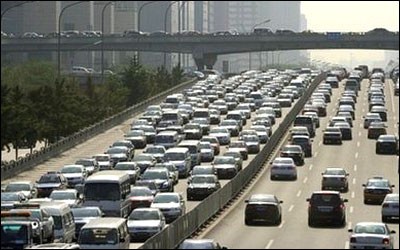
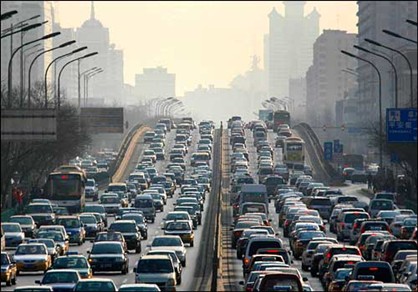
How about this: ONE traffic jam snaking into Beijing is 100km long and expected to last for a month . . .
showing how China’s economic growth and booming car numbers are still outstripping the billions being spent on infrastructure.
Baffled by the world’s longest traffic jam, the Chinese government has mobilised hundreds of policemen to clear the 100-km long stretch of the Beijing-Tibet highway, riddled with vehicles for 13 days, with the pile-up almost reaching the outskirts of the capital. Surprisingly, there have been no reports of road rage, and the main complaint has been about villagers on bicycles selling food and water at 10 times the normal price.
“Insufficient traffic capacity on National Expressway 110 caused by maintenance construction since August 19 is the major cause of the congestion,” a publicity officer with the Beijing Traffic Management Bureau told the Global Times this week.
The snarl up on the highway, on a section that links the capital to the Chinese region of Inner Mongolia was triggered by road construction and repair. While all sorts of vehicles appeared to have been caught up in the jam, it was mostly caused by lengthy coal carrying trucks, which brings fuel for the industries around the capital.
Traffic arrangements built up over generations in the U.S. are lacking in much of China, said Bob Honea, director of the University of Kansas Transportation Research Institute, who has visited China. “We’ll see this problem more and more often. It’s true of every developing country,” he said.
“Beijing’s already a big parking lot!” complained a taxi driver Gan during a traffic jam on the East Third Ring Road. “We’re making another Great Wall, it’s just that this one is made of cars,” he said.
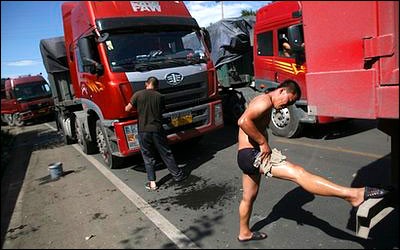
In the worst-hit stretches of the road in northern China, drivers pass the time sitting in the shade of their immobilized trucks, playing cards, sleeping on the asphalt or bargaining with price-gouging food vendors. Many of the trucks that carry fruit and vegetables are unrefrigerated, and the cargoes are assumed to be rotting.
No portable toilets were set up along the highway, leaving only two apparent options — hike to a service area or into the fields. At several places, drivers, sick and tired of the snarl up, were bitter and angry as temperatures soared during the day and dipped in the nights. Many complained that local vendors were fleecing them for food and water, charging heavy rates, by selling water for 10 yuan as against 1 yuan.
The jam which some in Beijing say was not new in that particular section has also brought the spotlight back on China’s soaring auto sales. The congestion is set to peak in five years, when the total number of cars is expected to nearly double, the Beijing Transportation Research Centre said in its new report.
If people continue to purchase vehicles at the current rate of 1,900 new cars a day, the total will reach seven million in 2015 in Beijing alone, reducing average speeds in the city to below 15 km an hour, the report said.
By the end of 2009, Beijing had four million cars, a growth of 17 per cent over 2008. Experts say the urban layout forces people to buy cars and the city planning leaves people no choice but to travel.
In recent years, vehicle buying in the world’s most populous nation has gathered pace. China last year passed the US for the first time as the world’s biggest buyer of automobiles.
Car ownership is soaring fastest in China’s biggest and richest cities such as Beijing and Shanghai. About 650,000 new cars are estimated to be put on the road every year in the capital alone.
Road-Straddling Megabus 2011-08-03 (TED) One radical solution thown up this month is a road-straddling mega-bus so big that cars can drive under it. Proponents say this would eliminate the need to tunnel underground or build expensive bridges. The elevated buses straddle the road on rails and provide enough clearance for other vehicles on the road - apart from large trucks - to drive beneath. This strategy would allow the buses to travel faster than the other traffic without the need for dedicated lanes or structures.
And construction of 15km of rail track is planned for Beijing’s Mentougou district this year, with a further 170km if it is successful.
Source: CCTV, The Australian, Global Times, The Wall Street Journal


 See the new City of Ordos in Inner Mongolia, China where the crowning of Miss World 2012 took place. It was won by








 Paul Chong's Blog