
By P Chong 1 March 2011
 China’s 56 Ethnic Minorities
Multiculturalism as practised in China is unique & unprecedented. It reflects diversity in unity & unity in diversity. It means on one hand the pride of conservation & presentation and on the other acceptance & respect by one & all.
In the atmosphere of peace & harmonious living, the minority groups are separate and yet integrated. As a matter of fact, with their fluency in Mandarin, the national language of China, any visitor would say that they are well assimilated and fully integrated in the society mainstream.
China’s ancient operas, performing arts, and other cultural legacies now have legal protections. The top legislature, the National People’s Congress Standing Committee, passed a new law on Friday 25 February 2011 to protect the country’s intangible cultural heritage.

Sun Anmin, member of NPC Standing Committee, said, “China’s thriving culture industry in the past few decades is in a large part owed to the increased tapping of intangible cultural heritage. As such, I believe it is important to emphasize rational exploitation, and protection. So we can have both effective use and protection at the same time.”
With an ancient history and diverse culture, China has a wealth of intangible cultural heritage. Just what new forms they will take and how they will develop are in the hands who love them – both Chinese and foreigners. Xie Zheng, CCTV reporter, said, “The passage of the new law is a milestone in China’s protection of its intangible cultural heritage. After all, a people without heritage fails its cultural identity, and the world without cultural diversity will be one that is too dull.”
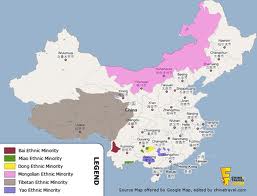
China is a big and united family made up of 56 ethnic groups. Geographically speaking, they are distributed in different parts of China with the resulting difficulty of experiencing each ethnic group‘s architecture, their festivals and tasting their snacks during one of your visits.
 Bai Minority
But the China Folk Cultural Village, lying at the Overseas Chinese Town, Shenzhen, will help solve this problem. It is the first spot in China where you can learn of the folk cultures of China. More than 200,000 square meters have
 Dai or Tai Minority
been made available to accommodate 24 peculiar cottages making up the cultural village to welcome visitors & tourists.
In the village, you will see the distinctive architecture of ethnic groups and can join in their brilliant festivals. Buying handicrafts or tasting local snacks is another way to experience the China Folk Culture Village.
Officially recognized, the following are the most numerous of the ethnic groups in mainland China:
- Han 漢族 1,230,117,207
- Zhuang 壯族 16,178,811
- Man 滿族 10,682,263
- Hui 回族 9,816,802
- Miao 苗族 8,940,116
- Uyghur 維吾爾族 8,399,393
- Tujia 土家族 8,028,133
- Yi 彝族 7,762,286
- Mongo 蒙古族 5,813,947
- Zang 藏族 5t,416,021 Source: Wikipedia (This page was last modified on 16 February 2011 at 07:40).
In our tour of Yunnan, we had the chance of meeting the Naxi 納西族 (308,839) and also the Bai 白族 (1,858,063). Many of the Naxi girls that we met are largely involved in driving taxis or running food stalls. Many are pretty but are conscious of their dark complexion. They speak perfect Mandarin and one that we met in the silk embroidery factory even has a college education and speaks good English.

Foreigners would love to marry these Naxis, for by tradition, they are the ones who work while the men are privileged to play. All responsibilities of life fall strictly upon the women. Naxi men are known to play & sing all day, drink, smoke & make merry . . . as though there’s no tomorrow!
Naxi women are traditionally forbidden to marry outside their cultural group. Modern educated Naxi girls however would rebel and much prefer to marry a Han man any time.
Miao Minority
 Tibetan Ethnic Minority


 Paul Chong's Blog