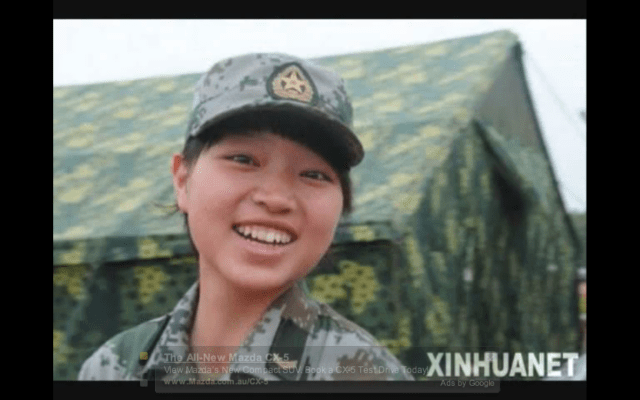
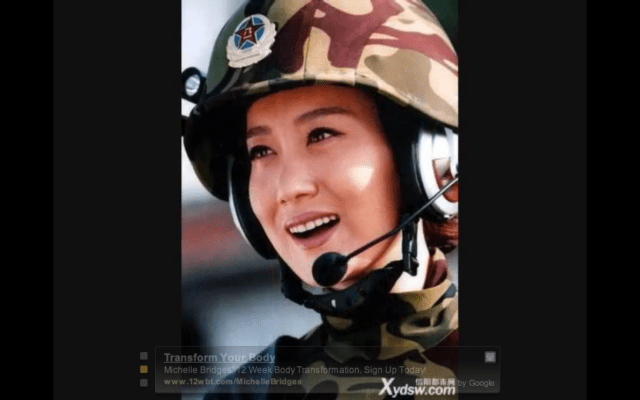
The number of women in the army is itself staggering at about 2 million
YouTube Video
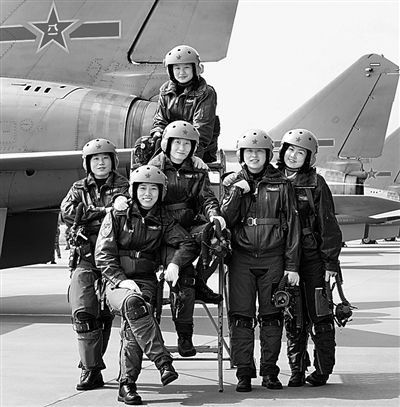
Speaking just on the Female Airforce, according to a Xinhua News Agency article the first six ”loyal and fearless” female pilots flying with the Xian JH-7 fighter bomber have just finished the training required to perform all-weather air-to-ground missions and are now able to attack and destroy targets located on unfamiliar ground, hidden by fog, using precision munitions.
The female fighter pilots, currently assigned to a PLAAF (People’s Liberation Army Air Force) Regiment, were selected from more than 20 million girls graduated from high school in Sept. 2005. After attending the flying school, they were assigned to a front line squadron in March 2011, where they conducted advanced training that included formation flying, low altitude attack, live firing exercises using conventional weapons.
The Xinhua article depicts the female pilots as “skilled” “loyal” and “fearless” and provides also a group shot of the six JH-7 pilots with flight suits and helmets. Wow, not bad for a totalitarian state where the information on women (and women’s rights..) is usually hidden or classified as secret.
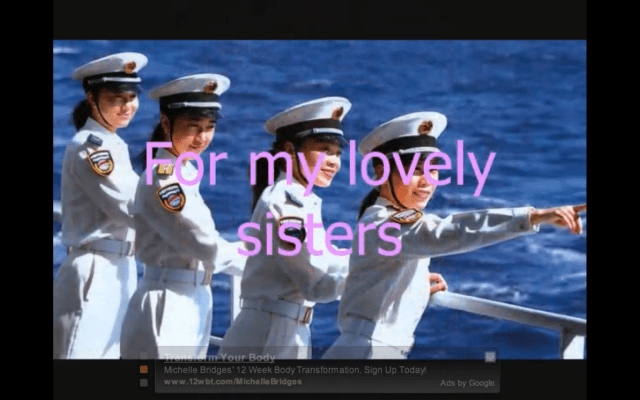
Below these female fighter pilots are among some 328 female pilots recently recruited and trained by China’s People’s Liberation Army Air Force. They don’t just look good, they can roar through the skies faster than the speed of sound. And they don’t just fly normal air force missions, they also take part in disaster relief flights, research-oriented trial flights and afforestation. They have also flown in China’s 60th national day parade.
She was the Chinese ambassador to the United Kingdom from March 2007 to 2009. From 2004 to 2007 she was the ambassador to Australia. She led the Chinese Delegation during talks with North Korea that led to the latter country’s decision (later reneged on) to abandon nuclear weapons.[2]
In 2008, she indicated the negative press coverage of the protests towards the 2008 Beijing Olympics could create possible backlash from China towards the west, claiming that the “demonising” approach to the protests harmed the west’s image in the eyes of the Chinese population.
She was cited by The Guardian newspaper to have said: “Many who had romantic views of the west are very disappointed at the media’s attempt to demonise China. We all know that demonisation feeds a counter-reaction”.[3] Currently she is Vice Foreign Minister of PRC.[4]
In February 2010 she was recalled as UK ambassador and replaced by Liu Xiaoming. (Source: Wikipedia)
In another World Policy Forum intervierw: FU Ying on China’s policy
VERY INTERESTING. A WOMAN OF HIGH CALIBRE, INTELLIGENCE AND FULLY CONVERSANT WITH WORLD EVENTS. IT IS SUCH A PLEASURE TO HEAR ANSWERS TO QUESTIONS ASKED JUST OFF THE CUFF. INDEED, GREAT LEADERSHIP IN A WOMAN!
In a SPIEGEL interview, China’s Vice Minister of Foreign Affairs, Fu Ying, 58, accuses Europeans and Americans of perpetuating Cold War . . .
‘The West Has Become Very Conceited’
(As shown by the intelligence & insights of Madame FU Ying, China’s Vice Minister of Foreign Affairs in a SPIEGEL interview)
In a SPIEGEL interview, China’s Vice Minister of Foreign Affairs, Fu Ying, 58, accuses Europeans and Americans of perpetuating Cold War stereotypes of her country, rejects allegations surrounding the treatment of artist Ai Weiwei and disputes notions that Beijing would like to rule the world.
SPIEGEL: Madame Fu Ying, few countries are more interesting to the West right now than China — and few others alarm the West to the same degree, now that you have launched your first aircraft carrier. Why does China need to arm itself to this extent?
Fu Ying: The first aircraft carrier going to sea is a very exciting event in China. It’s something the Chinese people longed for. People think it’s a natural step in the growth of the Chinese military — although this so-called aircraft carrier was really just a framework of a second-hand aircraft carrier that we refitted and will only be used for scientific research and training purposes. It’s far, far from being a full-fledged aircraft carrier. In that sense, China is well behind other countries, let alone the United States which has had a mature and highly developed fleet of aircraft carriers for a long time now.
SPIEGEL: Are there not more pressing areas where that money could go rather than towards increasing the military budget?
Fu Ying: A number of areas are given greater priority than the development of our defenses. The greatest emphasis is on economic development, the well-being of the people and the sharing of the wealth. My daughter’s generation is the first that never experienced hunger in this country. That is unbelievable progress. Your concern about the Chinese military appears to me to be clouded by stereotypes about China based in the Cold War thinking of the division between us ideologically. You feel comfortable with aircraft carrier ownership by your allies, like the United States and France, but you are more concerned if China also has one.
SPIEGEL: How far will China go in terms of defending its interests? In the dispute over the sovereignty of the South China Sea, the tone can at times be quite sharp.
Fu Ying: We, too, are wondering why there is such strong rhetoric, since the countries involved are already engaged in dialogues on the basis of the Declaration on the Conduct of Parties in the South China Sea in 2002. But this is a dispute of words, and what matters is that the shipping traffic in the South China Sea remains peaceful and there is no war or conflict going on.
SPIEGEL: The Americans clearly have doubts about your intentions. Pakistan is believed to have provided China with access to the wreckage of the high-tech US helicopter that crashed during the operation against Osama bin Laden. Are you in a position to confirm whether this is true?
Fu Ying: Both China and Pakistan have denied this rumor. I think the most important thing is the question of whether China and the US are enemies. Are we going to be in a war? Are we preparing for a war against each other? We certainly don’t see it that way. It is not very friendly that the US maintains a weapons embargo against China. We have no intention to threaten the US, and we don’t see the US as a threat to us. The West tends to place China in the framework of the Cold War. This puzzles China a lot.
SPIEGEL: Many Germans, while respecting China’s development, see your country more as a rival than a partner. Is that something that you can understand?
Fu Ying: I’m grateful you raised that point because it is something that has been on my mind for a long time. If you fundamentally accept that China’s growth has lifted countless people in the country out of poverty, then you also have to agree that China has done things right. One must also accept that there can be a different political system. The countries in the West think they have the only system that works and they have narrowed down “democracy” to a multi-party election system, which works well for some countries, most of the time, but as we are now seeing with the latest financial crisis, they sometimes experience difficulties too. The West has become very conceited. At the end of the day, democracy alone cannot put food on the table. That’s the reality.
SPIEGEL: China’s decision-making process appears to be shielded with black box secrecy, and even long-time observers are puzzled over how political decisions are taken. Does it really come as a surprise to you that many are wary of China’s intentions?
Fu Ying: China’s political system is a product of China’s history. It is based on the country’s own culture and is subject to a constant reform process, which includes the building up of democratic decision-making processes in China. In order to make the right decisions, you have to listen to the people and their criticism. No government can survive if it loses touch with the people and reality. And we have a very critical view of ourselves.
SPIEGEL: The West perceives a lack of transparency and rule of law in the Chinese model.
Fu Ying: I think at the moment it is the Western governments that are having problems. We are observing what is going on in the West. We try to understand why so many governments made so many mistakes. Why do political parties make commitments they cannot fulfill? Why do they spend so much more than they have? Has the West been stagnating since the end of the Cold War? Or has it just become conceited?
SPIEGEL: Democracies are very complicated, and compared to tightly ruled systems, they are at a disadvantage. Do you feel superior?
Fu Ying: Superiority is the not the word we use. The Chinese are very modest. We respect your success and we learn from you. You are in the post-industrialized era. Many of the problems you encounter might occur in China later. So we want to see how you address those problems, and if we can learn from you.
Part 2: ‘The Door to Dialogue’ with the Dalai Lama ‘Is Always Open’
SPIEGEL: The case of recently arrested artist Ai Weiwei, who is well-connected in Berlin, was seen in Germany as a provocation. Was it intentional that he was arrested shortly after German Foreign Minister Guido Westerwelle attended the opening of an exhibition in Beijing with Chinese officials?
Fu Ying: That’s why I say you are conceited. You really take yourself very seriously. Why would a country like China decide on domestic matters and try to make them coincide with a visit by a foreign minister from a European country? I don’t see the linkage. The case you are discussing is a legal matter. I am not really interested in this case.
SPIEGEL: If it is a legal case, then why wasn’t Ai Weiwei publicly charged? Instead he disappeared for 81 days. The allegations of tax evasion don’t appear to be very convincing.
Fu Ying: If you have such great interest in this case and believe there has been a breach of law or rules in his case, you may very well raise it. We can pass it on to the authorities. But how many more Chinese artists, writers, singers and movie stars do Germans know? Your view of China is very narrow and negative, and that’s why we don’t feel comfortable discussing human rights with you. Our understanding of human rights is based on the UN Charter, which guarantees political rights, the right to life and the right to development. But in your view, human rights seem to concern only some individuals who are subverting the state or are breaching laws.
SPIEGEL: Some of these people symbolically represent hundreds of others.
Fu Ying: But please try to put things into perspective. We have 1.3 billion people living in China. Since day one of our relationship with the West, human rights have been a subject for discussion. Many issues were discussed and solved and the content keeps changing. But today the Western understanding of human rights is used as an instrument against China, regardless of the fact that China has improved very much in this area, and no matter how intensively we are working on the issue.
SPIEGEL: Can you say anything more concrete about the Ai Weiwei case?
Fu Ying: He is being investigated and he has been released after paying bail. I don’t have any further comment on him.
SPIEGEL: As one dictator after another was chased out in the Arab world this year, critical journalists, attorneys and human rights activists in China have been experiencing a wave of repression, with some even speaking of a “Chinese Winter”. Does China fear a handful of activists?
Fu Ying: What was happening in the Middle East is an event that attracted attention all over the world. We, too, are trying to understand what led to these revolutions. As for China, I don’t see any direct linkage. Again, it’s the habit of some Western analysts to connect everything bad with China. If you think your society is strong enough to avoid infection by the Arab revolution, what makes you think that the Chinese society is so weak that it has to be infected? Eighty-seven percent of Chinese surveyed in a poll by the Pew Research Center in 2010 said the government is on the right track. In the US, however, recent polls show that a lot of people think the country is not on the right path.
SPIEGEL: China always shows pretty strong reactions when Western leaders meet with the Dalai Lama. You recommend that other countries should solve their disputes through dialogue. Why hasn’t China succeeded in reaching an agreement with the Tibetan spiritual leader?
Fu Ying: Our difficulty with the Dalai Lama is his political views and demands for Tibet independence. If you read his website, you will see what he wants. In essence, he wants an independent Tibet.
SPIEGEL: He has explicitly rejected that, saying he doesn’t want separation, but instead greater autonomy.
Fu Ying: Tibet is part of China. But, of course, the door to dialogue is always open. Dialogue is always welcome. I am glad more and more people are visiting Tibet, and more and more people understand life in Tibet better now.
SPIEGEL: Unfortunately, journalists are not allowed to access Tibet.
Fu: There is a bit of concern about the intentions and motives of Western journalists. Sometimes it’s as if some of them come to a wedding and only want to inspect the contents of a dark corner. They want to show the world there is no smiling bride, there is no groom and no happy friends — just darkness. They write about it extensively. They may be facts, but they are very selective facts.
SPIEGEL: The Dalai Lama has officially retired from his offices. Is this not a good point in time to seek a peaceful solution?
Fu Ying: The fact that he is withdrawing from his political offices shows that he does regard himself as the king and god in one and is thus the owner of Tibet. But those days are over. Tibet is finally undergoing development, and the region truly is doing better and better. So we will see whether the Dalai Lama can relinquish himself of his political demands.
SPIEGEL: It’s not only Tibet which is developing at a fast pace. Lately, the West has been up to its neck in debts, but China has experienced fantastic growth. Has communism ultimately defeated capitalism?
Fu Ying: We are not the Soviet Union. During the entire Cold War, the West and the Soviet Union were at each other’s throats. You each wanted to see the other side’s demise; that was your strategic objective. But China was not part of your fight and we have always supported Germany’s reunification.
Part 3: ‘China Has No Intention to Rule the World’
SPIEGEL: As of the end of June, China held US bonds with a total value of $1.165 trillion and European bonds worth $700 billion. Economically, China is already a superpower today. What does that mean for the political balance of power?
Fu Ying: Many say that power is shifting from the West to the East, but we believe that it is a process of diffusion. It used to be within the Western world, but now it is also diffusing to a wider world. There is a need to reform the current world structure, which was built after World War II to the benefit of around 1 billion people of the developed world. China is only one of the newly emerging countries. Brazil is growing. India is growing, as are parts of Africa. In the future, 3 to 4 billion people will be coming into this process of wider industrialization. But that reform needs to be an incremental process that is achieved not through war and not through conflict, but through dialogue.
SPIEGEL: Will the West wind up on the losing side?
Fu Ying: You are currently experiencing difficulties, but you have gone through so many difficulties in the past — Europe and the US — and you always bounce back. We are also interdependent, and your loss is not necessarily our gain. We’re in one boat. And we indeed worry when Western economies are experiencing difficulties. That’s why it is good that German Chancellor Angela Merkel and French President Nicolas Sarkozy are taking the lead. Very recently, my colleagues and I discussed the future of the European Union. The prevalent view was that if you work together to address the current difficulties, then the EU will go forward to become more integrated. If you do not, the euro zone might collapse.
SPIEGEL: What would it mean for China if the financial crisis in the West extends to other regions?
Fu Ying: Everyone would suffer.
SPIEGEL: Many observers believe that the legitimacy of the Chinese government hinges on its economic success. In the event of an economic crisis, would you need to be worried about your country’s stability?
Fu Ying: Do Western governments change their multi-party system during an economic crisis? I don’t think so. Why should we be worried? Having said that, our reform is an ongoing process and we will continue to move forward.
SPIEGEL: For a long time, the West believed that the developments in China were a win-win situation for everyone involved. Now, however, the impression is solidifying — even within international institutions like the World Trade Organization — that the Chinese want to shift the balance of the global economy to their advantage. The long-term policy of keeping the Renminbi artificially undervalued is just one example of this that is often cited.
Fu Ying: China has no intention to rule the world. But if you continue to see yourself as the center of the world, if you see yourself as the monopoly of all truths, all the right beliefs and all the right values, then you will always find it uncomfortable when you realize that the world is diversified. There are different values and cultures. And if you believe you have won the Cold War, then the Cold War is finished, over, done. We are living in a new world. Get down off your high horse of being on top of the world. Come down to be equals and join us on a level playing field instead of creating a new rival in the style of the Cold War.
SPIEGEL: You maintain very close relations with leaders like Kim Jong Il in North Korea, whose people are starving because he refuses to open up his country, or North Sudan’s President Omar al-Bashir, who is being sought for crimes against humanity. What is your philosophy regarding this?
Fu Ying: Our own sufferings in history have taught us that we should never try to impose on other countries or support others to impose. We have a permanent seat on the United Nations Security Council; we have hundreds of Chinese UN peacekeepers in Darfur, Sudan. If every time you don’t like the leader of a country and then move in and intervene, that would lead to chaos. Think of your own experience in intervention, which is not always successful.
SPIEGEL: You’re referring to the military deployment in your neighbor country, Afghanistan.
Fu Ying: You need to reflect on your own experience.
SPIEGEL: China weakens institutions like the United Nations, in particular, because you frequently water down joint resolutions against Iran, North Korea or Syria, whose President Bashar Assad allows the army to fire against his own people, to the point of ineffectiveness. Where are the limits to China’s tolerance of human rights violations?
Fu Ying: The case of Iran is part of the whole security situation. That’s why we have the five-plus-one discussions on Iran. In the case of the Democratic People’s Republic of Korea, we have the six-party talks. I believe patient diplomacy will pay off in the end.
SPIEGEL: With regard to Iran, this patience could result in us losing a race against time in the end.
Fu Ying: We don’t have a better solution.
SPIEGEL: Given differences of opinion like that, how are powers like China and the USA supposed to cooperate in dealing with global challenges like cyber security, financial stability, food security and nuclear proliferation?
Fu Ying: We need to overcome the wall of distrust. If we only allow ourselves to be led by our own views, our own feeling, our own emotions, even our own values, then we will only create more problems. Be it peacekeeping missions or the protection of shipping channels off the coast of Somalia or climate change, I think you will find China to be an enthusiastic participant in world affairs.
SPIEGEL: How does it feel to be viewed as a new economic superpower?
Fu Ying: It is flattering.
SPIEGEL: Does it make you nervous, as well?
Fu Ying: Not at all. We don’t view ourselves as a superpower. You are not going to see a USA or a Soviet Union in China. You are going to see a culturally nourished country with a big population, being more content, being happy, being purposeful — and it will be a friend to the world. There is no reason to worry about China.
SPIEGEL: Madame Fu Ying, we thank you for this interview.
Ginger is an herb, which originated in China and later, spread to India, Southeast Asia, West Africa and the Caribbean. It is basically the rhizome of the monocotyledonous perennial plantZingiber officinale. It has been in use since ages, both as a spice as well as an herb. The nutrients present inside ginger, especially its volatile oils – gingerols and shogaols, accord a number of health benefits to its users. Infact, ginger has also been found to be effective in fighting against some fatal ailments like cancer. In the following lines, we have provided information on nutritional value and health benefits of eating ginger.
Nutritional Value of Ginger
Ginger has been known to comprise of the following nutrients:
Peng Liyuan, the celebrated folk singer, is becoming China’s First Lady through her microphone. Whereas Jackie was a lesser known figure prior to her meeting up with President John Kennedy, Peng Liyuan is a celebrity in her own right. She’s glamorous, cultured, well educated with a master degree in folk music. It was her voice & singing that first wooed the heart of Xi Jinping, the next President-to-be of China.
She’s totally different from all the First Ladies you’ve ever known or heard of.
She’s China’s own & absolutely exceptional.
Until 2007, when Xi Jinping was promoted to top Party leader in Shanghai, his wife Peng Liyuan was a fixture at government-sponsored events, CCTV Festival Extravaganza which are the country’s largest and most conspicuously events watched by hundreds of millions. Ms. Peng was admired as much for her soprano vocal as she was for the way she exercised them in “shimmering chiffon gowns, with crimson-glossed lips”.
This slideshow requires JavaScript.
Her profile is summarily mentioned here:
* Ms. Peng, whose name means “Beauteous Beauty” in Chinese, has been known as a faithful “soldier of the arts.” in a state news agency profile page.
* She is China’s first folk-song master-degree recipient; youngest civilian general in the Chinese army’s musical troupe; honorary professor at Shanghai Teachers’ College.
* Her travels include trips to “various revolutionary districts, impoverished mountainous regions, and minority neighborhoods.”
* Ms. Peng has also been put forward as a celebrity ambassador for issues of public health including AIDS,requiring her to lobby foreign governments to help cure such dreadful disease & others.
* A friend and photographer once took pity on young Peng and snapped her first picture, immortalizing the young star for whom camera lenses would, soon enough, become a constant companion. That was late 60s or early 70s when she first set her eyes on a camera.
* The glamorous starlet initially dismissed the future President as a xiang ba lao, a country bumpkin with coarse skin who wasn’t much to look at, an impression that isn’t entirely unfounded, according to an article in the Zhanjiang Evening News in 2007 that was widely copied on the Chinese Internet but has since been mostly deleted.
* Even her final verdict came with honest qualifiers: “Isn’t [he] the one I’ve been looking for? Unsophisticated but really intelligent.” As for Mr. Xi, he was quoted as telling her that he knew she would be his wife within 40 minutes of meeting her.
She has also described how she was introduced to Mr. Xi through a mutual friend when he was working as the deputy mayor of the eastern port of Xiamen in 1986. Mr. Xi had been married once before, to the daughter of a Chinese ambassador to Britain, but that only lasted three years when her own desire to study abroad overtook Xi’s political ambition, and they had no children.
Political analysts say Ms. Peng, who is now 49, is already helping to bolster and soften Mr. Xi’s public image in a country that, stimulated by social media, has become increasingly hungry for news about its leaders and their personal lives.
She has already broken the mould by talking about her relationship with Mr. Xi prior to his promotion to the Politburo Standing Committee in 2007.
“When he comes home, I’ve never thought of it as though there’s some leader in the house,” she once told a state-run magazine. “In my eyes, he’s just my husband. When I get home, he doesn’t think of me as some famous star. In his eyes, I’m simply his wife.”
She has however taken a few tentative steps into the limelight again in recent years, fuelling expectations that she will be the first spouse of a Chinese leader to play an active “first lady” role after her husband takes power in October or November.
Last year, as mentioned, she became a Goodwill Ambassador for Tuberculosis and HIV/AIDS for the World Health Organization – a job that requires her to help lobby governments around the world to take action to prevent and cure the two diseases.
And after the devastating earthquake in Wenchuan, Sichuan Province in May 2008, she staged special performances in affected areas and announced publicly that their daughter, Xi Mingze, who was then 16 at the time, had volunteered to help relief efforts – another first for a Chinese leader’s family.
Come this fall, when Peng’s First Lady identity eclipses her superstar status, we must await to see the transformation in our dazzling star. Would she remain a noble, dignified mother only & a faithful wife?
The question is “Will she do anything exceptional to further boost the image of China? Or like her three other predecessors retreat into the background & remain a mystery?”
The photos and video of Ting Tsu-chi carrying his mother to the hospital have gone viral. (Internet photo)
Filial piety has become a hot issue in Taiwan, according to a Staff reporter on 2012-03-06, after video of a middle-aged man carrying his frail mother into the Chi Mei Hospital went viral, touching hearts all over the country. Now people want to know more about the man in the video.
But what’s FILIAL PIETY in today’s age?
”Filial piety” is deeply embraced in ancient Chinese culture, teachings and philosophy.
It’s Confucianism.
Here’s sharing an article written by Dr Chris Anthony . . .
This is no sermon nor a nag ; it’s a very simple message. The article below was written by Dr. Chris Anthony . To those of you who still have their parents living , I like to share this good piece of regret that I had not read it earlier during the days when both my parents were still alive.
Read on ……
The time is now.
It is better to give them a little time now than to give them the world when they are gone. The world is full of sons and daughters like you and I.
I had a marvellous mother, who loved me, sacrificed for me and helped me in every way possible. In all of my growing up from childhood through school and eventually marriage, my mother was always at my side.
And when I needed help with my little ones, she was there for me. A few years ago, we buried this wonderful woman.Can you imagine how I felt when I returned home and found a poem in her drawer, written by my mom:
Worse yet, I did not treat her as she deserved to be treated.
I found time for everyone and everything else But I never made time for her.
It would have been easy to drop in for a cup of tea And a hug but my friends came first.
Would any of them have done for me what my mother did?
I know the answer.
When I called mom on the phone,
I was always in a hurry.
I feel ashamed when I think of the times I cut her off,
The times I retorted back to her,
The times I glared at her in an angry mood when she wanted to correct me and guide me through the correct path.
I remember too, the times I could have included her in a trip out ,but did not.
My children loved Grandma from the times they were babies.
They often turn to her for comfort and advice.
She understood them.
I realize now that I was too critical,
Too short-tempered, too stingy with praise.
Grandma gave them unconditional love.
The world is filled with sons, daughters and a child like me.
I hope they see themselves in this letter and realize from it.
If this has touched you, please pass it on to all the sons and Daughters who have to praise their Mom for everything they are today.
Modern Day Family
Reflections
This story highlights that we must do whatever we can when our parents are alive to appreciate what we say or do, however little that may be.
Very often we are willing to spend thousands to give them a grand funeral with the most elaborate preparations and expensive coffins and so on. We are willing have memorials without fail year after year. We give alms in memory of our late parents but we could not afford to spend some time with them when they were with us before their death.
We were too busy with our lives.
How much do we treasure our parents? They may not be perfect but it is undeniable that they deserve more than what we are doing for them now.
We may be cruel to them or we may even be criminals but to our parents we are still good children and they continue to justify why have we become bad. They blame everybody else for their children being bad except them as they believe their children cannot have gone bad by themselves.
Nobody in the world does that. Many will flock to us when we are in a position to give but none when we are down and out. Our parents are the only ones who will be there with us and for us whether we are good or bad, up or down till their last breaths.
Let us search our hearts to see where we have placed our parents in it. If they are not in our hearts it is time to make a place for them there now. If they already there as in many of us, it is time to give them a little more. Let us not do something or fail to do it that we will regret later as it will be too late.
Filial piety is the duty that every Mother’s son or daughter , towards his / her parents. You can have many wives , husbands , mistresses , lovers , friends ; but you only have One biological Mother , Father. If you are a priviledged child with a Nanny , then the Nanny deserves your filial piety because she was the one who groomed you in your childhood years.
It is no use to spend lots of money for your parents’ funeral becos they are not able to cherish what you do ; the lavish funeral rites or expensive coffin that you spend on them ONLY BENEFIT the funeral caretakers ; nobody bothers how much you spend on your parents when they are dead. You may be magnanimous to donate money to charity in memorium of your parents …… who cares !!!
Hence , if you wanna to spend money on your parents , do it when they are still alive and able to appreciate and cherish your love.
When I read this message that you thoughtfully shared with me via email, tears just filled my eyes. In fact, I sobbed . . . and I had never been so touched by any story (true or otherwise). Such a TRUE story ought to be shared globally. I will use this story in my blog to tell the world of the basic goodness of mankind . . . that great emotion we loosely called LOVE . . . in the manner that in this DNA age we have lost its essential meaning!
God Bless
Paul
On 27/03/2012, at 1:01 AM, Richard Tay wrote:
A mother’s Love For Her Child Knows No Bounds . . .
This is a true story of a Mother’s sacrifice during the China Earthquake.
A Mother’s Herart Under Heaven
After the earthquake had subsided, when the rescuers reached the ruins of a young woman’s house, they saw her dead body through the cracks. But her pose was somehow strange that she knelt on her knees like a person was worshipping; her body was leaning forward, and her two hands were supporting by an object. The collapsed house had crashed her back and her head.
With so many difficulties, the leader of the rescuer team put his hand through a narrow gap on the wall to reach the woman’s body. He was hoping that this woman could be still alive. However, the cold and stiff body told him that she had passed away for sure.
He and the rest of the team left this house and were going to search the next collapsed building. For some reason, the team leader was driven by a compelling force to go back to the ruin house of the dead woman. Again, he knelt down and used his hand through the narrow cracks to search the little space under the dead body. Suddenly, he screamed with excitement, “A child! There is a child!”The whole team worked together; carefully they removed the piles of ruined objects around the dead woman. There was a 3 months old little boy wrapped in a flowery blanket under his mother’s dead body. Obviously, the woman had made an ultimate sacrifice to save her son. When her house was falling, she used her body to make a cover to protect her son. The little boy was still sleeping peacefully when the team leader picked him up.The medical doctor came quickly to examine the little boy. After he opened the blanket, he saw a cell phone inside the blanket. There was a text message on the screen. It said, “If you can survive, you must remember that I love you.” This cell phone was passed around from one hand to another. Everyone that read the message wept.
“If you can survive, you must remember that I love you.”
Such is the mother’s love for her child!
Here’s another touching story in nature depicting a mother’s love . . .
After a forest fire in Yellowstone National Park, forest rangers began their trek up a mountain to assess the inferno’s damage. One ranger found a bird literally petrified in ashes, perched statuesquely on the ground at the base of a tree. Somewhat sickened by the eerie sight, he knocked over the bird with a stick. When he gently struck it, three tiny chicks scurried from under their dead mother’s wings. The loving mother, keenly aware of impending disaster, had carried her offspring to the base of the tree and had gathered them under her wings, instinctively knowing that the toxic smoke would rise. She could have flown to safety but had refused to abandon her babies. Then the blaze had arrived and the heat had scorched her small body, the mother had remained steadfast…because she had been willing to die, so those under the cover of her wings would live.
‘He will cover you with His feathers, And under His wings you will find refuge.’ (Psalm 91:4)
According to News.com.au, drivers hoping to slip the surly – and traffic congested – have moved a step closer to realising their dream, as a US firm said it had successfully tested a street-legal plane.
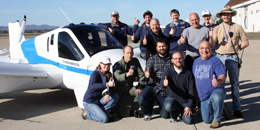
Massachusetts-based firm Terrafugia said their production prototype “Transition” car-plane had completed an eight-minute test flight, clearing the way for it to hit the market within a year.
“With this flight, the team demonstrated an ability to accomplish what had been called an impossible dream,” said founder Carl Dietrich.
The two-seater craft, which has the rounded features of a Fiat 500 and collapsible wings, is on presale for US$279,000 ($A267,869) and some 100 vehicles have already been ordered.
Flying car to debut at New York auto show
Terrafugia’s prototype of its Transition flying car leaves a garage in Massachusetts. The street-legal airplane carried out a successful first flight in March. Image courtesy of Terrafugia
US company Terrafugia has variously labeled its Transition model as a “roadable aircraft” and a “street-legal airplane”, perhaps in a quest to avoid the inherent fantastical connotations of “flying car.” Particularly when they are trying to make customers shell out $279,000 for each one. With its foldable wings, it can fit snugly in any road lane, and if given enough space for take-off it can fly two passengers at a cruising speed of 170 km/h, RT wrote. (Source: AP)
The New York International Auto Show will be kicking off tomorrow in the Big Apple. And the much talked-about flying car, the Transition, pioneered by US company Terrafugia, will be making a guest appearance at the show, alongside a vast slew of other vehicle innovations.
We’ve been hearing a lot about flying cars this week. For a start, Dutch company PAL-V announced on Monday that its two-seat hybrid car and gyroplane, the PAL-V One, had been on a maiden flight. The three-wheeled half-plane half-car apparently has a patented ’tilting system’ so people will be able to drive the vehicle to their nearest airfield in the future and take to the skies. The company said the car/craft would have a flight-certified aircraft engine that runs on gas and would be able to reach speeds of 180km/h on both land and when flying. PAL-V is now on the lookout for investors to take the concept vehicle to the commercial arena.
PAL-V One two-seat hybrid car and gyroplane takes off. Image courtesy of Pal-v.com
Then we heard about Terrafugia, a company based in Woburn, Massachusetts, in the US that has been working away on another flying car prototype called the Transition. Pilots and engineers from MIT founded Terrafugia. The company said a prototype of the street-legal airplane had carried out a successful first flight at Plattsburgh International Airport in New York on 23 March.
The Transition is a two-seat personal aircraft that, if produced, will apparently be capable of driving on roads and motorways. Plus you’ll be able to park it in a car garage. It will fly using unleaded automotive fuel, the company said.
Pingyao, an ancient city dating back 2700 years, was inscribed to the UNESCOWorld Heritage site list in 1997. It is one of the 4 most well preserved ancient city / town in China. The others being LiJiang 丽江in Yunnan, Yangshuo阳朔in Guangxi and Weizhou 微洲in Anhui. Pingyao boast a most complete and well maintained city wall.
In its hey days during the Qing Dynasty of the 1800s, this was also known as the “Wall Street” of China. Banking has its roots here in Pingyao. In fact, Pingyao spawned the famous term “汇通天下“ literally meaning….Remittance across all borders. Yes, what we are now familiar with of Bank Drafts, Electronic TT and in this cyberspace age of “Internet Banking” to a great extent has its roots in Pingyao…..
The city walls and gates of Pingyao are laid out in the shape of a turtle, the traditional Chinese symbol for longevity, though you’re more able to see the similarly shaped battlements as you explore the ancient banking capital’s interior and old town. Full of temples, traditional architecture and watchtowers, you’ll be enthralled with the town’s medieval history and feel. If you’re as keen as Pingyao’s founders on living a long time, perhaps you can benefit from Chinese tradition; find a store or dispensary that sells herbs and extracts for health and long life. Such shops in Pingyao, like elsewhere in China, are stuffed with extracts of ginseng, ma huang, gingko biloba and all manner of other natural products claiming to benefit longevity and virility. Or perhaps have a local meal chock-a-block with garlic – another magic ingredient with medicinal benefits. (Gecko’s)
Increases in tourism have put pressure on the ancient walled city of Pingyao. During the tourist high-season, the amount of visitors to the city can reach up to 3 times its maximum capacity per day.
Since 2007, non-profit organizationGlobal Heritage Fund (GHF) has been working with the Pingyao County Government to protect the city against various problems such as mass tourism and uncontrolled development. GHF’s stated goal for the project is to better preserve the cultural heritage of Pingyao ancient city in more comprehensive and systematic approaches as part of an integrated planning, conservation and development program. The Pingyao Cultural Heritage Development Program aims to preserve the vernacular architecture, revitalize and stimulate the traditional arts and establish special historic areas. (Source: Wikipedia, the free encyclopedia)
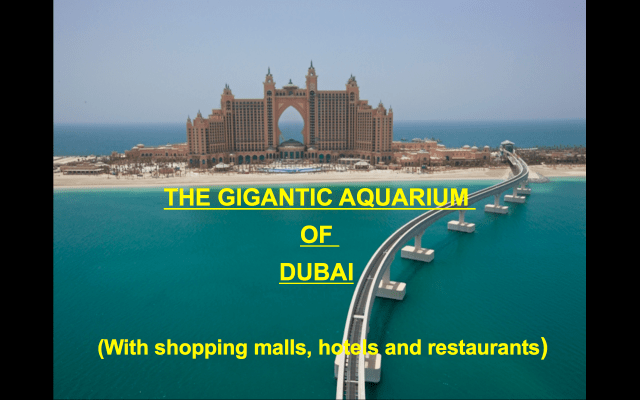
It’s the City that Oil Built. It’s always the greatest show on earth when Dubai presents with none anywhere else to compare!
Dubai was first mentioned in 1095, and the earliest settlement known as Dubai town dates from 1799. Dubai was formally established in 1833 by Sheikh Maktoum bin Buti al Maktoum when he persuaded 800 members of the Bani Yas tribe, living in what is now part of Saudi Arabia, to follow him to the Dubai Creek by the Al Abu Falasa clan of Bani Yas. It remained under clan control when the United Kingdom assumed the protection of Dubai in 1892. Its geographical location made it an important trading hub and by the beginning of the 20th century, it was an important port.
In 1966, oil was discovered, expanding the city by 300% and bringing in international oil interests.
The modern emirate of Dubai was created after the UK left the area in 1971. At this time Dubai, together with Abu Dhabi and four other emirates, formed the United Arab Emirates.
Although Dubai’s economy was built on the oil industry, the emirate’s model of business drives its economy, with the effect that its main revenues are now from tourism, real estate, and financial services, similar to that of Western countries.
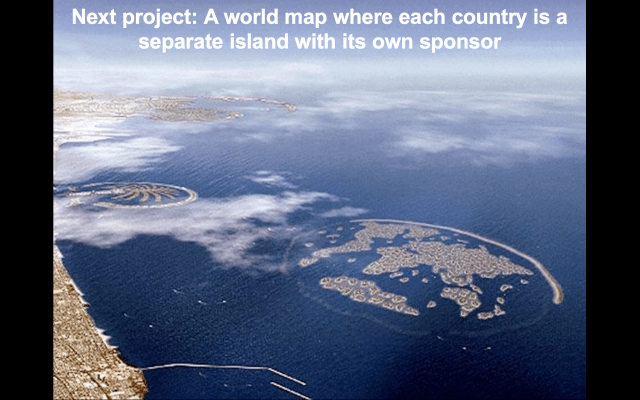
Dubai has recently attracted world attention through many innovative mega construction projects and sports events. This increased attention has highlighted labour rights and human rights issues concerning its largeIndians, which made up half of its total population.
Dubai’s property market experienced a major deterioration in 2008 and 2009 as a result of the worldwide economic downturn following the financial crisis of 2007–2010.
With that in hindsight, the show progresses on . . .


 Posted by David Cenciotti in China.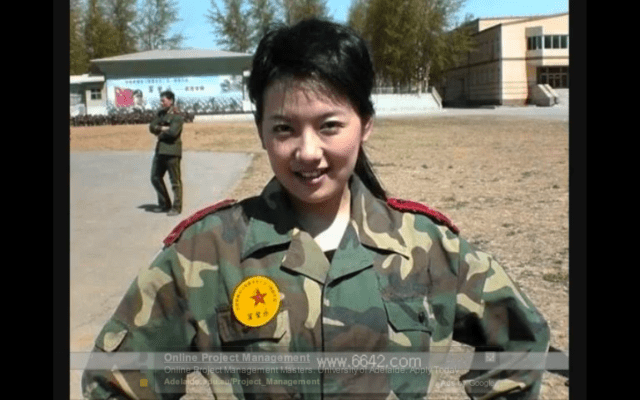














 Paul Chong's Blog