Ancient Discoveries in China: Underwater Pyramids

Sonar images

(Above photo: showing sonar mapping of the Chinese lake where multiple pyramids were discovered)

Fuxian Lake, Yunnan

Fuxian Lake, Yunnan

Just when you think you know enough of the mysteries in this world & hidden civilisation’s ruins, another fascination capture your imagination. Just how much do we really know about the world we live in. Just recently, I had posted an article about unknown pyramids in China, but now this discovery of Mayan-like pyramids in the Fuxian Lake in Yunnan Province . . . and they are underwater.

Pyramids in the Americas and Egypt are now losing their fascination to China’s own. It’s long been known that China had pyramids that were small and built for mausoleums and burial mounds, but this find appears to be different.

Divers took a look at the first building which was 19 meters high and 90 meters long. It appeared to be built in pyramidal shape for a higher civilisation and possibly a sacrificial alter. Sonar mapping revealed another 30 measurable and sizable “pyramids,” as well as nine buildings with similar scale of the one discovered. These resemble Mayan pyramids with flat tops for performing activities. There is also a round building like a coliseum.

Gengwei, a professional diver, told reporters on December 19, 2005, that images from sonar scans showed a large underwater relic covering at least 2.4 square kilometres in Fuxian Lake. He said eight main buildings were found all under the water, including a round building and two large high buildings with floors that liken to the Mayan pyramids of Latin America. The round one has been described as similar to a colosseum in architecture, with a 37-meter wide base and a gap to the northeast. One of the large, high buildings has three floors, a 60-meter wide base and lots of small steps linking the floors. Another is even larger, with a 63-meter wide base standing five floors and a total 21 meters high. A 300-meter long and 5 to 7 meter wide rock road connects the two buildings. The complex, located in present-day southern Yunnan province, is believed to be from an ancient civilisation dating back to the Qin and Han dynasties, approximately 2,000 years ago.

A Large City That Was Never Documented

Sonar surveys have revealed it to be larger than the capital of the Han Dynasty. People cannot help but wonder why such a large city left no trace in historical records.

The Underwater Pyramid is More Advanced Than the Egyptian Pyramids as the stones are ornamented with various designs and symbols.

Elsewhere in Cuba, Ocean engineer, Paulina Zellick’sF in Havana, Cuba has this to say about her finding earlier in 2000: “possibly a sunken city built in the pre-classic period and populated by an advanced civilisation similar to the early Teotihuacan culture of Yucatan. . . Researchers using sonar equipment have discovered at a depth of about 2,200 feet (700-800 meters) a huge land plateau with clear images of what appears to be urban development partly covered by sand. From above, the shapes resemble pyramids, roads and buildings.” (Earthfiles May 18, 2001)

Outside of Mexico City a pyramid was discovered under a hill called “Hill of the Star” used for reenactments of the crucifixion of Christ. This was built 1500 years ago by a culture that has since vanished called the Teotihu the mystery of Yonaguni underwater structure.

Yonaguni Pyramid

Mysteries abound the deep ocean floors that are beginning to be revealed more & more with the advancement of technologies in deep sea exploration.

Diaoyu Islands Ownership Identified

 images-1
images
images-2
Pertinent documents are at hand for Mainland Chinese & Taiwanese to show proof of Diaoyu Islands real ownership.
HISTORY TELLS NO LIES!
Share this vital information with all, especially those of Chinese Descent, including the Japs themselves!
LET THE TRUTH BE KNOWN & SAVE ALL THE POLITICAL OR DIPLOMATIC TUG-OF-WAR  TENSION & DISPUTE.
The Japanese government created tensions in East
 China Sea by ‘buying over’
the Diaoyu Islands from someone who illegally occupied the islands, which
historically belongs to the Chinese government.
Japanese Imperialists had
invaded Chinese territories and tortured and raped the Chinese populace,
be it in mainland China or in South-east Asia . Blood debts must be paid
in full to teach the arrogant Japs . . . claiming the islands as their own & naming them as Senkaku Islands.
With evidence of Empress Dowager Commandment,
the Diaoyu Islands ‘ owner has been identified.
Diaoyu Islands were  bestowed to Sheng Xuanhuai of Jiangsu Province
of Qing Empire by Commandment.
The Japanese ambassador said he does not believe
this circulation or email can reach 400 million people within two
weeks, otherwise he apologize to the Chinese people.
Please circulate immediately . . . 
72e628c9jw1dwrqy2rv86j.jpg
a7a28e5ejw1dw29rbveiij.jpg
58bcdbf2jw1dwrjcxd9q1j.jpg
6ba75546jw1dwr41b08h6j.jpg

China Builds ‘World’s Tallest Building’ in Changsha, Hunan Province

China Building World's TallestSky City 

China builds ‘world’s tallest building 

Sky City” in Changsha, Hunan Province, China will be world’s tallest skyscraper building by April 2014.

Heights Comparison It will be 220 floors above ground with a total height of 838 meters; will have a planned construction time of only 10 months; and cost 1.5 billion US$.

This will stand tallest at 838 meters/2749 ft. till the “Kingdom Tower” of Saudi Arabia is finally constructed. Its proposed height is 5,280 ft. which will be more than twice the height of Changsha’s structure at 2,749 ft.

Screen shot 2013-07-28 at 10.55.53 PM Screen shot 2013-07-28 at 10.57.00 PMThere will be 104 high-speed elevators; 10 fires escape routes, which can evacuate people each floor within 15 minutes; the building will be fire-resistant for up to three hours.

It will also have 17 helipads.

Sport facilities will include 6 basketball courts, 10 tennis courts.

Plans include preserving green space around the building.

Sky City at Night

This “city” building will house shops, restaurants, offices, 5 schools, an elderly care centre, and a hospital on the lower levels; while 31,400 people apartments and 1,000 guests’ hotels would make up the upper levels.

The 4-layered glass windows will keep the temperature of the building constant between 20 to 27°C.

The air indoors will be filtered to 20 times cleaner than the outside air.

The lamps used in the building will be energy saving LED.

The building is designed against earthquakes of up to 9.0 on the Richter Scale.

800 meters in 6 months: Sky City Tower


‘World’s Largest Building’ – New Century Global Center, Chengdu, China

Aerial viewBiggestOpening

Years ago I had the notion that the great shopping mall in Edmonton, Canada was the greatest. Then last summer, we visited The Venetian in Las Vegas and thought that this was even more fantastic. Now we see such similar structures as in Marina Bay Integrated Resort in Singapore or in Macau & Dubai. But nothing come anywhere near to compare with the greatest human structure of them all . . . the one & only “New Century Global Center” in Chengdu, China.

It’s China’s gift to the world!

It’s where history & modernisation harmonise!!

China’s fourth largest city may have problems with smog, but you’d never know it sitting at the urban centre’s beachside resort. Of course, Chengdu, doesn’t have a beach, and the resort is indoors.

The city has just opened the New Century Global Centre, a structure that China touts as the “World’s Largest Building.” The giant structure has 1.76 million square metres of floor space and is half a kilometre long, 400 metres wide and more than 100 metres tall.

iMax Screen

Contained inside is a 14m-screen IMAX theatre, two five-star hotels, a shopping village and a long stretch of offices. The developers claim that you could fit more than 20 Sydney Opera Houses inside the Global Centre.

We have borrowed a Japanese technique,” guide Liu Xun told the Sydney Morning Herald. “There is an artificial sun that shines 24 hours a day and allows for a comfortable temperature.”

Beachfront layout

The sun shines down on a manufactured beach-side resort built to hold over 6,000 people.

images-1

When people first enter into the massive structure, they are met with an 18-storey concourse, with giant escalators highlighting the building’s huge glass ceiling.

images-5

The entranceway alone is shocking in its opulence, the Guardian reports:

Lined with a stratified cream cake of hotel balconies and zig-zagging escalators, visitors are blasted with artificial sea breeze, designed to ‘make one intoxicated, as if he were enjoying himself in the fabulous heaven.’ Moving past aquarium walls and through a strange hybrid townscape of Polynesian huts crossed with a middle eastern kasbah, tourists arrive at the 400 m-long coastline, where the largest artificial waves in the world break in front of the longest LED screen in the world – on which ‘the alternating morning cloud and twilight afterglow extend the horizon limitlessly in the temporal and spatial directions.’

”It is Manhattan, not Chengdu,” Zhau Yun, who heads the British Chamber of Commerce, told the Sydney Morning Herald.

Zhau said that the city is building new superbuildings faster than Shanghai and that she hopes the city knows what it’s doing.

Of course, the Global Centre isn’t the only mega-building project in China. A few hundred kilometres away in Changsha, the Sky City project looks to erect the world’s tallest skyscraper — a building that will top the current champion, the Burj Khalifa, by 30 feet.

Now do you still think greatly of Miyazaki Ocean Dome: Largest Indoor Water Park in the World – Japan?

CHINA-ARCHITECTURE-GLOBAL CENTER

CLICK ON YOUTUBE


Truth Behind the Great Firewall of China

Screen shot 2013-07-20 at 11.52.23 AM

 Michael Anti (aka Zhao Jing), a key figure in China’s new journalism, explores the growing power of the Chinese internet & the truth behind  the great firewall of China.l

He has been blogging from China for 12 years. Despite the control the central government has over the Internet — “All the servers are in Beijing” — he says that hundreds of millions of microbloggers are in fact creating the first national public sphere in the country’s history, and shifting the balance of power in unexpected ways.

One morning in 2011, Michael Anti woke up to find himself a nonperson: His Facebook profile, with 1,000+ contacts, had been suspended. Anti, whose given name is Zhao Jing, ran up against Facebook’s real-name policy – but he points out that for Chinese bloggers and information activists, the pseudonym is an important protection for the free exchange of information.

Facebook itself is blocked in China (along with Twitter and YouTube), but the country boasts some 500 million netizens – including 200 million microbloggers on sites like Sina Weibo, a freewheeling though monitored platform for text and photo updates that offers, perhaps for the first time, a space for public debate in China. It’s not a western-style space, but for China it is revolutionary. It’s the first national public sphere. Microblogs’ role became clear in the wake of the high-speed train crash in Wenzhou in 2011, when Weibo became a locus of activism and complaint – and a backchannel that refuted official reports and has continued to play a key role in more recent events.

Recently a TED video featuring Michael Anti on China’s Censorship seems to be making the rounds.  I think Anti does bring some unique insights to the English speaking audience about China that we don’t generally see in Western media; hence his video below:

Imagine there are 500 million internet users in China!

Screen shot 2013-07-21 at 1.01.41 AM

Chinese Equivalent Internet Sites

Google       Baidu

Twitter       Weibo 

FaceBook    Renren

             YouTube       YouKu or TuDou 

Mysterious Pyramids of China

chinapyramidsbl5 Screen shot 2013-07-16 at 4.20.18 AMSource: Google

Scientists have always claimed that there are no pyramids except pagodas in China, unlike Egypt or Mexico.Though only discovered in the 20th century, they had been built just as long ago as ancient Egypt.

These days Google Earth can reveal all unknown landscape from the sky. They are placed near the city of Hsien-yang north-west of Xi’an where a “pyramid nest” exists, as shown by satellite images.

The biggest one has a length at the base of about 219 to 230 meters, corresponding to the size as those in Egypt and Mexico.

Screen shot 2013-07-16 at 6.09.56 AM

Interestingly, there is this “White Pyramid” near Xi’an first published in 1947. It is the well known Maoling Mausoleum of the Emperor Han Wudi who reigned from 140 – 87 B.C. Deep within China near the ancient capitol of Xi’an lies a series of pyramid mounds virtually unknown outside the China. Entwined with the reality of these remote tombs, lies a legend of an even greater pyramid seldom seen; a pyramid of such size and grandeur as to put all the other pyramids of the world to shame. This is the legend of the “White Pyramid” of China.

Qin Shih Huangdi, the emperor who lived from 259 to 210 B.C., is said to be the great architect & builder as with the Great Wall of China.

China’s Great Pyramids Controversy

Despite speculation about the existence of great pyramids in China, archaeologists and bureaucrats have refused to consider even the rumours about such structures. But recent pictorial evidence proves that China’s pyramids are indeed real, rivalling those of Egypt and Central America for their age, size and significance

Read more here www.philipcoppens.com…

ANCIENT PYRAMIDS IN CHINA

Hartwig Hausdorf, a researcher in Germany, sent over these photographs from his collection, taken during his 1994 trip to the Forbidden Zone in The Shensi Province in China. Estimates for an age are 4,500 years old, but Hausdorf mentions the diaries of two Australian traders who, in 1912, met an old Buddhist monk who told them these pyramids are mentioned in the 5,000 year old records of his monastery as being “very old.”

It’s most intriguing is that around 5000 b.c, everyone in the world was building pyramids just like everyone today build 4 walled houses and skyscrapers.

It’ll be great if the Chinese pyramids would be further investigated by archeologists. Interestingly, did these ancient peoples coincidentally build the pyramids all over the world at almost the same time frame without having any contact with each other or did they collaborate with each other?

Also, why would our ancestors build something that can last thousands of years. They must have planned that. No skyscraper will last more than 100 or more years.

More . . . CLICK VIDEO

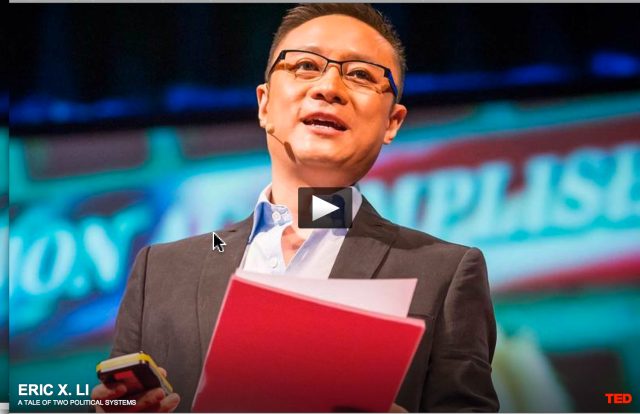
Eric X Li – “A Tale of Two Political Systems”

Eric X Li's Screen Shot

 It’s interesting to lend two attentive ears to Eric Li‘s view on the meritocracy of the One-Party System of Chinese government. Then you’d be the judge & jury on the question of legitimacy, adaptabiiity, competence, transparency & meritocracy.

Then truth will set you to rethink aboutDemocracy” being the only panacea to political, economic and social ills of nations so often asserted by the western world.

China‘s “We-can-do vision” & its political will & skill has outshone all other nations in the world. It’s a system evolved over thousand of years, though not perfect, but dynamic & ever changing for the better.

It’s unique & not exportable . . . it can perhaps be duplicated with some variations as in Singapore & Vietnam.

The reality of “Chinese Dream” will dawn sooner than expected.

In the Next Ten Yea

  • China will surpass the US & become the largest economy in the world; income per capita will be near the top of all developed countries.

  • Corruption will be curbed, not eliminated, and China will move up 10-20 notches to above 60 in TI ranking.

  • Economic reform will accelerate, political reform will continue, and the one-party system will be holding firm.

It’s a standard assumption in the West: As a society progresses, it eventually becomes a capitalist, multi-party democracy. Right? Eric X. Li, a Chinese investor and political scientist, begs to differ. In this provocative, boundary-pushing talk, he asks his audience to consider that there’s more than one way to run a successful modern nation.”

CLICK BELOW . . .

Eric X Li’s “A Tale of Two Political Systems” 

YouTube Video: 20:37 mins.


Ageing China

24 Paragons of Filial Piety 5
24 Paragons of Filial Piety 5 (Photo credit: Wikipedia)

Filial Piety

CHINA TG 946.jpg

China, a country steeped in traditional Confucianism of filial piety, the foundation of all social values, is without exception as with Japan, rapidly facing the changes & challenges of an aging population.

While the physical needs of the aged can be taken care of financially, their social, spiritual & emotional needs are in fact far more critical.

Can we expect the old folks to be left on their own in care or nursing homes? Left to their own accord to congregate among themselves to play Chinese chess, mahjong or tai-chi exercise, as they are fond of & popularly known to indulge?Many old folks complain about being left there alone at care or nursing homes without visits from their loved ones.

Without adequate safety net for the elderly & which is not quite in place, the staggering number & rapid growth of the aged are indeed scary.By 2050 more than a quarter of the population will be over 65 years old and younger generations face an unprecedented burden of care.The present figure stands at 180 millions. The enforced one-child policy & the fact that longevity is prolonged nationally at around 75 because of improvement in health & medical care further aggravate the situation.

The unprecedented growth of such sheer numbers will definitely pose a serious threat to China’s social fabric and economic stability.The planning & tasks ahead are enormous.

China has recently stirred family emotions with a new law making it compulsory for grown adults to visit their elderly parents. It states that adults must take care of their parents’ spiritual needs. The law is short on detail – frequency of visits or potential punishment, but courts could impose fines or jail terms. This is indeed a surprised move.

Another area of concern, both in China and globally, is the proportion of older people living alone. The UN estimates that 40 percent of the world’s elderly are living independently alone or with their spouse, with an big gap depending on where you live – urban or rural.

IMG_6132

So, is China right to make children legally obliged to look after their aged parents? Is the world ready to cope with a rapidly ageing population?


Old parents/grandparents, in their golden years of life, deserve to be well looked after & enjoy whatever leisure & pleasure that the diminishing years ahead of them have to offer.

It’s a shame that in this fast changing world, a lot of traditional practices are phasing out. Nothing pleases the old folks more or can replace the simple pleasure & joy of family reunions during birthday & anniversary celebrations, Spring festivals & others . . . or two, three or four generations simply coming together for meals. Now you see old folks selling off their family home and downsizing to live in apartments or care homes.

The Most Mysterious School in China . . . shaping China’s future

National emblem of the People's Republic of China
National emblem of the People’s Republic of China (Photo credit: Wikipedia)


Xi Jinping

Here is an interesting article you may care to read. It describes part of the extensive and arduous educational process necessary for those in China who show promise as national leaders.

Apart from the fact that China’s national leaders are a special selected elite bunch of highly-educated, knowledgable, trained & put to the mills, experienced & tested, their role as national leaders leaves you with little doubt of their suitability, competency, legitimacy & meritocracy.

A school that shapes China’s future

By Li Jing and Peng Yining (China Daily) – 2011-06-01

Group interviews were on the agenda last June when 70 journalists from home and abroad visited the Party School of the Central Committee of the Communist Party of China.This might be the most mysterious school in China. The gates are closely guarded by the People’s Armed Police, 24 hours a day, seven days a week.

Headmasters of this place, a training ground for future leaders of the Communist Party of China (CPC), are always one of the country’s vice-presidents, if not the president. Former headmasters include Mao Zedong, Liu Shaoqi and Hu Jintao.

It is also a haven where possible cures for China’s economic and social ills are discussed and debated, and where policy trends are set. By influencing decision-makers, experts say, the Central Party School is partly navigating the country’s development.

Situated next to the Summer Palace, an 18th century imperial retreat in suburban Beijing’s northwest, the Party School of the Central Committee of the Communist Party of China – the Central Party School – is like no other university or college in the country.

Without the usual hustle and bustle, the 100-hectare leafy campus is extremely quiet, and almost empty. There is no bicycle congestion. Instead, the roads outside school buildings are lined with black Audis, the German brand selected as the government’s official sedans.

The serenity and security are prepared for those who study there – provincial governors and ministers, young and middle-aged officials, their guest speakers and sometimes the country’s top leaders.

The speeches that top leaders deliver at the Central Party School, and their articles printed in the school’s publications, often signal new strategies and policies that will be adopted by the central government.

Seeking new solutions

The most recent example is the notion of innovative social governance – keeping a handle on social issues while fulfilling people’s fundamental interests – brought about amid growing public concerns over unbalanced and unsustainable development.

In February, at the opening ceremony of a seminar for provincial and ministerial officials at the school, President Hu Jintao called for new methods of social management in a bid to “ensure a harmonious and stable society full of vitality”, Xinhua News Agency reported. Hu acknowledged that the country is “still in a stage where many conflicts are likely to arise”, despite remarkable social and economic development.

In his speech, Hu highlighted the necessities to “improve the structure of social management”, which must be achieved through the Party committee’s leadership, government’s responsibilities, support from non-governmental organizations and public participation.

In March, at the annual sessions of the National People’s Congress and the Chinese People’s Political Consultative Conference National Committee, a proposal high on the agenda called for establishing a sound social management system with Chinese characteristics during the 12th Five-Year Plan (2011-2015) period.

More detailed plans have since been drafted, including one for a comprehensive and dynamic national population database. Zhou Yongkang, secretary of the Central Political and Legislative Affairs Committee of the Communist Party of China, made that proposal in an article published in Qiushi, the CPC central committee’s biweekly journal.

Steering the policymaking in China is a tradition for the Central Party School, according to Wang Haiguang, a professor in the school’s history department.

Broad range of programs

The Central Party School, founded in 1933 in Jiangxi province, has trained 61,024 officials under different types of programs.

Provincial and ministerial-level officials usually undergo two months of training on political science, public management, economy and history. Young and middle-aged officials spend six months to a year at the school, usually followed by a promotion.

Since 1981, the school also has offered postgraduate and doctoral programs for about 500 non-official students. They focus on philosophy, economics, laws, politics and the history of the Communist Party of China.

“The Central Party School has played an important role in several critical stages in China’s history,” Wang said. “In some way, it is partly navigating the country’s development through influencing decision-makers.”

Following the end of the “cultural revolution” (1966-1976), Hu Yaobang, then headmaster of the Central Party School, led a fervent discussion about the criterion for “testing truth” among the officials receiving training at the school.

At the time, whatever Mao said was regarded as the truth or principle to follow. The discussion led by Hu was whether this rule should continue.

The discussion was held in a stubborn social environment still dominated by the notion of “two whatevers” – “we will resolutely uphold whatever policy and decisions Chairman Mao made, and unswervingly follow whatever instructions Chairman Mao gave.”

It led to the publication in May 1978 of a commentary piece, titled “Practice Is the Sole Criterion for Testing Truth,” in Guangming Daily. The concept put forward in the article won approval by the majority of Party members, but it also touched off a fierce national debate.

The debate was believed to be a great movement to free the minds of Chinese people from personality cults, and also a solid ideological foundation for the economic reforms and opening-up that would follow.

Freedom of speech

Although outsiders expect the Central Party School to be conservative, the school tolerates free internal discussions, even without limits. Li Tao, a 27-year-old postgraduate student at the school, was surprised by the freedom of speech in class.

“Teachers told us there were no taboos in their teaching, and officials can debate on almost any sensitive issues in the country,” Li said. “This is actually a place of mind emancipation and free speech.”

“Officials might be discreet in talking to strangers or in public, but their internal discussion in class is unbounded,” said Wu Zhongmin, a professor at the Central Party School who focuses on social justice research. “Sometimes their opinions can be really audacious and revolutionary.

“The Central Party School is a place where officials and researchers debate about the future of the country and the Party,” Wu said. “They have to face the problems and find ways to solve them. Speaking empty words or simply flattering makes no sense here.”

Discussions are closely linked to the most sizzling social problems, such as illegal land grabs, inequality between rural and urban areas, and corruption. To give trainees a better understanding of these problems, the Central Party School sometimes invites outspoken scholars to give lectures.

One speaker, in 2009, was Yu Jianrong, head of the Rural Development Institute of the Chinese Academy of Social Sciences and a prominent advocate for farmers’ rights. He addressed the rapid urbanization that has resulted in farmland being taken up for construction projects and the use of the petition system for redress.

Some farmers, believing they had not been adequately compensated for their land, appealed to the petition system. But going over local officials’ heads by petitioning can lead to ill treatment by officials whose job performance is downgraded when they do not handle problems well locally.

Wang Changjiang, director of the school’s Party Building Teaching and Research Department, said officials are aware that mishandling such social problems could create greater chaos.

“China has so many problems now,” Wang said. “As the country’s governors, officials have no reason to ignore those problems. They must bear in mind that only reform and changes to the Party can help it stay in power.”

Social and economic changes also have led to changes in officials’ mindset, he said. In the early 1990s, higher ranked officials were unaware of some of the problems at the grassroots.

Wang said he met strong opposition from trainees when he tried to talk about democratic reform in 1996. But in recent years, more high-ranking Party leaders began to realize the need to carry out government reform following economic progress.

“The Central Party School might be the most ideal place for such discussions,” he said, “because you can’t find anywhere else where hundreds of high-ranking officials gather for months.”

International exchanges

Since the mid-1990s, the Central Party School has welcomed another group of guest speakers – top leaders from foreign countries – in a bid to give Chinese officials a wider horizon and better understanding of different cultures, values and political systems.

Most recently, Herman Van Rompuy, president of the European Council, gave a speech titled “Europe and China in an Interdependent World” on May 17 during his visit to Beijing. Besides talking about the economic crisis, he also addressed human rights, climate change and other concerns common to both Europe and China.

Xu Wei contributed to this report.

A Brief Look at China’s Government – Stuff You Thought You Knew, But Didn’t

Image

Looking at the western democratic governments these last 30 years, more negatives than positives are apparent. The latest to add to the fold of turmoil & instability is Egypt – an ancient civilisation that once held its glory & pride. US, so claimed as the master of western democracy, in its attempt to dominate & impose its system of government on others has itself been drowning in the ocean of economic woes & other problems.

In the article below, the Shanghai Chinese author presents to us the meritocratic system of the Chinese government that ignorant critics are quick to condemn. Knowing the truth will breed better understanding of the merits & the way the system works.

Deng Xiaoping referred to it as “capitalism with Chinese characteristics.”

Here’s to the Most Vocal & Unforgivably Uninformed . . . who will begin to understand why China has emerged as a major political and economic power on the international stage, and the pace of this growth has been astonishing.

China is like having the longest root of capitalism to capitalism. Its meritocracy is certainly a good or even better alternative to US imperial democracy.

Article by 龙信明 (Lung XinMing)

http://www.bearcanada.com/china/brieflookatchinasgovernment.html

A Bit of Background 

You probably already know that China has a system of annual university entrance examinations, taken by about 10 million students each year. This set of examinations is quite stiff and perhaps even harsh, covering many subjects and occupying three days. The tests require broad understanding, deep knowledge and high intelligence, if one is to do well. Any student whose results are near the top of the list, is in the top 2% or 3% of a pool of 1.5 billion people. 

Getting a high mark qualifies a student to enter one of the top two or three universities, which will virtually guarantee a great job on graduation, a high salary and a good life. Moving down the scale of results, the prospects become increasingly meager. You may not know that China also has a system of bar examinations which every graduate lawyer must pass in order to practice law in China. For these, we can bypass “stiff” and “harsh” and go directly to “severe”. Out of about 250,000 graduate lawyers who sit for the exam, only about 20,000 will pass and obtain qualifications to actually be a practicing lawyer in China. Once again, the exams require broad understanding of all matters legal, deep knowledge of the laws, and high intelligence. So if you happen to meet a Chinese lawyer, you can be assured you are dealing with someone from top 1% or 2% of a pool of 1.5 billion people.

I mention these two items only to introduce a third – the Civil Service Examinations.

Becoming a Government Official in China

The Imperial examinations were designed many centuries ago to select the best administrative officials for the state’s bureaucracy. They lasted as long as 72 hours, and required a great depth and breadth of knowledge to pass. It was an eminently fair system in that the exam itself had no qualifications. Almost anyone, even from the least educated family in the poorest town, could sit the exam and, if that person did well enough, he or she could join the civil service and potentially rise to the top. The modern civil service examination system evolved from the imperial one, and today, millions of graduates write these each year. And for these, we can bypass “severe” and go directly to “brutal”, because out of the millions of candidates only about 10,000 will get a pass.

The Chinese Have High Standards

And that pass doesn’t get you a job; all it gets you is an interview. If you meet anyone in China’s central government, you can rest assured you are speaking to a person who is not only exceptionally well educated and knowledgeable on a broad range of national issues but is in the top 1% of a pool of 1.5 billion people. Moreover, China’s government officials are all highly-educated and trained engineers, economists, sociologists, scientists, often at a Ph.D. level. 

Contrast this with the Western system where most politicians are either lawyers or those with no useful education. We should also remember that the Chinese generally score about 10% higher on standard IQ tests than do Caucasian Westerners, and couple this with the Chinese process of weeding out all but the top 1% from consideration. When you add further the prospect of doing your weeding from a pool of 1.5 billion people, you might expect China’s Central Government to be rather better qualified than that of most other countries. And it is. 

The point of this is to bring your attention to the disparity between the quality of ‘politicians’ in Western countries and China’s government officials. The discrepancy is so vast that comparisons are largely meaningless.

Friends, Family and ‘Connections’ 

There are some who will tell you that family connections in China can produce a government job for some favored son, a claim that may be true in some places though extremely difficult at the national level. But no amount of ‘connections’ will move you into senior positions or to the top of decision-making power; those places are reserved for persons of deep experience and proven ability. “Of the Communist Party’s highest ruling body, the 25-member Politburo, only seven came from any background of wealth or power. The rest of them, including the president and the prime minister, were from ordinary backgrounds with no special advantages. They worked and competed all the way to the top. 

In the larger Central Committee, those with privileged backgrounds are even scarcer. A visit to any top university campus in China would make it obvious to anyone that the Communist Party continues to attract the best and the brightest of the country’s youth. In fact, China’s Communist Party may be one of the most meritocratic and upwardly mobile major political organizations in the world – far more meritocratic than the ruling elites of most Western countries and the vast majority of developing countries.” 

(1)Choosing the Nation’s Leaders 

Consider how it would be if a Western country could identify and assemble the 300 best, brightest, wisest, most educated and experienced people in the nation, men and women of great proportion whose depth and breadth of knowledge and ability were the envy of all. And consider this group selecting some to be their leaders – the Prime Minister, President, Cabinet members. That’s essentially how China does it. On what basis can we tell them their way is wrong? For Westerners to refer to this as a dictatorship is offensive and merely stupid. 

In contradistinction to the West, China’s system cannot produce incompetence at the top because in a population of 1.5 billion people there are just too many available candidates with stunningly impressive credentials. In China’s system, leaders and officials are evaluated and selected by their peers, not by the unqualified and uninformed ‘man in the street’. It is the only government system in the world that ensures competence at the top, because these people are evaluated on the basis of real credentials rather than public popularity or TV charisma. 

Leaders are selected on the basis of true leadership, on their ability to bring together all factions, to create harmony and consensus on their realisable vision for the country, to wisely control and direct the military. They have a firm understanding of the economy, of the nation, of society and its problems and the best way to meet them. They are not only admired and respected by their peers, but able to draw others to them in order to form that consensus and harmony that are so desirable and necessary for stability.

Education and Training of Government Officials 

There is another factor to consider, that of education and training. In the West, senior government officials – the politicians – are seldom renowned for competence or even intelligence. For the Western politicians who who exercise all the real decision power to shape a country, there is no education or training available or required. It is all a kind of ‘earn while you learn’ system. 

In China, those who will become the senior officials and civil servants have entered a lifelong career in a formidable meritocracy where promotion and responsibility can be obtained only by demonstrated ability. Once in the system, the education and training are never-ending. The system is generally well understood within China, and it meshes well with Chinese culture and tradition as well as conforming to the Chinese psyche in their Confucian overview and their desire for social order and (yes) harmony. The Western world understands this dimly, if at all, and inevitably forms incorrect and often absurd conclusions about China and its government – especially the mindless references to China being a ‘dictatorship’.

The President Goes to School 

The Central Party School in Beijing has been called the most mysterious school in China, and is like no other university or college anywhere. Here is a link to an article on this university that will give you more information: Read here. At various times, the most promising young and middle-aged officials attend this university for up to a year at a time, to expand their knowledge and understanding of all issues relating to China. 

The Headmaster of the school is often the President of China, and the lecturers are usually foreign dignitaries, high-level officials, and renowned experts on everything from economics and international finance to social policy, foreign policy, industrial policy and even military matters. The cornerstone of the school’s educational policy is that everything is on the table. There are no forbidden topics, and even reactionary, revolutionary or just plain whacky positions are discussed, analysed and debated to resolution. All manner of planning, problems, solutions, alternatives, will be discussed, examined, debated, explained, with any number of prominent experts available as reference material. 

When these sessions are completed, all students will have an MBA-level or better appreciation of the entire subject. And this is only one subject of many they will encounter. When you consider that these officials entered the government with an already high level of education, and with an already demonstrated broad level of understanding and exceptional intelligence, these additional layers of training and education cannot help but produce an impressive level of overall knowledge and ability throughout the government. Nothing like this system exists in the West, which is why senior civil servants in most Western countries often look on their leader-politicians with a mixture of disdain and contempt for their lack of knowledge and ability.

The Functioning of China’s Government 

Few Westerners have bothered to learn even the simple basics about the form of China’s government, preferring instead to parrot foolish Western supremacist nonsense about China being a dictatorship. China has a one-party government. 

If you listen to Western ideologues, you will be told this is heresy in the eyes of the Gods of Government in 6 galaxies. But it is no such thing, and contains enormous advantages. Here, there is no forced separation of officials on the basis of political ideology. China’s entire social spectrum is represented in government in the same way as in Chinese – or any other – society.

There is no partisan in-fighting. 

Unlike the West, China’s system looks for consensus rather than conflict. Government decision-making is not a sport where my team has to win. It is simply a group of people with various viewpoints working together to obtain a consensus for policy and action for the overall good of their nation. From everything I have seen, China’s one-party system is superior in many respects to what we have in the West. This is what has produced a growth rate of over 10% per year for 30 years, compared to perhaps 3% in the West. And how can it be otherwise? 

China’s government doesn’t waste its time fighting juvenile ideological battles with ‘opposition parties’, but instead everyone gets down to the business of doing the best for the nation. China’s government leaders manage by consensus, not by power, authority or bullying. It is their job to create agreement and unified willing participation in the country’s policies to meet its goals. At this level there are no children, and there is no one person with the power to start a war just because he doesn’t like someone, or who is free to alienate other nations on the basis of some blind personal ideology.

Lobbying and Influence 

In China, many people and industries are permitted to present their case, but private or short-term interests will not emerge victorious in this system. Your proposals will receive support and will succeed only if they are to the long-term benefit of the country as a whole – the greatest good for the nation and for the population. That’s how it works. In the US system, corporations control the government; in China’s, the government controls the corporations. And those firms may often not get their way even if they are government-owned. Consider the introduction of HSR (High-Speed Rail) in China. Some Chinese airlines (especially the state-owned ones), complained like hell, and with good reason, about the inauguration of HSR. Some have had to dramatically scale back their flight schedules because many people prefer the train. But the wide HSR network was seen as being in the best interests of the entire country and it went ahead. Read more here. That is also why China has the best (and cheapest) mobile phone system in the world. Read more here.

The “Loyal Opposition” 

China’s system also has an ‘opposition’, but this body has two major differences from Western governments. Also, it functions intelligently, so let’s make that three major differences. First, it does not function to ‘oppose’ but rather to consult. This body is charged with the responsibility to consider not only the government’s directions and policies but also to devise alternatives and make recommendations. And the government must by law consider and respond to all these consultations – which it does. Second, this opposition group are not the marginalised ‘losers’ as in the Western systems but a second tier of extremely competent people who were not selected to the top governing positions. And, rather than lose all this expertise, this secondary group was created to contribute to the development of their country.

The Success of Government 

Probably the greatest deciding factor permitting China’s rise is the political environment. China’s one-party government is in for the long term; it makes no short-term decisions for the sake of political expediency. China makes decisions for the good of the whole country and, having made them, implements them. 

There is no partisanship, no lobbyists, no special interest groups that skew these important decisions and rob the population of what they might have had. 

The benefits of this system can be seen in its results. China has already far surpassed the undeveloped nations that adopted Western democratic governments,and likely has a brighter future than most of them. Why is the West so eager for China to abandon a centuries-old system that clearly works well, in favor of one designed for ideological battles, conflicts and shouting wars? Many foreign observers are now, (finally) admitting openly that China’s form of government exhibits signs of superiority over Western systems, and that it is largely responsible for China’s efficiency, for its rapid development, and for its speed of response in areas like the Sichuan earthquake and the planning and deployment of its high-speed train system. 

The “Free World” could learn a lot from China’s government system. It works, beautifully. It has transformed the economy and brought hundreds of millions out of poverty. It has put men into space, built the world’s fastest trains, the longest undersea tunnels, the world’s longest bridges, the largest dams. 

It is rapidly creating the world’s largest genuine middle class. And it’s hardly begun. (1) From an article by Eric Li.