China’s Rich Cultural Heritage

By P Chong                                                                                                       1 March 2011

China’s 56 Ethnic Minorities

Multiculturalism as practised in China is unique & unprecedented. It reflects diversity in unity & unity in diversity. It means on one hand the pride of conservation & presentation and on the other acceptance & respect by one & all.

In the atmosphere of peace & harmonious living, the minority groups are separate and yet integrated. As a matter of fact, with their fluency in Mandarin, the national language of China, any visitor would say that they are well assimilated and fully integrated in the society mainstream.

China’s ancient operas, performing arts, and other cultural legacies now have legal protections. The top legislature, the National People’s Congress Standing Committee, passed a new law on Friday 25 February 2011 to protect the country’s intangible cultural heritage.

China's Ethnic Minorities

Sun Anmin, member of NPC Standing Committee, said, “China’s thriving culture industry in the past few decades is in a large part owed to the increased tapping of intangible cultural heritage. As such, I believe it is important to emphasize rational exploitation, and protection. So we can have both effective use and protection at the same time.”

With an ancient history and diverse culture, China has a wealth of intangible cultural heritage. Just what new forms they will take and how they will develop are in the hands who love them – both Chinese and foreigners. Xie Zheng, CCTV reporter, said, “The passage of the new law is a milestone in China’s protection of its intangible cultural heritage. After all, a people without heritage fails its cultural identity, and the world without cultural diversity will be one that is too dull.”
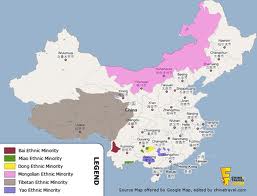
Distribution of the Ethnic Minorities

China is a big and united family made up of 56 ethnic groups. Geographically speaking, they are distributed in different parts of China with the resulting difficulty of experiencing each ethnic group‘s architecture, their festivals and tasting their snacks during one of your visits.

Bai Minority

But the China Folk Cultural Village, lying at the Overseas Chinese Town, Shenzhen, will help solve this problem. It is the first spot in China where you can learn of the folk cultures of China. More than 200,000 square meters have

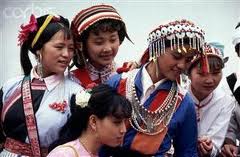
Miao Artist Song Zuying

Dai or Tai Minority

been made available to accommodate 24 peculiar cottages making up the cultural village to welcome visitors & tourists.

In the village, you will see the distinctive architecture of ethnic groups and can join in their brilliant festivals. Buying handicrafts or tasting local snacks is another way to experience the China Folk Culture Village.

Officially recognized, the following are the most numerous of the ethnic groups in mainland China:

  1. Han 漢族 1,230,117,207
  2. Zhuang 壯族 16,178,811
  3. Man 滿族 10,682,263
  4. Hui 回族 9,816,802
  5. Miao 苗族 8,940,116
  6. Uyghur 維吾爾族 8,399,393
  7. Tujia 土家族 8,028,133
  8. Yi 彝族 7,762,286
  9. Mongo 蒙古族 5,813,947
  1. Zang 藏族 5t,416,021 Source: Wikipedia (This page was last modified on 16 February 2011 at 07:40).

In our tour of Yunnan, we had the chance of meeting the Naxi 納西族 (308,839) and also the Bai 白族 (1,858,063). Many of the Naxi girls that we met are largely involved in driving taxis or running food stalls. Many are pretty but are conscious of their dark complexion. They speak perfect Mandarin and one that we met in the silk embroidery factory even has a college education and speaks good English.

The Naxi Ethnic Minority

Foreigners would love to marry these Naxis, for by tradition, they are the ones who work while the men are privileged to play. All responsibilities of life fall strictly upon the women. Naxi men are known to play & sing all day, drink, smoke & make merry . . . as though there’s no tomorrow!

Naxi women are traditionally forbidden to marry outside their cultural group. Modern educated Naxi girls however would rebel and much prefer to marry a Han man any time.

Miao MinorityTibetan Ethnic Minority


Guangzhou – Venue of 2010 Asian Games

By P Chong                                                                  26 February 2011

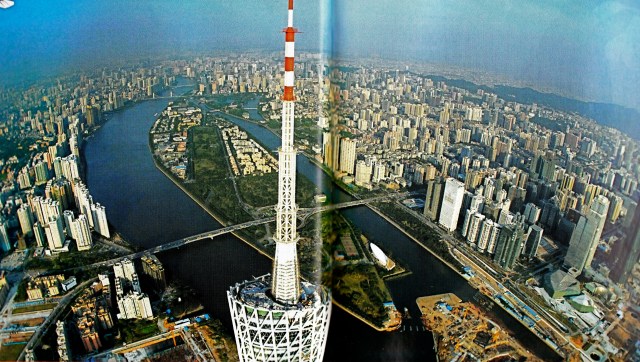
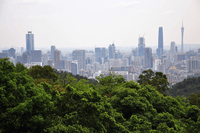
Panoramic Guangzhou
In the grip of nostalgia, I revisited Guangzhou in November 2010. I was first there in 1989 when it was no more than an“international sprawling village” with old derelict buildings, narrow twisted streets & lanes . . . so very crowded with both people & bicycles. Today, there is only one word to describe the scenes that greet the eyes – unbelievable! It’s a miraculous transformation!
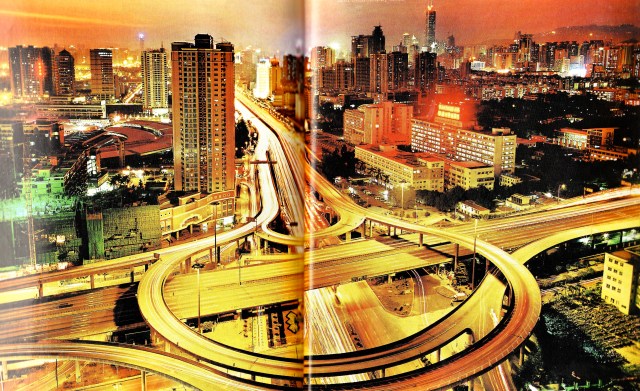
Guangzhou Traffic Network
Guangzhou, known invariably as Flower City & City of Rams, is a historic-cultural city with a history of 2200 years. Today, it’s an economic power-house in the south of China. Its growth is phenomenal and as part of the conglomerate group of the nine cities to form the largest megapolis in the world, it will continue to spearhead the future growth of the Pearl River Delta region. (Please refer “China – World’s Largest Megapolis” on 25 February 2011).

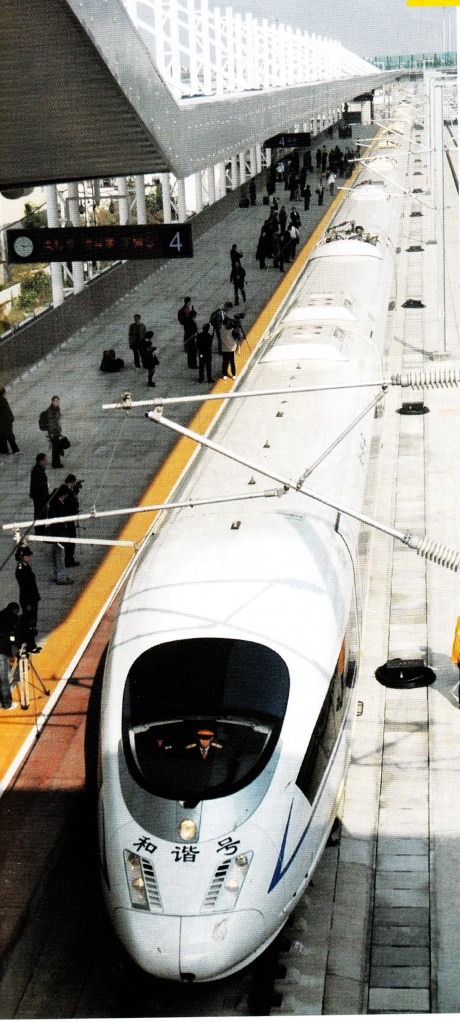
Modern Guangzhou with 11.7 million population has everything that an international megacity has to offer – a sprawling network of highways, super bullet train network links, underground commuting network, super shopping malls, high-rise skyscrapers, parks & gardens, top-class hotels, entertainment, golf courses, theme park resorts . . . and rightly playing host to the 16th Asian Games and making it the largest & grandest ever.

CRH Bullet Train

As with all the major tourist places, first class hotels were sprouting up everywhere to usher in tourists in the 1980s. Guangzhou then boasted of its famous White Swan Hotel, located on the historical Shamian Island, the old concession zone during the late 19th century and early 20th century (where dogs and Chinese were forbidden). It overlooks the Pearl River and faces the White Swan Lake. Reached by its own private 635 meters causeway, the White Swan Hotel is only 10-minutes drive from downtown and 1-hour drive from New Baiyun International Airport.


Opened in 1983 and refurbished in 2002, it is still majestic though there are now many other 5-star hotels. The White Swan Hotel boasts of a total of 843 exquisitely decorated and well appointed guest-rooms. All rooms and suites are comfortably furnished and well-equipped with modern amenities. The restaurants in the hotel offer a wonderful variety of Chinese and Western food. Fitness and entertainment facilities in the White Swan Hotel include swimming pools, gymnasium, sauna and massage room, squash and table-tennis room and so on.

It is best known for its elegant design and high quality service. Its lobby is featured with a tropical waterfall and a display of many huge jade carvings. The hotel used to receive visiting foreign heads and government officials and was regarded as the landmark building of the city of Guangzhou in 1980s and 1990s. The hotel amenities even include a toy room sponsored by Mattel that provides toys for children of every age and gender.

Shamian used to be a place where foreign enterprises concentrated with a lot of western- style buildings. Now Shamian has become a beautiful city park with cafes and bars here & there.

Having stayed there during our first visit to China in 1989, it’s really reminiscent to be seeing it again after more than two decades.


World’s Largest Family

Indian man has 39 wives, 94 children, 33 grandchildren.

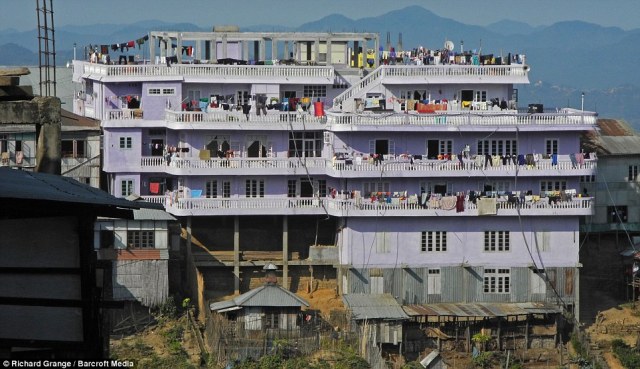
100-Room Mansion to house the Family


Five of the wives

We have heard of Emperors and Maharajahs having concubines and harems, but here’s Ziona Chana, a 66-year-old Indian man who has 39 wives, 94 children, 14 daughters-in-law and 33 grandchildren, is probably the head of the world’s biggest family, according to Reuters.

The big family lives in a four-storey mansion with 100 rooms in a village in Mizoram, northeast India. Chana’s wives and children live in different rooms but share one kitchen.

Chana said that he in his younger days once married 10 women in only one year. He enjoys his own double bed while his wives have to make do with communal dormitories. He keeps the youngest women near to his bedroom with the older members of the family sleeping further away – and there is a rotation system for who visits Mr Chana’s bedroom.

He considered himself a lucky man since he is given so many people to look after. Mr Chana told the Sun: ‘Today I feel like God‘s special child. He’s given me so many people to look after. I consider myself a lucky man to be the husband of 39 women and head of the world’s largest family.’

Although Chana has already had a 167-member family, he still would like to expand it and “go to any extent to marry. ”To expand my sect, I am willing to go even to the U.S. to marry,” he said. One of his sons insisted that Mr Chana, whose grandfather also had many wives, marries the poor women from the village so he can look after them.

Rinkmini, one of Mr Chana’s wives who is 35 years old, said: ‘We stay around him as he is the most important person in the house. He is the most handsome person in the village.

She says Mr Chana noticed her on a morning walk in the village 18 years ago and wrote her a letter asking for her hand in marriage.

Another of his wives, Huntharnghanki, said the entire family gets along well. The family system is reportedly based on ‘mutual love and respect’ And Mr Chana, whose religious sect has 4,000 members, says he has not stopped looking for new wives.

The family is organised with almost military discipline, with the oldest wife Zathiangi organising her fellow partners to perform household chores such as cleaning, washing and preparing meals.

One evening meal can see them pluck 30 chickens, peel 132lb of potatoes and boil up to 220lb of rice.

Chana is also the head of a local Christian religious sect which allows polygamy.

One of his sons insisted that Mr Chana, whose grandfather also had many wives, marries the poor women from the village so he can look after them.

Source: China Daily


China – World’s Biggest Megalopolis with 42 Million !

Pearl River Delta area, showing boundaries of ...
Pearl River Delta area, showing boundaries of the Special Administrative Regions of Hong Kong and Macau (in green), and the bordering Guangdong Prefectures Map drawn in October 2007 using various sources, mainly : Map of the Pearl River Delta from http://www.johomaps.com Map of administrative boundaries from http://www.hydrocarbons-technology.com (Photo credit: Wikipedia)

By P Chong                                                                         25 February 2011

Million population cities in China are a dime a dozen. According to a Mckinsey Report, China by 2025, will have 219 cities with more than one million inhabitants, compared with 35 in Europe today and 24 cities with more than five million people. China doesn’t do things by halves. Take the Three Gorges Dam for instance – it’s the largest hydroelectric project in the worldcosting some $39 billion to build. China builds around 20 brand new cities each year – a phenomenal scale the world has ever known.

Now the ‘Turn The Pearl River Delta Into One’ scheme will build a 16,000 square mile urban area that is 26 times larger than Greater London, or twice the size of Wales, says The Telegraph report. This will be equivalent to the size of Switzerland.

The Chinese government has announced plans to amalgamate the nine major cities in the Pearl River Delta (home to a manufacturing-driven economic boom) into a single city with a population of 42 or more million people (more than Argentina, the world’s 32nd largest country), occupying an area twice the size of Wales. The “Turn The Pearl River Delta Into One” will link all of these centers by high-speed rail links that will put every point in the new megacity within an hour’s journey of every other point.

The plan, announced in state media, would unite several existing cities in the prosperous Pearl River Delta region, including Guangzhou (12 million), Shenzhen (8.6 million), Dongguan (6.9 million) and six smaller cities. Together, these cities already account for about 10% of China’s economy. All these cities lie around the Pearl River Delta, and unsurprisingly the plan has been dubbed the “Turn The Pearl River Delta Into One” scheme.

Guangzhou

The ambitious plan will see China attempt to combine over 150 major infrastructure projects including transport, energy, water and telecommunications networks over the next six years. This alone is expected to cost £190 billion. On top of this, an express rail line is will be constructed to connect the mega-city with nearby Hong Kong. Twenty-nine rail lines, totalling 3,100 miles, are to be constructed to reduce rail journeys around the urban area between the different city centers to a maximum of one hour of journey. Hospitals and schools will be improved as a result of the development.

Shenzhen

The idea is that when the cities are integrated, the residents can travel around freely and use the health care and other facilities in the different areas,” said Ma Xiangming, the chief planner at the Guangdong Rural and Urban Planning Institute and a senior consultant on the project. He continued, ”It will help spread industry and jobs more evenly across the region and public services will also be distributed more fairly.”

On the green side, pollution, which is a major problem in the Pearl River Delta due to the major industry cities, is to be addressed with an “united policy.”

The long-term plan for China is to move ever greater numbers into its cities, creating some city zones with 50 million to 100 million people and “small” city clusters of 10 million to 25 million.

Briefly, to sum up what Ma Xiangming said:

  • The infrastructure project to be built over 10 years will link around 150 projects in transport, energy, water and telecommunication networks of the nine cities together with an express rail line connecting the hub with commercial Hong Kong.
  • “The idea is that when the cities are integrated, the residents can travel around freely and use the health care and other facilities in the different areas.”
  • The new mega city will help spread industry and jobs more evenly across the region and public services will also be distributed more fairly.
  • Rail journeys around the urban area will be cut to a maximum of one hour between different city centers helped by the inclusion of 29 rail lines totaling 3,100 miles, the report quoted Xiangming as saying.
  • Chinese planners believe the project will help in reducing phone bills by 85 percent as also improve conditions of hospitals and schools. The mega city project also expects to address the issue of pollution caused by industrialization around the Pearl River Delta.

A specialized conglomerate of nine cities into One Megapolis of 42 million people

Its total urban infrastructure investment will equal about £685 billion over the next five years while, by 2025, it will have added some 350 million city-dwellers to its population.

As in a grand prix race, while you stall others will roar. China is doing all that it positively can to be in the lead.

Would the name “Pearl-Megalopolis” be apt for the unnamed megacity?

Source: The Telegraph

World’s Longest Cross-Sea Bridge – The Pearl River Delta Bridge

By P Chong

24 February 2011

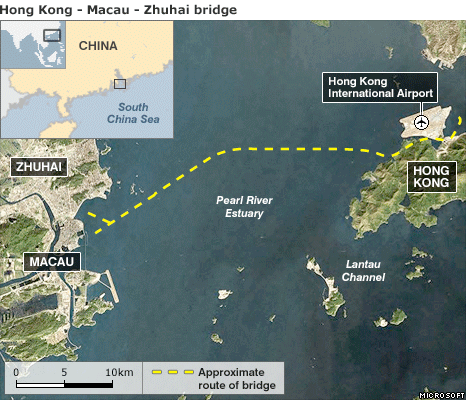
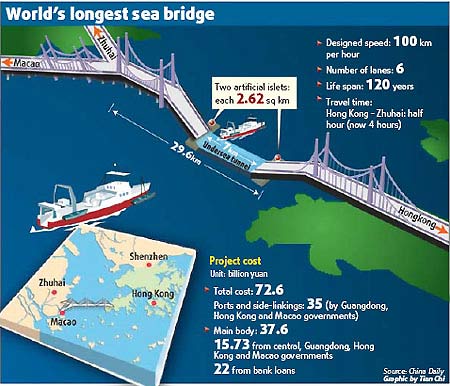
It’s absolutely mind boggling to even think of it! It’s been a dream for the last decade and that dream is now becoming a reality. China never does things in half measures. China has begun constructing a bridge to link southern Guangdong province, China‘s main manufacturing hub, with Hong Kong and Macao. When completed by 2016, officials say it will be the world’s “longest sea-crossing bridge” – spanning nearly 50km (30 miles). One branch of the bridge will reach Zhuhai in Guangdong province.

Pearl River Delta Bridge


The bridge will be a six-lane expressway that can withstand earthquakes up to 8.0 magnitude, strong typhoons and the impact of a 300,000 tonne vessel, said Zhu Yongling, one of the officials leading the project. (This is just the prelude to even greater projects to come in the wake of “Turn The Pearl River Delta Into One”. More details to follow after this article).

Thirty-five kilometres of it will be over water. Driving times between Zhuhai and Macau to Hong Kong will be cut from three hours to about 30 minutes. According to the China Daily, Guangdong has reached an agreement with Hong Kong and Macao on funding. “The bridge will cost 42.2 billion yuan ($5.9 billion). The project will be partly funded by the governments of the three neighbouring regions, and the rest will be raised through public bidding,” Governor Huang Huahua, who is also a deputy to the 11th NPC, told reporters on the sidelines of the annual session of the top legislature.

An artist’s impression of the completed bridge

Summary Facts:

  • About 30 km long.
  • Total investment of about 42.2 billion yuan ($5.9 billion), instead of 36 billion yuan previously estimated.
  • Toll charge for 50 years, investment to be recovered in 37 years.
  • Reduces travel time between Hong Kong-Zhuhai and Hong Kong-Macao from about six hours currently to less than an hour.
  • It will consequently help to reduce transport costs.
  • The three already enjoy close economic ties, but they must contend with a complicated network of ferries and zigzagging roads for transportation. This will be an excellent short-cut.

The project is expected to boost economic development in the region and improve the comprehensive competitiveness of the Pearl River Delta area, experts said.

Guangdong has been a key laboratory for experiments involving the country’s reform and opening up policy over the past 30 years. The southern province saw its gross domestic product rise 14.5 percent year-on-year in 2007, to 3 trillion yuan, accounting for about one-eighth of the country’s total. The plan to build the cross-sea bridge is just one of the moves Guangdong has made to strengthen its economic cooperation with Hong Kong and Macao.

Huang said the provincial authorities will invest in infrastructure in the Pearl River Delta, which has become a magnet for overseas investors, particularly from Hong Kong and Macao.

A complex rail transit network is also in the pipeline that will one day ensure that a journey between any two cities in the region takes less than one hour, Huang said.

The governor said he expects Shenzhen, which is the closest city to Hong Kong, to set an example for the whole province’s close relations with the special administrative region.

According to projections more than 200 million vehicles a year will be using the bridge by 2020, carrying 170-220 million tons of freight.

“Through a more convenient and fast transport network, Hong Kong’s financial, tourism, trade and logistics and professional services can become better integrated with the Pearl River Delta and the surrounding areas,” said Donald Tsang, Hong Kong’s Chief Executive, at a ceremony launching the project.

Indicative of the importance Beijing has attached to the project, the Chinese vice-premier Li Keqiang, the man widely tipped to succeed the prime minister Wen Jiabao in 2012, was on hand to inaugurate construction.

Make 2016 a date in your travel calendar to visit

this Special Economic Zone region to witness

the splendour & magnificence of

the economic wonder that China has in store for you!


Source: The Telegraph & Chinese Daily


Yunnan – “The Southern Clouds” in China

By P Chong

23 Feb. 2011


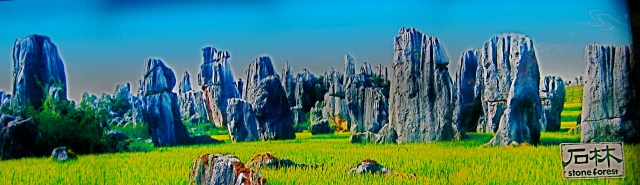
Stone Forest, Kunming

Yunnan is endlessly a place of fascination

Surpassing many well-trodden places

To delight the hearts & souls

With hills & valleys away from shores

With rivers & streams gurglingly flow

Through its streets both new & old

Beneath its natural clear blue sky

From its distant snow-capped mountains

To the lakes & canals of its cities & towns.


Yunnan - Tourist Map

Though occupying only about 4.1% of China‘s landmass, it contains 25 different ethnic minorities reflecting the most culturally diverse province in China & the national realm of harmonious living in unity in diversities.

From the UNESCO listed Stone Forest of Kunming, the Capital of Yunnan, an unique karst topography, depicting the concrete jungle of modern metropolitan China to the age-old towns of Dali or Lijiang, the traveller can feel the pulse of China’s economic surge while being reminded of a land unsurpassed in history & culture.

Electric Tourist Cart for Rounding Stone Forest. Entrance: Seniors FREE.

This plateau land in the south-west corner of China beckons to you, one & all, though for the seniors, I would suggest that you’re fit to truly enjoy the many natural spots of interests, without having to worry about aching feet or weary & painful backs. The are certainly lots of cobble-stone roads to trudge, laborious steps & stairs to ascend or descend, jostling crowds to mingle with . . . ceaseless streets with surprising turns of fun & joy.

Dali Against Its Snow-Capped Moutain (Cangshan)
Erhai Lake, Dali
City Wall & Tourist Taxi Van

For the ‘shopperholics’, the narrow streets are lined with quaint little shops filled with leather goods of sorts, souvenirs both old & new, clothing, jade, silverware & porcelain ware. The atmosphere is one of festivities, colours everywhere with red as the dominant choice for prosperity & good fortune.

Street Scene

The crowd is predominantly young. I would say 99% of them with a sprinkle of senior members & foreigners. Thousands of these tourists are Chinese nationals. This is such a prominent feature everywhere you turn . . . young & vibrant, mobile, modern tech population group with time to spare & money to spend. Virtually everyone, male or female alike, is equipped with the mobile phone, the popular iPhone or other smart phones.

Both Dali & Lijiang have preserved their ancient enclosed or walled townships where visitors & tourists are encouraged to stay rather than in their developed new areas and experience of a life of an era gone by.


Local Snack Food Galore


Town Square - Cobble-Stone
Stone Forest, Kunming

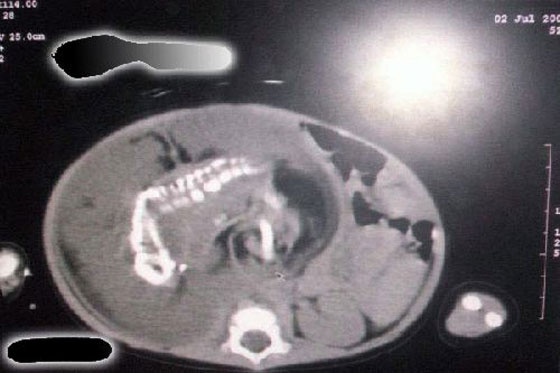
Believe It Or Not – One Year Old Child Is Pregnant!

By P Chong                                                                    Sat. 30 Oct. 2010


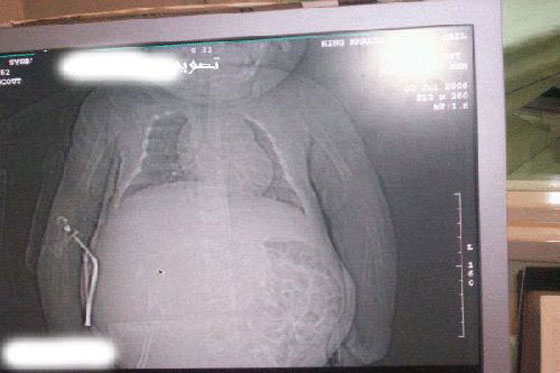
From the Virtual Fun Zone site came this amazing unbelievable story: “One Year Child Is Pregnant”! This news is indeed the most popular & shocking news on the web! It’s true. Believe it or not!

It is reported that a one year old child has been found pregnant in Saudi Arabia. Doctor says it’s a unique case for this world! Medical Science Report says : “When the mother of this child was pregnant, she had 2 foetuses inside her. But one of the foetus grew inside the other, this why this girl was born with the other foetus inside her womb.”


I am only guessing . . . this must be one in a million chance that such a natural phenomenon or freak occurred. Many questions come to mind:

    • Will the pregnancy be allowed to continue?
    • How will the little child mother cope?
    • If allowed to continue, will the foetus grow normally?
    • What medical ethics are there to rule in such a case?


Perhaps you have more questions to ask . . .


Here are some more pictures from the hospital:


Source: http://virtualfunzone.com/1-year-old-child-is-pregnant.html


China’s Great Engineering Feat: The Three Gorges Dam

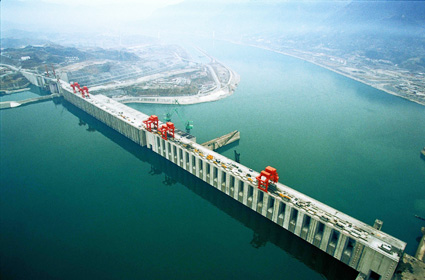
Three Gorges Dam in 2006
Image via Wikipedia

By P Chong                                              Fri. 29 Oct. 2010

长江三峡大坝

AP/Cheng Min

The Yangtze has long been China‘s famed attraction for cruises up the spectacular Three Gorges. There was much controversy when the government embarked & relentless touted on its humongous $23 billion hydro-electric dam project as the best solution to end centuries of floods along the mighty Yangtze & no less to boost & fuel China’s economic boom. It is now completed & generating electricity at full capacity. This is yet another China’s engineering feat.

In the construction process, millions have been displaced and great swaths of productive farmland sacrificed. Geologists have warned that damming up too much water in the reservoir carries a heightened risk of landslides, earthquakes and prolonged damage to the river’s ecology. Wary of such dangers, the dam officials will in the future maintain the water level, depending on flood-control needs, to within 100 feet (30 meters) of the maximum.

Company Chairman Cao Guangjing called its feat a “historical milestone.” He said annual power generation will reach 84.7 billion kilowatt hours, enabling “the project to fulfil its functions of flood control, power generation, navigation and water diversion to the full.”

The Modern Seventh Wonder of the World?

The growth & surge in China’s economic development in the last three decades have resulted in many fields of human endeavour such as launching of three manned space flights, the building of the rail connection between Beijing & Lhasa across the high altitude of the Tibetan Plateau and embarking on building the nation’s network of high-speed rail, something which even US is without.

The staging of the very successful 2008 Beijing Olympics and the present mammoth Shanghai World Expo all add up to the enhancement of China’s international image & power to demonstrate its ability & managerial sophistication. While others stall in the wake of economic crisis, China roars ahead in building its infrastructures on an enormous scale.

This massive project will be remembered for the greatest number of people displaced (more than 1.2 million), number of cities and towns flooded (13 cities, 140 towns, 1,350 villages), and length of reservoir (more than 600 kilometers).

In the field of human endeavour, the race always go to the swift & the smart . . . for when you stall . . . others will roar!


China’s Engineering Might: Bullet Train

By P Chong                                             Thurs. 28 Oct. 2010

AP/Eugene Hoshiko

The image of a powerful modern China in all its mega-engineering projects simply staggers the mind of the Westerners especially the British who first initiated and engineered the Industrial Revolution. In a matter of three decades or so, China has acquired Western technology & set new heights beyond all past human innovative spirit. Even the American standards have been surpassed. This is China’s era.


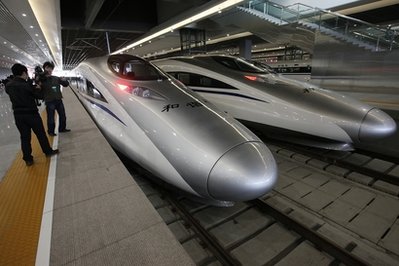
With the closing of the Shanghai‘s Expo by 31 October 2010, China is rolling out its new high-speed trains, shaped like bullets, linking Shanghai & Hangzhou, the Three Gorges Dam which is already working & generating hydro-electricity at full capacities.


More mega projects are still in the works: nuclear power plants, a gargantuan project to pump river water from the fertile south to the arid north, & a $32.5 billion, 820-mile (1,300 kilometre) Beijing-to-Shanghai high-speed railway link scheduled to be opened in 2012. China’s engineering triumphs & the nation’s growing ambitions are in line with its economic boom. (Read by same author: “If You Stall . . . Others Roar”).

Completely New Railway Station

On the railway front, its technology is second to none. “We are now much faster,” Railway Ministry spokesman Wang Yongping said at Tuesday’s inauguration of the super-fast line from Shanghai’s western suburb of Hongqiao to the resort city of Hangzhou. “Now other countries are hoping to cooperate with us.” The train will cruise at a top speed of 220 mph (350 kph), making the 125-mile (200-kilometre) trip in 45 minutes.

Pretty Rail Stewardesses At Your Service

Although China holds the patents on the technology, design and equipment used by the CRH380 train, some in the industry question the degree to which China is justified in claiming the latest technology as its own. In a recent interview, Michael Clausecker, Director General of Unife, the Association of the European Rail Industry said, “Everybody knows that a lot of the core technology is European”.


The benefits of high-speed railway are obvious, but with speed costs soar and people are reluctant to pay higher fares particularly on shorter routes. However, the government has embarked on upgrading the whole national network.

A Female Construction Worker Watches As Train Passes By

Cancer: Man’s Own Doing?

By P Chong                                                             Mon. 25 Oct. 2010

Blood runs through our veins

In modern day living Cancer is the bane.

Google Picture of Mummy

When young I had often wonder why the study of archaeology or anthropology. I just couldn’t visualise the benefits to the living human. Directly or indirectly, they have much relevance & reveal hidden knowledge to the medical field. For instance, archaeology & the study of Egypt mummies have proved that cancer was extremely rare in ancient times.

Leading medical researchers are led to conclude from archaeological findings that cancer is a relatively modern disease, brought on by our lifestyle & diet – being most endemic in industrialised societies. Could this be conclusive?

National Geographic: Breast Cancer Survivors

US-based writer & investigator Terrence Aym’s article on “Egyptian Mummies Prove Cancer Is Man-Made” claims that while “cancer kills millions of people annually . . . the strange fact is that there is no trace of the insidious killer among the remains of ancient peoples”.

Professor Michael Zimmerman, the US biologist, recently declared in an interview with a British newspaper, “In an ancient society lacking surgical intervention, evidence of cancer should remain in all cases”. However, in a study of the Egyptian mummies, it simply does not exist. Zimmerman concluded “The virtual absence of malignancies in mummies must be interpreted as indicating their rarity in antiquity, indicating that cancer-causing factors are limited to societies affected by modern industrialisation”.

Zimmerman’s colleague, Professor David, spoke at a conference in early 2010. During her presentation she stated that, “In industrialised societies, cancer is second only to cardiovascular disease as a cause of death. But in ancient times, it was extremely rare.

”There is nothing in the natural environment that can cause cancer,” she noted. “So it has to be a man-made disease, down to pollution and changes to our diet and lifestyle.”

Perhaps all this new evidence should make the US FDA reconsider artificial sweeteners, binders, and preservatives not to mention irradiated food, genetically engineered crops and animals and the newly approved cloning?

For some years many cancer experts have contended that the modern-day malady must have its roots in the modern-day lifestyle, particularly that of the Western culture. The mute mummies have actually communicated a lot: their bodies’ lack of cancers and tumours underscore many researchers’ suspicions and tend to support their theories. 

Not content to let physical evidence alone prove the case that cancer is man-made, Zimmerman and an associate, Rosalie David, poured through ancient literature, classical medical writings and investigated fossil records likely to contain the tell-tale signs of encroaching carcinoma but to no significance.

A previous study of thousands of bones from the remains of Neanderthals also failed to turn up evidence of any cancers. According to the study, only one Neanderthal may have been afflicted with cancer, and even that is not proven

Although the ancient Greeks were the first to write of diseases that today would be identified as forms of cancer, the condition was exceedingly rare. It was not until the middle of the 17th Century that medical texts began defining the disease which had suddenly become more prevalent.

Zimmerman asserts that his research shows that distinctive tumours, carcinomas and cancerous lesions only began to be seen about 200 years ago. That falls in line with the beginning of the Industrial Revolution and the introduction of pollutants into the air and water and the addition of chemicals with artificial processing of of foods to preserve them longer than traditional methods of salting, smoking or drying.

Evidences point that an unhealthy lifestyle, smoking, pollution, obesity stress, tension and bad eating habits have made what used to be a relatively rare disease far more widespread. We may thus conclude that wile cancer though may not be entirely man-made, but the hand of humankind in its propagation is very clearly visible.

My brother-in-law recently passed on at age 64 of lung cancer. He was a non-smoker. I believe it’s the polluted environment of Taipei where he lived that contributed to his cancer, which was only detected in the fourth stage – just too advanced for any cure. People say the good die young. At 64, with the advancement of modern medical science, he was indeed young to have passed on.