The Overseas Chinese, a term first came to be used with reference to the pioneering Chinese who for hundreds of years, have emigrated across the South China Sea seeking fortune & exploring unknown lands. Most came through sheer economic pressure at home with the expressed desire & hope of returning home one day.
The home returning never materialised. While many sent for their loved ones or arranged brides, others settled down inter-marrying with the locals. My grandparents were both from Fujian Province in China. The majority of the Overseas Chinese remain ethnically & distinctively Chinese, except for a minority who married the locals, such as the ‘Babas’ of Malacca. My wife’s grandparents were both from China. Her maternal grandfather was a high government official.
This writing is to set the record right in the history of Malaysia. History cannot lie, though vain attempts have been made to eradicate the horror of the Holocaust & the war atrocities by the Nazis & Japanese. Turning back the pages of history, the following facts are borne out lucidly:
While the Malays, less competitive in their lifestyle, were mainly &
traditionally in the rural areas, the Chinese were concentrated in the urban areas engaging in trading & business activities, rubber & tin mining, building factories & townships.
The generations following the pioneering Chinese were all born
in Malaysia – so rightly & legally can claim their birthright in the
land of their birth.
The Chinese, past & present, are a definite asset to Malaysia. Whatever wealth & fortune accumulated by them are spelt with sweat & toil, strictly meritoriously.
The Chinese are very independent, most resilient & tolerant in nature. They are more individualistic than communal. They are certainly not religiously fanatic. They are known to be most assiduous in their economic pursuits, with the courage, strength & tenacity to face all adversities. Despite claims & illusions deliberately created about the Chinese expansionist myth, the Chinese with all their secret societies are definitely not politically inclined, at l;east not in the Western concept.
The Malaysian Chinese are much to be blamed for the present political woes in the country. With their weighted concentration in commerce & industries, they neglected the political arena, leaving it to the less competitive Malays to wield & seal their political clout. As it turned out, with political power, everything else fell unto their lap – with the Chinese & Indians tolling the line. As way back as 1970s, Datuk Musa Hitam, then the Deputy Prime Minister, confirmed this truth when addressing an ADMO (Alliance Direct Membership Organization – now non-existent) assembly.
People should be respected & accepted as they are. Every human being is the same the world over. They have the same hope, dreams & aspiration in life, though they may differ in colour, culture & language. There is no such thing as royal or elite blood, otherwise the procedure of blood donation & transfusion would be difficult. The main blood groups & composition are scientifically or racially undifferentiated.
Historian Arnold Toynbee emphasized the Chinese migrational trend as “peaceful penetration”. The feared “Yellow Peril” just does not exist, nor will ever be. There is no threat at all, either imminently or belligerently. Even China today advocate very strongly a peaceful & harmonious co-existence.
Why all these political divisions? Why such polarisations? Why the sporadic outbursts of racism? Why such persecutions & social injustices? Why all the discrimination & seizing all power to dominate?
Both the Chinese & the Indians have contributed much in the nation building.
They have given much but received nuts. How much more do you want? Enough is enough. Be fair & just.
Chinese are known for their culinary skills, and the dominant presence of Chinese restaurants in foreign lands reflects that. It is generally acceptable that Chinese food is tasty and most palatable. In Perth, for example, on a per capita basis there are more Chinese restaurants than anywhere else I know. Eating out in a Chinese restaurant on a Friday evening is a norm among the Aussies.
Perhaps, when you look at the life style in Hong Kong, where living space is a premium, and where people generally work right round the clock, then you begin to understand why Hongkies choose to eat out. The roaring trade of the restaurants here does not in any way indicate that the economy is down. People are still entertaining out or eating out with their families. Most families generally don’t have the luxury of proper dining room or kitchen facility adequately made for entertainment. Seldom you get an invitation from your Hong Kong friends to dine at their homes. Most meeting and entertainment whether social or otherwise are done outside the home.
Shopping in Ikea the other day provided an interesting experience, particularly in the café section. We were utterly surprised to see a great number of students doing their schoolwork there. Considering that the place, public though it is, probably provide a more conducive environment than the home for their studies. The management gladly permit them to linger on. Rightly and profitably too this crowd does form a sizeable clientele. Another venue popular with students is the many outlets of McDonalds and KFC. The availability of community libraries may be a solution for the students.
People are naturally gregarious and habitually gather together or congregate at “mahjong” tables or in the morning favour Dim Sim Houses for “Yum Cha”. Having lived for some twenty-six years in Perth where “Yum Cha” has taken on even with the Aussies, the atmosphere of such Dim Sim places is utterly different. Forget about the limit of noise pollution. In there all rules are broken. Don’t be annoyed that you can’t even hear your own self. Back in 1972 on our first visit to Hong Kong, we noticed that people literally had to queue by your table, waiting to pounce upon your vacating it. Today this may not be so, but people still queue outside with allotted numbers.
Seafood Restaurant Serving Fresh Seafood
Our son and daughter-in-law took us to a rooftop restaurant in City One, Shatin, where full-suit attired male waiters serve on their diners. We had expected a quieter atmosphere, but not so even with all its grandeur. I guess Hongkies are generally loud people. Hong Kong must be the noisiest city in the world. Perhaps, if the floor is carpeted and the walls soundproof . . . but then the authenticity will be altered. All would seem so alien. The busy pressure of serving, the noise generated by the diners, and the impatient diners all contribute towards the “fun and joy” of dining out in Hong Kong. I guess this is one experience quite unlike anywhere in the world. But generally the food is good and the price . . . well, it depends where you dine or what you compare with.
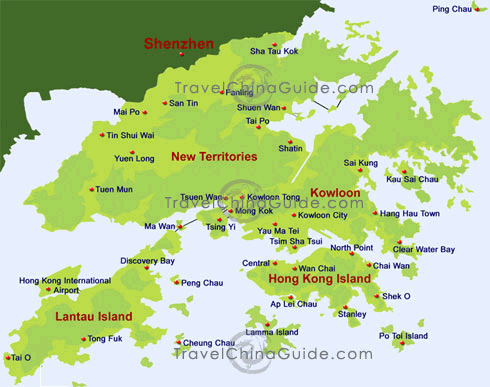
For all its shortfalls, Hong Kong cooks are about the best there is in all China and possibly in the world. Whatever the outcome, people will continue to eat out! I guess this is one of the simple pleasures in life. With the famed roast goose and such seafood paradise as Lei Yue Mun and Sok Kwu Wan, sometimes I wonder whether we eat to live or live to eat!
My article was initially written in 2001. This little island paradise
has one aspect of tourists’ delight that foreign visitors to Hong Kong know
little about – sort of a well kept secret.
Hometown Boy - Chow Yun-Fatt & Granitz
Being of Chinese descent, and though an Australian citizen by consent or choice, you can’t help feeling proud that for the first time among the glitter of stars at the Hollywood Academy Award 2001 ceremony were Chow Yun-fatt, Michelle Yeoh Choo Keng, Zhang Zi Yi and of course director Ang Lee of the famed “Crouching Tiger & Hidden Dragon”. It looks like China is finally awakening and ready to pounce on the world scene with its staging of the 2008 Olympics in Beijing and its recent entry into World Trade Organization after long and tedious negotiations.
A pavilion on Lamma Island – hikers’ resting place & look-out point
Chow Yun-fatt, in the footsteps of Jacky Chan, is also the star of “Anna & The King ” and who would have thought that he was born in a humble and tranquil place like Lamma Island, a half-hour boat ride from the bustling metropolitan Hong Kong. Through the assistance of a young lady by the name of Claudia whom I met at the North Lamma Island Library we located the house which Chow Yun-fatt stays each time he returns from Hollywood. Accordingly, he is most friendly with a ready smile for everyone, ever ready to oblige with his autographs. The true human nature of a person is never ever to forget his roots.
With the interest of the knowledge of the famous Chinese star’s association with Lamma Island, I spent a week exploring this place not too far from the maddening crowd of Hong Kong. Lamma Island is the second largest of Hong Kong’s 232 islands. It is an island with a conglomeration of villages. The one that Yun-fatt calls home is Wang Long Village. The house is newly built, three storeys tall, and I was told two floors are rented to some Japanese working at the Lamma Island Power Station. Most of the villages, like Tai Yuen Village, Sha Po New Village and Wang Long Village sort of merge into one another, mainly three-storied, sitting on the valleys and rising from the slopes of surrounding hills. Yung She Wan is the main town centre with a galore of shops, many of them opening well past eleven at night. Other villages, nearly 20 of them, such as Tai Ping Village, Yung Shue Long New/Old Village, Po Wah Yuen, Pak Kok, Tai Wan To Village, Sok Kwu Wan and others are all linked by cemented Family Trials. The houses all present an air of affluence. There is no motor traffic on the island except the small tractor-type of vehicle, similar to those I found in China, used for multi-purposes like land ploughing, load and people transportation in the rural areas. In China where bicycle is fast fading from the streets, especially in Beijing, mountain bikes here provide a useful means of individual transportation and rambling up and down the hilly scenery.. It’s a walking paradise under the canopy of trees and greenery. For the more ambitious hikers, there are many more unpaved and challenging trials.
Ferry Jetty - Bicycles Galore (Park & Ride)
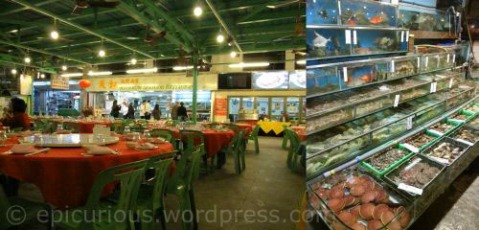
Lamma Island is far from being rural. It’s well built-up and everywhere you turned there are people around. Ever so frequently teams of holidaymakers stream onto the jetty, making their way to such picnic spots like Hung Shing Yeh Beach with its barbeque facilities, shark safety net on the fringe of the bay, and lifeguards on two watchtowers. Some come just to sample its famous seafood restaurants, lining the Yung Shue Wan Main Street with their display of live-seafood of a good variety of fish, crabs, prawns, shrimps, scallops, oysters and other shell varieties. The best seafood restaurants are found in Sok Kwu Wan, particularly Rainbow Seafood Restaurant and Winstar Seafood Restaurant which offer free ferry services to and from Queen’s Pier and Sok Kwu wan or between Repulse bay and Sok Kwu Wan. Like Lei Yue Mun, the seafood speciality place in Hong Kong, this is the seafood paradise on the Island.
Seafood Restaurant
The roads made largely for human traffic and small vehicles are cement paved with the narrower ones known as Family Trials. A network of such trials with proper signage covers virtually every part of the island. It’s a pity that the Islands District Office has not established the many lookout points in Northern Lamma for visitors to enjoy breath-taking views. Perhaps following the norm of international signage, brown signs could be displayed pointing to spots of tourists’ interest. On the trial to Sok Kwu Wan, which leisurely takes about one and a half hours, there are pavilions for resting and serve as points for lookout.
Un-spoilt Beach
The streets are clean and rubbish bins are well positioned and provided. There is a post office, banking facility (HSBC), hotel (Man Lai Wah Hotel), police station and several police report centres, fire station which also houses an ambulance vehicle and primary school. Generally, Chinese are most assiduous in their economic pursuit. Everybody is busy and doing something. Empty lands are covered with vegetable gardening. There is a sizeable portion of European population living on the Island and who made the crowd that frequent the bars at night. Lamma Island can boast of having clean public toilets. Martin Yan, internationally well-known chef, chose Lamma Island as the backdrop of his culinary program.
It may be of interest to folks with rural experience to live in a place like Lamma Island. For the city folks, they might need getting used to be wakened by nature’s alarm clock – the not so familiar cockcrow. Cocks turn on their early musical repertoire as early as 4 am and unceasingly follow it through till the break of dawn. To me this is pleasant compared to the noise pollution of Hong Kong, not just in the streets, the ever-crowded shopping centres or eating in the restaurants. Hong Kong people are so loud! I find the lifts being the only places where people are quiet – not a word is exchanged. Exchanging greeting in the streets is a rare phenomenon. Don’t expect it to be reciprocated! Friendliness is so vital, and the display of hospitality will go a long way to establishing a place like Lamma Island as a top tourist spot. . . . a retreat from the hustle and bustle of hectic living in Hong Kong . . . or just a quiet place to visit and enjoy.
Talking of Chow Yun-fatt having his annual retreat in Lamma Island, what of Michelle Yeoh’s. I well remember her as a young girl living adjacent to Ipoh Swimming Club, Malaysia, playing squash with a group of us. She first came into public eyes as a teenage Queen in our Ipoh Lions Club Motor Show in the 1970s. Hailed as a former Miss Malaysia, she has made it in the glitter world of the big screen. I wonder if she still retains that sweet and friendly nature of her young days. People do change due to circumstances and success and stardom may mean non-association with the past.


 Sunrise Over
 Jumbo – Famous Floating Seafood Restaurant
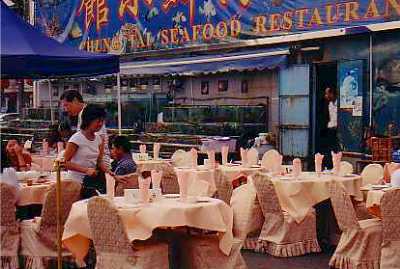 Seafood Restaurant Serving Fresh Seafood

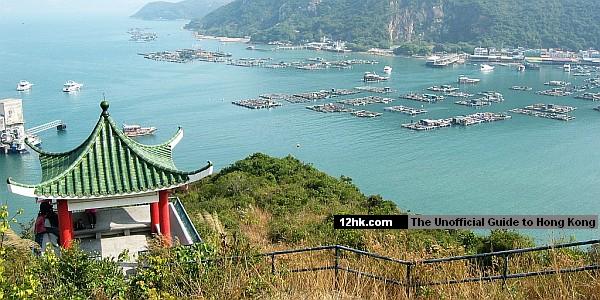 A pavilion on


 Paul Chong's Blog