La Sagrada Familia, Barcelona

English: West side of the Sagrada Familia, Bar...
English: West side of the Sagrada Familia, Barcelona, Spain Français : Côté ouest de la Sagrada Familia, Barcelone, Espagne (Photo credit: Wikipedia)
Sagrada Família, Barcelona
Sagrada Família, Barcelona (Photo credit: Wikipedia)

View of the Passion Façade (Western side) in September 2009

Construction started:1882   Height170 m   OpenedNovember 7, 2010  The Basílica i Temple Expiatori de la Sagrada Família, commonly known as the Sagrada Família, is a large Roman Catholic church in Barcelona, Catalonia, Spain, designed by Catalan architect Antoni Gaudí. WikipediaAlthough incomplete, the church is a UNESCO World Heritage Site, and in November 2010 was consecrated and proclaimed a minor basilica by Pope Benedict VI.

It certainly has taken a long time to see it finally opened for public viewing & appreciation. We first laid eyes upon this spectacular structure during our Whitsun Holidays in 1960, when we visited France, Spain & Portugal. This was one sight not to be missed in Barcelona that was a MUST-SEE in our itinerary. Of course, we didn’t get to see the inside!

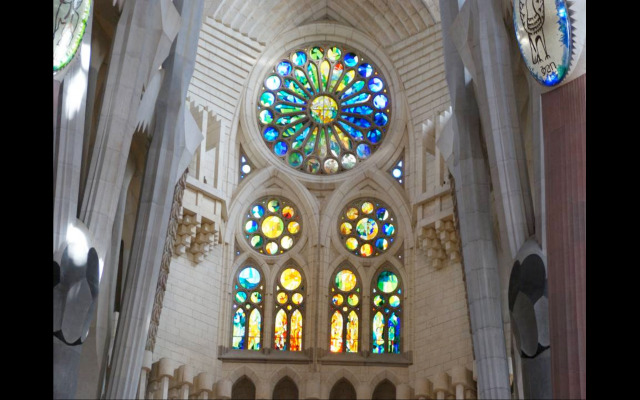
The building is still under construction so be prepared to see a lot of work continuing when you visit. The interior proves to be more interesting than its unusual exterior.The Sagrada Familia it is a truly magnificent building and an absolute must-see when you visit Barcelona.

HERE HAVE A INSIDE VIEW: 

Though construction of Sagrada Família had commenced in 1882, Gaudí became involved in 1883, taking over the project and transforming it with his architectural and engineering style—combining Gothic and curvilinear Art Nouveau forms.

Gaudí devoted his last years to the project, and at the time of his death in 1926, less than a quarter of the project was complete. Sagrada Família’s construction progressed slowly, as it relied on private donations and was interrupted by the Spanish Civil War—only to resume intermittent progress in the 1950s. Construction passed the midpoint in 2010 with some of the project’s greatest challenges remaining and an anticipated completion date of 2026—the centennial of Gaudí’s death

This slideshow requires JavaScript.

Describing Sagrada Familia, art critic Rainer Zerbst said “it is probably impossible to find a church building anything like it in the entire history of art” and Paul Goldberger called it ‘the most extraordinary personal interpretation of Gothic architecture since the Middle Ages’.

The basílica has a long history of dividing the citizens of Barcelona—over the initial possibility it might compete with Barcelona’s cathedral, over Gaudí’s design itself, over the possibility that work after Gaudí’s death disregarded his design, and the recent possibility that an underground tunnel of Spain’s high-speed train could disturb its stability.

Antoni Gaudi

Bullfighting in Madrid

By P Chong                                         Wed. 13 Oct. 2010

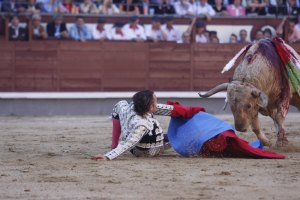
It was Whitsun holiday in 1960 when a small group of us college students found ourselves touring through France, Spain & Portugal. We were fresh & young & eagerly looking forward to any new thrill & excitement to enrich our youthful experience. When in Madrid, the capital of Spain,we were attracted & drawn to their famous bullfight.

I remember it well & clear. It was a Sunday. Having obtained the tickets for the bullfight through an agent in the hotel, we made our way to the arena by way of jammed packed Metro, with standing room only & literarily squashed to the bones. However, we were willing to bear the discomfort for we really wanted to be part of this quintessential Spanish tradition at least once during our trip. We were told this was a special Sunday fight when the older matadors would be challenging a team of younger ones.

At the Plaza del Toros, the arena looks a lot like the Colosseum in Rome, and we were both struck by the make-up of the crowd jostling to get to the arena – old and young, men and women, rich and poor – the bullfight belongs to all, and is clearly as much a social event as a sporting spectacle.

The Spanish bullfight remains one of the most controversial forms of mass entertainment in the world. It is despised and revered in almost equal measure depending on whose opinion you seek. Yet this quintessential Spanish tradition is a traditional spectacle of Spain, Portugal, southern France and several Latin American countries, in which one or more bulls are ritually killed in a bullring as a public spectacle. It is often called a blood sport by its detractors but followers of the spectacle regard it as a fine art and not a sport as there are no elements of competition in the proceedings.

Supporters of bullfighting argue that it is a culturally important tradition and a fully developed art form on par with painting, dancing and music, while animal rights advocates hold that it is a blood sport resulting in the suffering of bulls and horses.

As it is in Spain today, this traditional spectacle is being endangered by the dwindling interest or a recent ban on the sport in Catalonia. ‘Bullfighting belongs to Spain and that will always be the case. The young are more interested in football & tennis.

It was to us an electrifying experience – a riot of colours, especially red and sound that set our senses on edge. Trumpets sounded, blood poured, crowd cheered & jeered . . . every move,. Every turn, every expression of the matador and their compatriots is designed to engaged the crowd. It is a blood sport and in many respects cruel . . . but seriously compelling & thrilling!

But what do you think?