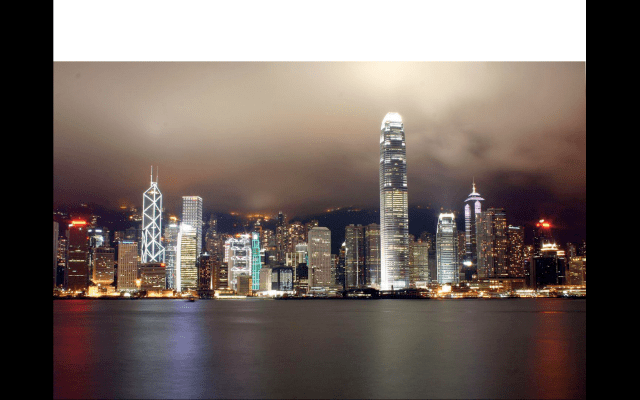
Situated on top of the International Commerce Centre, Ritz Carlton Hotel offers spectacular views across the waters to the skyline of Hong Kong Island.It perches on floors 102 to 118 and has 312 rooms all with city and harbour views.
International Commerce Centre (Photo credit: jimbowen0306)
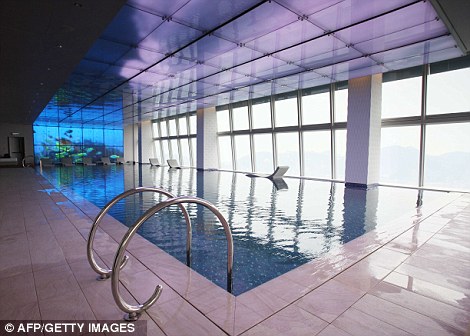
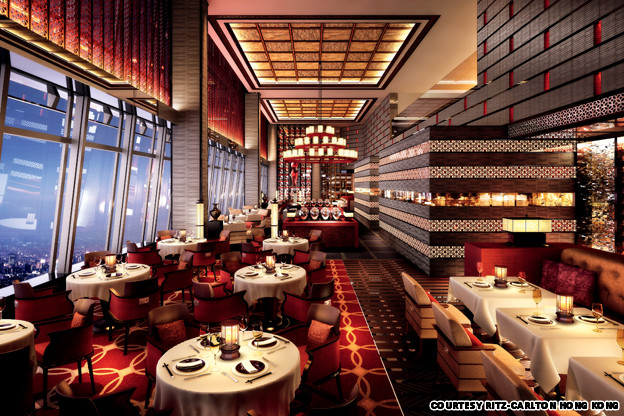
The hotel offers six restaurants, a sky-high spa with floor-to-ceiling windows and an indoor infinity pool overlooking the iconic harbour.
The Ritz-Carlton Hong Kong officially became the world’s tallest hotel – and the fourth highest building in the world – when it opened its doors to the public in 2011.
Herve Humler, president of luxury hotel chain said the building was a landmark hotel which was the culmination of many years of hard work ‘We have been able to create truly spectacular so we can welcome our guests not just to the tallest hotel in the world, but also to one of the very best hotels in the world,’ he said. ‘We are taking luxury to new heights in every sense.’
Special Features:
It has taken years to build the hotel which also has a shopping mall. Other hotel’s facilities include state-of-the-art technology including WiFi, iPod docking stations, Blu-ray DVD players and flat screen TVs. There are three restaurants on the 102nd floor, including Tin Lung Heen, which is a Chinese restaurant serving refined Cantonese cuisine; Tosca, an Italian restaurant which offers Southern Italian cuisine and the very stylish The Lounge & Bar with fire pits and open kitchens.
In addition, there is a chocolate-themed lounge named The Chocolate Library on 103rd floor and a stylish patisserie located on 9th floor. Managers say the jewel in the crown is Ozone, located on the hotel’s 118th floor.
It offers contemporary Asian tapas and signature cocktails to a backdrop of incredible views as well as the chance to drink on the world’s highest al fresco terrace.
The hotel has an ESPA on site which is located on the 116th floor.
It’s clearly seen from the vicinity of West Kowloon Cultural Centre.
Iconic: The building towers over other skyscrapers nearby.
Long after Shanghai’s 2010 World Expo has gone, the China Pavilion still stands magnificently. This striking immense red structure is the first building you’ll see upon entering the Expo Park & the last one upon leaving.
It’s certainly reflecting the theme: Better City, Better Life.
Timelapse and video shot on Canon 7d and GoPro Hero HD for SeeChina.org.cn and Danwei.tv by Janek Zdarski
“The main structure of the China Pavilion, “The Crown of the East,” has a distinctive roof, made of traditional dougong or brackets, which date back more than 2,000 years. The dougong style features wooden brackets fixed layer upon layer between the top of a column and a crossbeam. This unique structural component of interlocking wooden brackets is one of the most important elements in traditional Chinese architecture. Dougong was widely used in the Spring and Autumn Period (770 BC-467 BC).”
The contour design of the pavilion is based on the concept of “Oriental Crown, Splendid China, Ample Barn, and Rich People,” to express the spirit and disposition of Chinese culture. The pavilion has a core exhibition area on the top floor, an experience area on the second and a functional area on the first. China’s achievements in urban development from ancient to modern times are shown as the core theme of the pavilion.
The China Pavilion sits right next to the Expo Boulevard and the Sun Valleys, which act as the center of the Expo. (Slideshow Below)
This slideshow requires JavaScript.
Painted the same red as the Forbidden City, the China Pavilion consists of four pillars with 6 floors expanding out and up. The 30 meter high roof is constructed from 56 wooden brackets (dougong), which represent the 56 minority ethnic groups of China. Additionally, nine folded scripts engraved on the surface of the building list the short names of China’s provinces.
Designed by He Jingtang, the director of the Architectural Academy of the South China University of Technology, “the Pavilion includes many energy saving technologies. The exterior of the structure offers a temperature buffer zone and natural ventilation for the interior, and the inverted shape of the pavilion acts as shading for entire building as well as the courtyard below. The roof of the structure includes eco-friendly landscaping and harvests rainwater.”
The China Pavilion, also known as the Oriental Crown, represents the spirit of the people of China and is one of the 5 permanent green buildings on the Expo Park converted into a national history museum.
Video hosted by Nancy Merrill below showing the background to its construction:
As opposed to all Western negative reports, Chinese women are changing China and the world.
From the social-economic front to the war front, we find women in China playing a significant role.
Confucian patriarchal hierarchy has been an impediment to women’s leadership in China, but not since Mao Zedong said that ”Women hold up half the sky”. . . a view of women as a resource that ought to be deployed outside the home – fueled the rise of many women in professional fields,” said A Report on Women’s Leadership in Asia, entitled “Rising to the Top?”
As a result, Chinese women, who make up 49 percent of the population and 46 percent of the labor force, have achieved a higher proportion in the top layers of management than women in many Western countries, said the report which mostly analyzed data on gender equality and women’s leadership in the region. ”In China, gender equality embedded in communist ideology has mitigated the impact of Confucian patriarchy,” it said.
The findings of the report may be summed up:
In East Asia, “China leads in terms of women in senior management.”
Some 29 million, a quarter of the national total of China’s entrepreneurs, are female.
The highest percentages of women employed in Asia are also in China.
Half of the 14 billionaires on Forbes magazine’s 2011 list of the world’s richest self-made women are from mainland China. Many of them are property magnates; the others focus on retail and consumer goods.
“The pathway for female entrepreneurs tends to lead from excellent universities to high posts at large, state-owned enterprises, allowing women to build up business acumen, managerial skills, and networks that later enable them to raise capital for their new enterprises.”
Women in Asia are closing the gap with males in health, education, and employment, but are severely under-represented at top leadership levels, paid less than men, and disadvantaged by cultural and social norms.
Since 1949 China has promised women’s equality. “Women hold up half the sky,” Mao said. His revolution turned society and family upside down: It abolished family property, and replaced family-jobs patronage with a state bureaucracy. Mao put a final, nationwide end to the centuries-old practice of “foot binding.” For a time, communism was a girl’s best friend.
China’s 1950 marriage laws, for example, made men and women, at least theoretically, equal. They banned bride sales and concubines, and legalized divorce. For centuries men were allowed three or four wives, and women had no rights. It was a feudal world with brutally stark winners and losers. The film “Raise the Red Lantern,” with its bitter, subtle infighting among concubines vying for the attentions of a patriarch, captures something of those family dynamics.
According to Martin Whyte of Harvard University, “Changes in the Chinese family were imposed quickly and radically, In most societies these changes would take generations. In Mao’s China they were compressed into a time frame, really, of two or three years. Changes [involving women] are probably more important than the Great Leap Forward or the Cultural Revolution. By 1960, China had a ‘modern society’ in cities.”
Ironically, China is a developed country inside a developing country. Progress for women is found in cosmopolitan centers where law and culture are emphasized. Shanghai has always been a mecca for females. The mid-20th-century novels of Eileen Chang set in Shanghai that illustrate an independent voice for women are now extremely popular among college students.
In the metropolis, the family is undergoing a “permanent revolution.” The phrase is actually Mao’s. Courtship and choice between young people is more open – made possible by new wealth – new attitudes, and cellphones, and it is giving rise to new family types, the diminishing of patriarchy, and an often more confident and assertive female.
China’s patriarchy is a feudal holdover, scholars say, where land equals power. Male children inherited land. In an urban culture, where mobility is valued, and land is not an issue, female talents are more emphasized.
Changes of the nature as described above breed a different set of social problems, which can only be judged by time alone.
Recent Related Articles by Paul:
1. China’s First Lady-in-Waiting (Sun. 22 April 2012)
2. Fu Ying: “The West Has Become Very Conceited” (Tuers. 24 April 2012)
The tragedy of tens of thousands living in 6ft by 2ft rabbit hutches – in a city withmore Louis Vuitton shops than Paris
Hong Kong, one of the world’s richest cities, is abuzz with a luxury property boom that has seen homes exchanged for record sums.
But the wealth of the city has a darker side, with tens of thousands priced out of housing altogether and forced to live in the most degrading conditions.
This slideshow requires JavaScript.
These pictures by British photographer Brian Cassey capture the misery of people – some estimates put the figure as high as 100,000 – who are forced to live in cages measuring just 6ft by 2 1/2ft.
The city is one of the planet’s most densely packed metropolitan areas, with nearly 16,500 people living in every square mile of the territory.
Unscrupulous landlords are charging around US$200 a month for each cage, which are packed 20 to a room, and up to three levels high.
The lower cages are more expensive because you can almost stand inside them, but the conditions are no less squalid.
Tai Lun Po, 79, has lived in the cage he is sitting in for an extraordinary 30 years
Eight-year-old Lee Ka Ying lives in a 6ft square ‘cubicle cage home’ with her mother
Yan Chi Keung eats takeaway outside his wire cage home – there are no cooking facilities
Tai Lun Po walks to the bathroom which he shares with the other residents
Occupants must share toilets and washing facilities, which are rudimentary. Many of the apartments have no kitchens, forcing their impoverished residents to spend there meagre incomes on takeaway food.
The cage homes have been a running scandal in Hong Kong’s housing market for decades, yet rather than disappear, they are on the rise.
As the world economic crisis has lashed the city a former British territory whose economy is focused on financial services, more have been forced to turn to them for a place to stay.
The alternative is life on the streets
A building in Mongkok that houses cage people, sometimes squeezed twenty to a room
‘The temperature inside the cages can be two to three degrees higher than what they are outside,’ he said.
‘It’s really uncomfortable, and sometimes I cannot sleep until after 5 in the morning.’
Cockroaches, wall lizards, lice and rats are common. ‘Sometimes I am worried if lizards or cockroaches will crawl into my ears at night,’ said Cheung.
Cage Occupants must share toilets and washing facilities, which are rudimentary. Many of the apartments have no kitchens, forcing their impoverished residents to spend there meagre incomes on takeaway food. The cage homes have been a running scandal in Hong Kong’s housing market for decades, yet rather than disappear, they are on the rise. As the world economic crisis has lashed the city a former British territory whose economy is focused on financial services, more have been forced to turn to them for a place to stay. The alternative is life on the streets.
At the abattoir, quite often strange happenings of animals crying go unnoticed by human beings. I was talking to my wife about the story below “of a sorrowful buffalo suddenly standing still, refusing to move forward, kneeling on its two front knees, and with tears streaming from its eyes,” when she recalled of her young days living in Taiping, Malaysia. She too had observed in the nearby abattoir of cows awaiting to be slaughtered crying aloud, seemingly knowing their fateful demise.
But this water buffalo had real tears that touched the hearts of the butchers & changing their lives!
The Buffalo was standing still, sad and frightened to tears.
According to China’s People’s News, whether people believe it or not, this incident actually happened in Hong Kong. TheWeekly World News reported that a group of workers were bringing a water buffalo into a packaging factory, ready to slaughter it to make steak and beef stew.
When they approached the front door of the slaughterhouse, the sorrowful buffalo suddenly stood still, refusing to move forward, kneeling on its two front knees, and had tears streaming from its eyes.
How could the buffalo be aware that it was going to be slaughtered, before entering the slaughterhouse? This shows that it was even more alert than many a person. “When I saw what is believed to be a stupid animal actually crying, and when I noticed that its eyes were full of fear and sadness, I could not help but shiver.” Extremely shocked by this, butcher Shiu Tat-Nin recalled: “I quickly called the other people to come and see, and they were as surprised as I was! We pushed and pulled the water buffalo, but it would not move; it just sat there crying constantly.”
Billy Fong, the boss of the Hong Kong packaging plant said, “Mankind has always thought that animals are not like people who can cry, but this buffalo is really sobbing like a baby!”
At that time there were at least a dozen strong, burly men present, but their hearts were softened by the buffalo’s crying, and those who were responsible for killing water buffaloes were even more touched by this, tears welling out of their eyes.
Buffalo weeping non-stop – When workers from other slaughterhouses heard the news, they also ran to the crying and kneeling buffalo, and the site was soon crowded with people who were astonished at what they saw. Three of them were so shocked that they said that from now on, even when they slaughter other kinds of animals, they will never forget that buffalo’s tears.
At the point when a buffalo is crying and people are crying as well, we can all be sure that none of them will kill the buffalo now. Then the question was how to take care of this matter. Finally, they decided to buy the water buffalo with cash, and then they sent it to a Buddhist temple, for the monastic to take good care of it, so that it could be assured of living out its life peacefully.
When this decision was made, an amazing thing happened again: “When there was an assurance that the buffalo would not be killed, it finally agreed to move, got up, and it’s here with us.” How could a water buffalo understand human words? Shiu said: “Whether you believe it or not, this is really true, although it sounds really incredible.
Undoubtedly, this buffalo has changed the lives of these butchers.
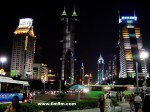
Shenzhen was voted by ForbesChina in 2010 as the most innovative city in mainland China. It virtually started from scratch.
Shenzhen in the 1970s was but a small village. Its metropolitan cityscape is the result of the vibrant economic growth made possible by rapid foreign investment since the institution of the policy of “reform and opening” establishment of the SEZ in the late 1970s. Both Chinese and foreign nationals have invested billions in the Shenzhen SEZ. More than US$30 billion in foreign investment has gone into both foreign-owned and joint ventures, at first mainly in manufacturing but more recently in the service industries as well. Shenzhen is now reputedly one of the fastest-growing cities in the world.
Shenzhen continued to top the list of the most innovative cities on the Chinese mainland this year, followed by Suzhou and Shanghai.
Shenzhen continued to top the list of the most innovative cities on the Chinese mainland this year, followed by Suzhou and Shanghai, according to the latest list of the 25 Chinese mainland cities with the strongest innovation capabilities released Monday by Forbes China.
with the municipal GDP of above RMB 43.6 billion yuan (US$6.84 billion) in 2010
also the number of patents newly applied for (per capita and total number)
the proportion of sci-tech expenses to local fiscal expenditures (including expenses on trial development of new products, intermediate experiment allocations and subsidies for important scientific research projects).
In 2010, the value-added of Shenzhen’s high-tech industry rose 17.1 percent to RMB 305.9 billion yuan, while the total output value of high-tech products made in Shenzhen hit about RMB 1.02 trillion yuan, with 60.1 percent contributed by products with independent intellectual property rights.
The Yangtze River Delta region retained its predominant status this year, with 15 cities edging into the list. Jiangsu province alone has 11 cities included. Five cities from the Pearl River Delta moved up into the list, while no cities from Western China appeared there.
Statistics show that China’s smaller cities are amazingly eye-catching for their innovation capabilities with more than half cities on the list being county-level and prefecture-level cities. Of the top ten, there are 4 county-level cities: Wujiang, Kunshan, Changshu and Zhangjiagang.
The report, which defined the wealthy as people with at least $US1 million in net assets (excluding their homes, collections, consumer and durable goods), said the wealth of Asia-Pacific rich surpassed Europe as early as in 2009 and increased 12.1 percent to US$10.8 trillion last year, compared with Europe’s US$10.2 trillion.
In the Asia-Pacific region, real estate and equities investment still made up the primary choices for the rich last year, with 27 percent choosing housing market, far higher than the global average of 19 percent.
The report also predicted that the Asia-Pacific wealthy will beef up stock and fixed-return investment while reducing holdings of cash and deposit from 2011 through 2012.
While economy stumbles globally
The rich & famous have cash to splash around still.
Known among his friends as the “Singing Doctor”, he prescribed
medicine with a smile, and sang with his heart. His deep melodious voice was soothing to the ears and more so to the hearts of women who literally worshipped him with sheer admiration. He rendered both Mandarin & English songs with ease & charm . . . that handsome look with his boyish smile ever so radiant & bright!
Sadly, we shall no longer have his company nor to have him entertain us with rendition of songs by Michael Ball such as “Love Changes Everything” or his favourite song on Shanghai Bund in Cantonese. He passed on some days short of his sixtieth birthday defeated by that dreadful cancerous disease of the colon.
He sang as though there were no tomorrow . . . impressing on the importance of the present. In all the years that I have known him, he never turned me down to be present to sing, whether it was a home karaoke dinner or a public charity performance. All the time unknown to me he was fighting to beat this dreadful disease.
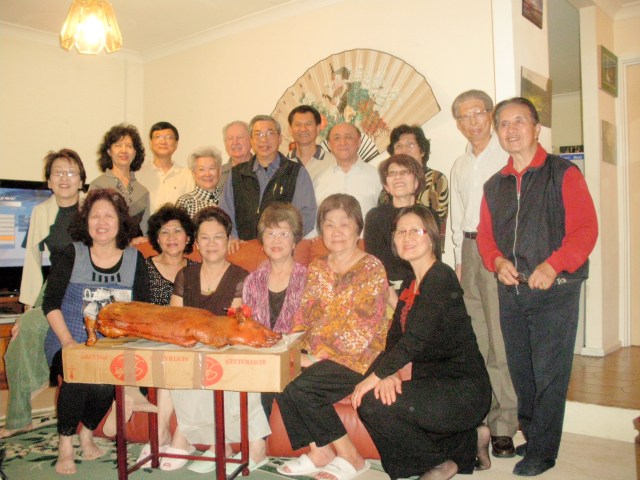
Below: A happy Dr Yap at our party to celebrate Tom’s birthday (1 October 2010)
At the last function (29 September 2010) attended by him in my house, he was in real high spirit, giving no indication of his being ill as you can observe from all the illustrated pictures. We had a roasted suckling pig and nobody was handy with slicing off the crunchy skin of the pig. He rolled up his sleeves saying “No problem” for in his father’s house in Ipoh, Malaysia, they always had this three times a year.
Dr Yap exhibiting his slicing skill with the pigling (Picture: Above & below)
A shock to all of us, he was in China when he passed away . . . seeking his last hope of living.
Gone but not forgotten, In Heaven he lives on. No longer forlorn, he’s telling us that life’s still worth the living, and living it to the full. Sing with a merry heart & make others merry! Don’t be sad when life is bad. Sing unto Him with a merry heart. Play your part out with a mighty shout: “Glory be to God!”


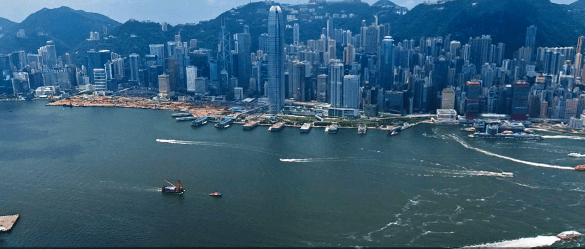


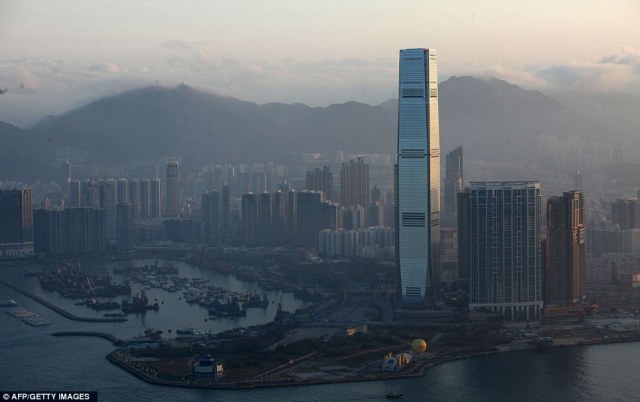 Spectacular: The Ritz Carlton Hong Kong (centre) became the tallest hotel in the world



























 Paul Chong's Blog